


Cape Town’s plans to build a wall to prevent attacks on the airport highway have divided South Africa’s tourist hotspot, with critics calling it an apartheid throwback to hide poverty.
The nearly 9km wall would separate part of the road that leads in from the international airport from the packed, impoverished settlements that line the route. Attacks — some deadly — have been reported for years along the busy multi-lane route, including hijackings and smash-and-grab ambushes.
“They’ll come with a stone and break the windscreen,” e-hailing driver Mustafa Hashim said, recounting stories of attacks on the corridor known as the “N2 hell run.”
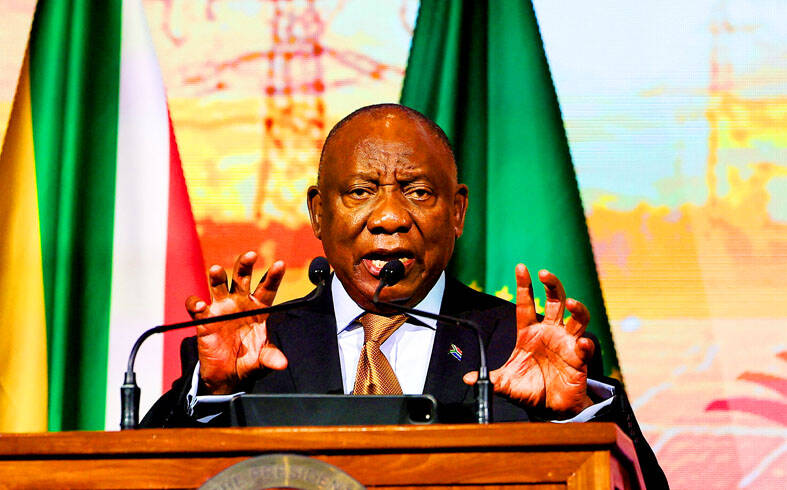
Photo: Reuters
“If you want to keep your life, then you just leave them to take whatever they want,” Hashim said.
The city announced the 114 million rand (US$7 million) N2 Edge safety project in December last year, shortly after a woman was fatally stabbed at a traffic light just off the highway after leaving the airport complex.
The key feature is a 3m “safety barrier” to reinforce a broken concrete palisade fence, which aims to keep the road clear of criminals, pedestrians and animals.
“Literally hundreds of thousands of people a day use that road, and many of them feel unsafe,” Cape Town Mayor Geordin Hill-Lewis said, adding that most were local commuters.
Residents of the Nyanga informal settlement that would fall behind the highway wall said they are victims of the same crimes reported on the road, but the new barrier would do nothing to help them.
The attackers just disappear into the maze of shacks, resident Linda Monakali said.
“This wall will assist the motorists, but for us, the perpetrators will be with us,” she said.
Between October and December last year, the Nyanga Police Station reported the highest number of robberies with aggravating circumstances in the country, police statistics showed.
The station was also listed as the second-highest for murders, seeing a 29 percent increase compared with the previous quarter.
South African President Cyril Ramaphosa has announced the imminent deployment of the army to parts of the city gripped by bloody gang wars.
City authorities should work out “how can we ensure we better our living environment rather than thinking of building a security wall on the N2,” Nyanga Community Policing Forum chairman Dumisani Qwebe said.
That included 24-hour surveillance cameras and decent sanitation, with women particularly at risk of sexual violence when they use outside toilets at night.
“Walls might stop bullets, but it doesn’t stop crime,” city councilor Jonathan Cupido said.
The city’s government — led by the Democratic Alliance (DA) party — is “trying to hide what we cannot fix,” Cupido said.
Thirty years after the end of white-minority rule, disparities between Cape Town’s formerly segregated white and black areas are stark, with the city’s DA authorities accused of not doing enough tackle the imbalance.
Anger over the N2 wall dominated the Cape Town Pride mardi gras this month where activists called on the city to address its deepening housing crisis instead.
“They are trying to build a wall behind which they are trying to hide the poor,” former anti-apartheid activist and cleric Allan Boesak said, calling it an “apartheid wall.”
“They are trying to hide the fact that there is indeed a black Cape Town and a white Cape Town — a privileged Cape Town and a privileged-deprived Cape Town,” he said.

SPEAKING OUT: After Siranudh Scott’s allegations surfaced, celebrities and public figures took to social media to share their own experiences of sexual misconduct and abuse A high-profile alleged sexual abuse case within a wealthy Thai beer brewing family has prompted a wave of painful accounts from survivors of unconnected abuse in the conservative nation. Siranudh Scott, a member of the billionaire Thai family that founded the ubiquitous Singha beer brand, posted an emotional video this month accusing his elder brother Sunit of repeatedly abusing him when he was a teenager. Sunit, who is in his 30s, later denied the allegations in a video posted online, but Singha parent Boonrawd dismissed him from his executive role with the company on Tuesday last week. “I felt I needed to speak

SEEKING ORDER: Rodrigo Paz said that ‘anyone who wants to destroy the nation will have to deal with this president and the full force of the constitution’ Bolivian President Rodrigo Paz on Wednesday said that the nation was at a “breaking point” after nearly a month of protests that have caused shortages of food, fuel and medicine. Paz, who took office six months ago amid the worst economic crisis there in four decades, is battling a groundswell of fury over his policies. The political capital, La Paz, has been besieged by low-income workers and members of the indigenous majority calling for his resignation. “The country needs order and is reaching breaking point,” the 58-year-old said at a public event in La Paz, renewing his appeal for dialogue. On Tuesday, the Bolivian
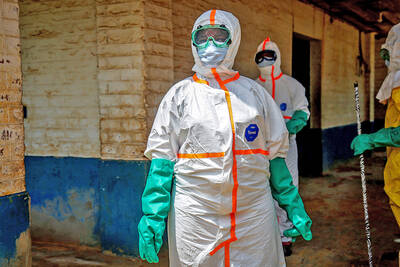
COMMUNITY CONFLICT: Concerns about disease spread from corpses has run up against friends and families’ desire to bury their dead as infection spreads in the area Angry residents of a town at the epicenter of the Ebola outbreak in the Democratic Republic of the Congo (DR Congo) attacked and burned a tent that was part of a health center where people are being treated for the virus, the staff there said Saturday. It was the second such attack in the region in a week. No one was hurt in the attack, according to reports but as patients ran out to escape the fire, 18 people with suspected Ebola infections fled the facility and are unaccounted for, a hospital director said. Angry residents arrived at the clinic in the
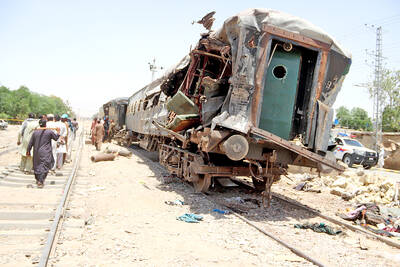
INSURGENT ACTION: A local independence movement in Balochistan, alleged by Pakistan’s government to be backed by India, claimed responsibility for the strike A suicide bomber detonated an vehicle-borne IED near a railway as a passenger train passed through the southwestern Pakistani city of Quetta yesterday, killing at least 23 people and wounding over 70, officials said. The explosion caused two of the train cars to overturn and catch fire, according to footage shared online. The attack happened in an area where security forces are usually stationed, badly damaging several nearby buildings and smashing more than a dozen vehicles parked along the road, according to witnesses and images circulating on social media. Doctors at local hospitals said they had received the wounded, with 20 in critical


 RSS
RSS