


Counting was under way in Nepal yesterday, after a high-stakes parliamentary election to reshape the country’s leadership following protests last year that toppled the government.
Key figures vying for power include former Nepalese prime minister K. P. Sharma Oli, rapper-turned-mayor Balendra Shah, who is bidding for the youth vote, and newly elected Nepali Congress party leader Gagan Thapa.
In Kathmandu’s tea shops and city squares, people were glued to their phones, checking results as early trends flashed up — suggesting Shah’s centrist Rastriya Swatantra Party (RSP) was ahead.
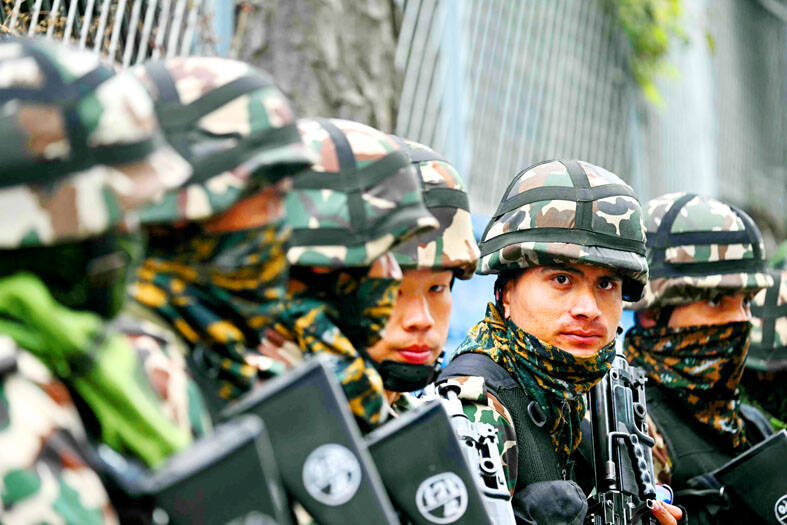
Photo: AFP
Nepalese Election Commission spokesman Prakash Nyupane said the counting was ongoing “in a peaceful manner” across the Himalayan nation, from snowbound high-altitude mountain regions to the hot plains bordering India.
Voters have chosen who replaces the interim government in place since the uprising in September last year, in which at least 77 people were killed, and parliament and scores of government buildings were torched.
Youth-led protests under a loose Gen Z banner began as a demonstration against a brief social media ban, but were fed by wider grievances at corruption and a woeful economy.
“This is even a bigger upset than we expected — it underscores the level of public disenchantment with the old parties for under-performance, as well as anger over the events of September,” Nepali Times publisher Kunda Dixit said.
The polls are one of the most hotly contested elections in the Himalayan republic of 30 million people since the end of a civil war in 2006.
All eyes are watching the results in the key head-to-head battleground constituency of Jhapa-5, a usually sleepy eastern district, where 35-year-old Shah challenged directly the veteran Oli, aged 74.
Shah, better known as Balen, snappily dressed in a black suit and sunglasses, has cast himself as a symbol of youth-driven political change — and early trends suggested he was in the lead.
Soldiers with armored trucks manned barbed wire barricades around the counting center in Jhapa.
“I hope this result changes the fate of the country for the better,” said Bhagawati Adhikari, who was among a crowd of dozens at Jhapa gathered outside the security cordon. “The country should be peaceful and secure, youth should get opportunities, corruption should stop — that’s my appeal.”
More than 3,400 candidates ran for 165 seats in direct elections to the 275-member Nepalese House of Representatives, the lower chamber of parliament, with 110 more chosen via party lists. Turnout was 59 percent.
Some results were expected later yesterday, but full nationwide tallies could take several days.
Even then, negotiations to form a government might drag on if — as many analysts predicted — no single party secures an outright majority.
However, Dixit raised the possibility that Shah’s RSP could stage a dramatic win.
“If RSP hits the magic 138 seats, Balen will become prime minister — and hopefully a cabinet of technocrats,” Dixit said.
Nepalese Interim Prime Minister Sushila Karki praised the peaceful conduct of a vote she has said was critical in “determining our future.”
The challenge that Karki now faces would be managing the reaction to results.

SPEAKING OUT: After Siranudh Scott’s allegations surfaced, celebrities and public figures took to social media to share their own experiences of sexual misconduct and abuse A high-profile alleged sexual abuse case within a wealthy Thai beer brewing family has prompted a wave of painful accounts from survivors of unconnected abuse in the conservative nation. Siranudh Scott, a member of the billionaire Thai family that founded the ubiquitous Singha beer brand, posted an emotional video this month accusing his elder brother Sunit of repeatedly abusing him when he was a teenager. Sunit, who is in his 30s, later denied the allegations in a video posted online, but Singha parent Boonrawd dismissed him from his executive role with the company on Tuesday last week. “I felt I needed to speak

A Hong Kong astronaut is to join a Chinese space mission for the first time as part of a three-person crew launching today, as Beijing edges closer to its goal of landing people on the moon. The Tiangong space station — crewed by teams of three astronauts that are typically rotated every six months — is the crown jewel of China’s space program, boosted by billions in state investment in a bid to catch up with the US and Russia. The Shenzhou-23 mission is to blast off at 11:08pm from the Jiuquan Satellite Launch Center in northwestern China, carrying three astronauts to

UPGRADED ALERT: The risk inside DR Congo is now considered ‘very high,’ while neighboring countries face a ‘high’ threat as the outbreak continues, the WHO said Ebola is spreading faster than responders can track it in eastern Congo, where health workers managed to follow up with barely one in five identified contacts in a single day. Authorities in the Democratic Republic of the Congo (DR Congo) reported 83 confirmed infections, 746 suspected cases and 1,603 identified contacts as of Thursday, but health workers were able to follow up on only 342 contacts that day — about 21 percent of the total under monitoring — data released by the DR Congo Ministry of Public Health on Friday showed. The figures suggest the response is falling behind the outbreak itself,

SEEKING ORDER: Rodrigo Paz said that ‘anyone who wants to destroy the nation will have to deal with this president and the full force of the constitution’ Bolivian President Rodrigo Paz on Wednesday said that the nation was at a “breaking point” after nearly a month of protests that have caused shortages of food, fuel and medicine. Paz, who took office six months ago amid the worst economic crisis there in four decades, is battling a groundswell of fury over his policies. The political capital, La Paz, has been besieged by low-income workers and members of the indigenous majority calling for his resignation. “The country needs order and is reaching breaking point,” the 58-year-old said at a public event in La Paz, renewing his appeal for dialogue. On Tuesday, the Bolivian


 RSS
RSS