


The US on Monday said that it was imposing sanctions on Rwanda’s military, taking action against a longtime partner it accused of breaching a peace agreement in the Democratic Republic of the Congo (DR Congo).
The mineral-rich east of DR Congo has seen decades of conflict, but violence flared last year when the Rwandan-backed M23 group made huge gains, capturing strategic mines and towns, and displacing thousands of people. US President Donald Trump in December last year brought together the leaders of Rwanda and the DR Congo to sign a peace deal, predicting a “great miracle,” but just days afterward, the US Department of State said that the M23 captured the key Congolese city of Uvira.
The US said that it was imposing sanctions against the Rwanda Defence Force (RDF) and four officers, including the army chief of staff Vincent Nyakarundi, saying they were critical to M23 gains.
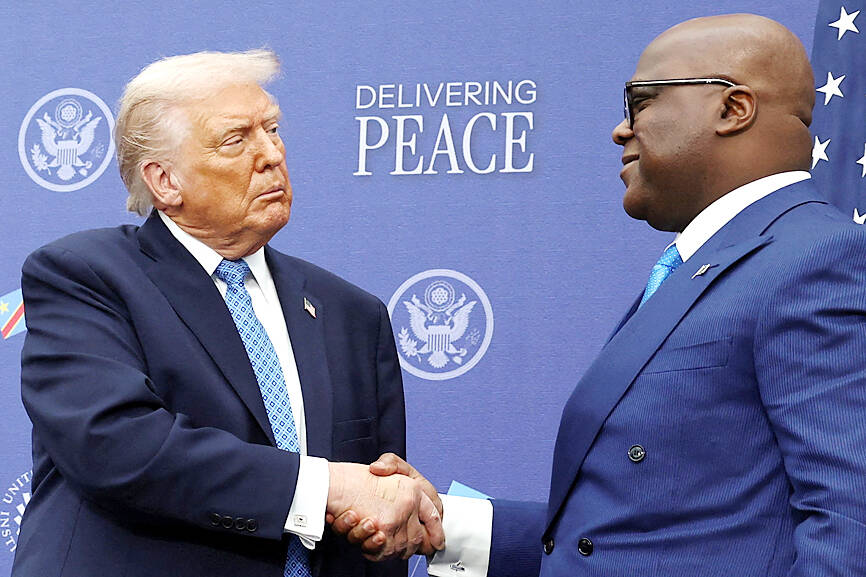
Photo: Reuters
“M23, a US and UN-sanctioned entity, is responsible for horrific human rights abuses, including summary executions and violence against civilians, including women and children,” state department spokesman Tommy Pigott said in a statement.
“The continued backing from the RDF and its senior leadership has enabled M23 to capture DR Congo sovereign territory and continue these grave abuses,” the statement said.
Trump had earlier sounded positive about working with Rwandan President Paul Kagame, a veteran leader who has been willing to take in migrants deported from the US, a top political goal for Trump.
The peace deal had also been hailed by Trump as a way to secure critical minerals from the DR Congo.
The sanctions would block any assets that the RDF or the four officers hold in the US and criminalize any financial transactions with them.
In a separate statement, US Secretary of the Treasury Scott Bessent said the US expected “the immediate withdrawal of Rwanda Defence Force troops, weapons and equipment.”
“Thousands of RDF troops are deployed across eastern DR [Congo], where they actively engage in combat operations and facilitate M23’s control of territory,” the statement added.
Rwanda said the US sanctions were “unjustly targeting only one party” and “misrepresent the reality and distort the facts of the conflict.”
It said “consistent and indiscriminate drone attacks and ground offensives constitute clear violations of ceasefire agreements by the DR [Congo].”
The Congolese government expressed its “deep appreciation” of the US, calling the sanctions “a clear signal of support” for the respect of its “sovereignty and territorial integrity.”
Rwanda says it is only involved in the eastern DR Congo to help protect against an enemy militia formed from the remnants of those who committed the 1994 Rwandan genocide of the Tutsis, denying direct military involvement, despite considerable evidence from UN observers and others.
In turn, it has demanded that the Congolese government clamp down on Hutu militants from the genocide, who targeted ethnic Tutsis and moderate Hutus.
Outmatched on the ground by the better-equipped M23 and Rwandan troops, Kinshasa’s forces have relied in part on US pressure on Kigali to stabilize the front line, regional specialists and security sources said.
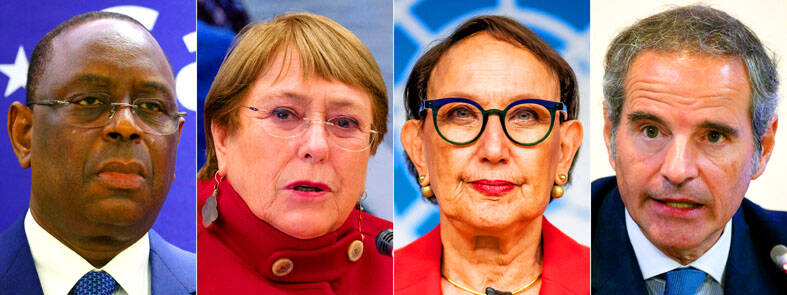
Four contenders are squaring up to succeed Antonio Guterres as secretary-general of the UN, which faces unprecedented global instability, wars and its own crushing budget crisis. Chile’s Michelle Bachelet, Argentina’s Rafael Grossi, Costa Rica’s Rebeca Grynspan and Senegal’s Macky Sall are each to face grillings by 193 member states and non-governmental organizations for three hours today and tomorrow. It is only the second time the UN has held a public question-and-answer, a format created in 2016 to boost transparency. Ultimately the five permanent members of the UN’s top body, the Security Council, hold the power, wielding vetoes over who leads the

A humanoid robot that won a half-marathon race for robots in Beijing on Sunday ran faster than the human world record in a show of China’s technological leaps. The winner from Honor, a Chinese smartphone maker, completed the 21km race in 50 minutes and 26 seconds, said a WeChat post by the Beijing Economic-Technological Development Area, also known as Beijing E-Town, where the race began. That was faster than the human world record holder, Ugandan Jacob Kiplimo, who finished the same distance in about 57 minutes in March at the Lisbon road race. The performance by the robot marked a significant step forward
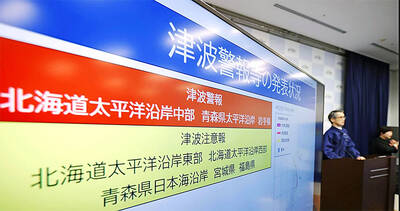
An earthquake registering a preliminary magnitude of 7.7 off northern Japan on Monday prompted a short-lived tsunami alert and the advisory of a higher risk of a possible mega-quake for coastal areas there. The Cabinet Office and the Japan Meteorological Agency said there was a 1% chance for a mega-quake, compared to a 0.1% chance during normal times, in the next week or so following the powerful quake near the Chishima and Japan trenches. Officials said the advisory was not a quake prediction but urged residents in 182 towns along the northeastern coasts to raise their preparedness while continuing their daily lives. Prime
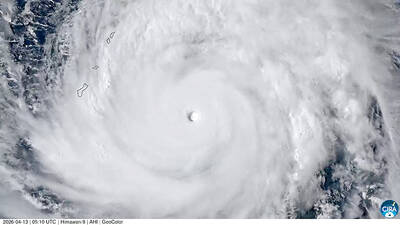
HAZARDOUS CONDITION: The typhoon’s sheer size, with winds extending 443km from its center, slowed down the ability of responders to help communities, an official said The US Coast Guard was searching for six people after losing contact with their disabled boat off the coast of Guam following Typhoon Sinlaku. The crew of the 44m dry cargo vessel, the US-registered Mariana, on Wednesday notified the coast guard that the boat had lost its starboard engine and needed assistance, Petty Officer 3rd Class Avery Tibbets said yesterday. The coast guard set up a one-hour communication schedule with the vessel, but lost contact on Thursday. A Coast Guard HC-130 Hercules aircraft was launched to search for the six people on board, but it had to return to Guam because of


 RSS
RSS