


French President Emmanuel Macron on Monday said that France would expand its atomic arsenal and could deploy nuclear-armed aircraft to allied nations for the first time, as he unveiled an unprecedented plan to bolster security on the continent.
Speaking from the Ile Longue nuclear submarine base as the clock ticks on his presidency, Macron announced that eight European nations including Germany, Poland and Sweden, had agreed to participate in what he called a “forward” nuclear deterrence scheme.
“Today more than ever, independence cannot mean isolation,” Macron said in his 50-minute speech, with one of France’s four ballistic missile submarines in the background.
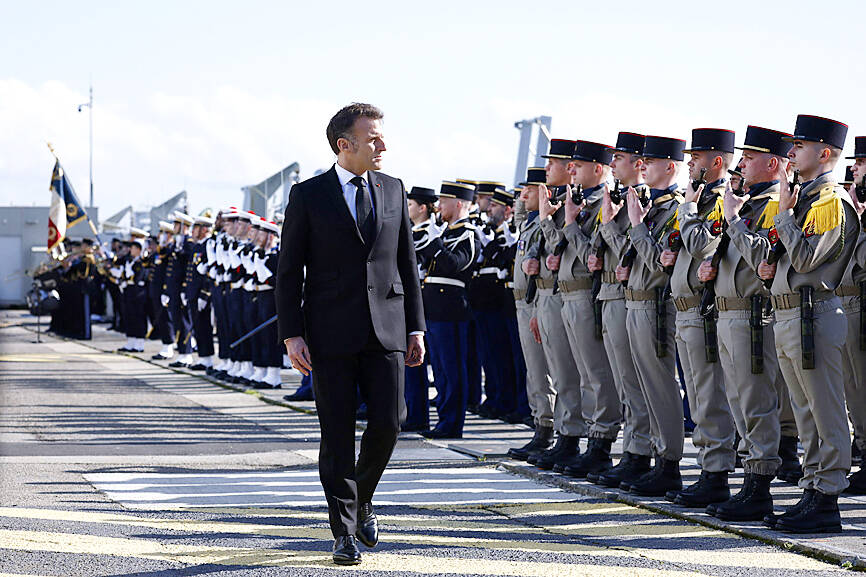
Photo: Reuters
“We are currently experiencing a period of geopolitical upheaval fraught with risks,” Macron said, speaking after the launch of US and Israeli attacks against Iran in a campaign that risks destabilizing the Middle East.
Macron said eight European nations had agreed to join his plan to use France’s nuclear stockpile to bolster security on the continent.
“Germany will be a key partner in this effort,” he said.
In a joint statement following Macron’s speech, France, the EU’s only nuclear power, and Germany said they had set up a “nuclear steering group,” adding that such an arrangement would “add to, not substitute for, NATO’s nuclear deterrence.”
The Netherlands, Belgium, Greece, Denmark, the UK, Germany, Poland and Sweden would be able to temporarily host French “strategic air forces,” which would be able to “spread out across the European continent” to “complicate the calculations of our adversaries,” Macron said.
The scheme could also involve “the conventional participation of allied forces in our nuclear activities,” such as military exercises in which British forces have been involved, Macron added.
He said that France would maintain tight control over nuclear decisionmaking.
France and Germany said they had agreed to take “first concrete steps beginning this year,” including German conventional participation in French nuclear exercises.
Macron updated France’s nuclear doctrine as Russia’s war against Ukraine grinds into a fifth year and NATO allies worry about Washington’s wavering commitment to Europe.
Reassurances from US officials that the US deterrent would continue to cover Europe under the NATO alliance have done little to quell European fears of fickleness under US President Donald Trump.
Macron said the new effort would be “in addition to NATO’s nuclear mission.”
The US stations nuclear weapons in five European nations — Italy, Germany, the Netherlands, Belgium and Turkey.
He also said he ordered an increase in the number of nuclear warheads, but added that France would no longer be disclosing any details on its stockpile.
Macron listed the measures as France’s allies fret that a possible victory by the euroskeptic far-right National Rally party of Marine Le Pen in next year’s presidential election could undermine European cooperation.
Polish Prime Minister Donald Tusk said Poland was in talks with France and other European allies on further steps.
“We are arming up together with our friends so that our enemies will never dare to attack us,” he said on social media.
Swedish Prime Minister Ulf Kristersson also said that his nation viewed Macron’s initiative “positively.”
France maintains the world’s fourth-largest nuclear arsenal, with about 290 warheads. The UK, which is no longer a member of the EU, is the only other European nuclear power. By contrast, the US and Russia, the world’s two main atomic powers, each have thousands of nuclear warheads.
Jean-Marie Collin of the International Campaign to Abolish Nuclear Weapons said that he envisaged “an increase of between 50 and 100 nuclear warheads within around 10 years.”
He said an end to transparency announced by Macron was “contrary to the spirit” of the Non-Proliferation Treaty.
Rafael Loss of the European Council on Foreign Relations said that a far-right electoral victory next year “could walk back many or even most of these steps.”
“Electoral politics can have a great impact on the credibility of nuclear deterrence as perceived by allies and adversaries — as developments since Trump’s re-election demonstrate,” he said.
National Rally leaders Le Pen and Jordan Bardella took issue with Macron’s “forward deterrence” plan.
“This new concept effectively means dispersing our nuclear assets across European territory,” they said in a joint statement. “Between now and the next presidential election, National Rally will defend the sovereignty and effectiveness of our nuclear force with the utmost vigor.”

SPEAKING OUT: After Siranudh Scott’s allegations surfaced, celebrities and public figures took to social media to share their own experiences of sexual misconduct and abuse A high-profile alleged sexual abuse case within a wealthy Thai beer brewing family has prompted a wave of painful accounts from survivors of unconnected abuse in the conservative nation. Siranudh Scott, a member of the billionaire Thai family that founded the ubiquitous Singha beer brand, posted an emotional video this month accusing his elder brother Sunit of repeatedly abusing him when he was a teenager. Sunit, who is in his 30s, later denied the allegations in a video posted online, but Singha parent Boonrawd dismissed him from his executive role with the company on Tuesday last week. “I felt I needed to speak
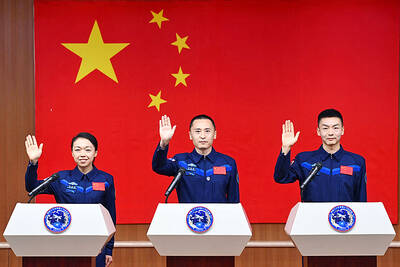
A Hong Kong astronaut is to join a Chinese space mission for the first time as part of a three-person crew launching today, as Beijing edges closer to its goal of landing people on the moon. The Tiangong space station — crewed by teams of three astronauts that are typically rotated every six months — is the crown jewel of China’s space program, boosted by billions in state investment in a bid to catch up with the US and Russia. The Shenzhou-23 mission is to blast off at 11:08pm from the Jiuquan Satellite Launch Center in northwestern China, carrying three astronauts to
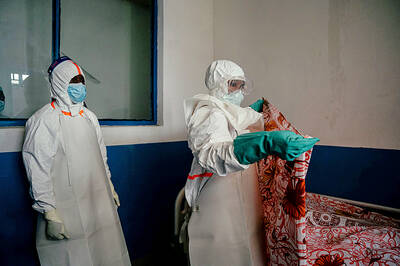
UPGRADED ALERT: The risk inside DR Congo is now considered ‘very high,’ while neighboring countries face a ‘high’ threat as the outbreak continues, the WHO said Ebola is spreading faster than responders can track it in eastern Congo, where health workers managed to follow up with barely one in five identified contacts in a single day. Authorities in the Democratic Republic of the Congo (DR Congo) reported 83 confirmed infections, 746 suspected cases and 1,603 identified contacts as of Thursday, but health workers were able to follow up on only 342 contacts that day — about 21 percent of the total under monitoring — data released by the DR Congo Ministry of Public Health on Friday showed. The figures suggest the response is falling behind the outbreak itself,

SEEKING ORDER: Rodrigo Paz said that ‘anyone who wants to destroy the nation will have to deal with this president and the full force of the constitution’ Bolivian President Rodrigo Paz on Wednesday said that the nation was at a “breaking point” after nearly a month of protests that have caused shortages of food, fuel and medicine. Paz, who took office six months ago amid the worst economic crisis there in four decades, is battling a groundswell of fury over his policies. The political capital, La Paz, has been besieged by low-income workers and members of the indigenous majority calling for his resignation. “The country needs order and is reaching breaking point,” the 58-year-old said at a public event in La Paz, renewing his appeal for dialogue. On Tuesday, the Bolivian


 RSS
RSS