


Violent clashes between protesters and security forces in Pakistan’s southern port city of Karachi and in the country’s north left at least 22 people dead and more than 120 injured, as demonstrators supportive of the Iranian government attempted to storm a US consulate on Sunday, authorities said.
In the north of the country, demonstrators attacked UN and government offices.
The violence came after the US and Israel attacked Iran, killing its supreme leader Ayatollah Ali Khamenei.
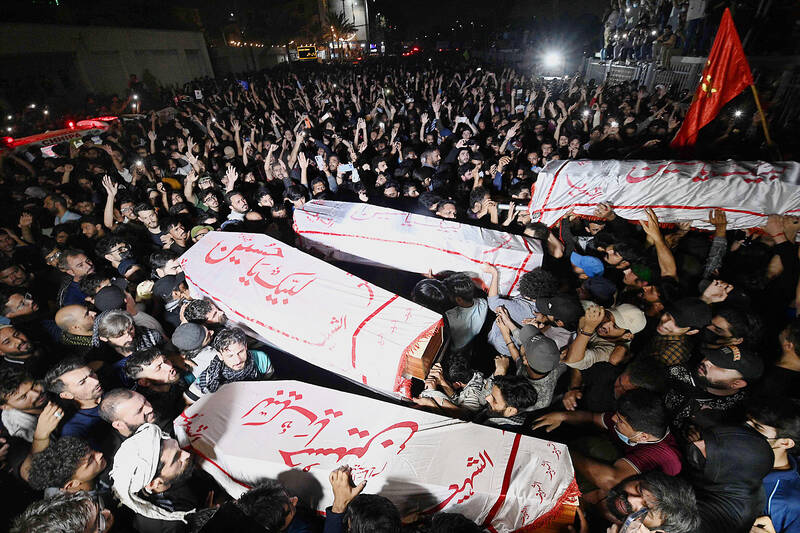
Photo: EPA
Police and officials at a hospital in Karachi said that at least 50 people were also wounded in the clashes and some of them were in critical condition.
Pakistani President Asif Ali Zardari expressed his “profound sorrow over the martyrdom” of Khamenei and conveyed his condolences to Iran, his office said.
“Pakistan stands with the Iranian nation in this moment of grief and shares in their loss,” he said.
Summaiya Syed Tariq, a police surgeon at the city’s main government hospital, confirmed six bodies and multiple injured people were brought to the facility. However, she said the death toll rose to 10 after four critically wounded people died.
In addition, 12 people were killed and more than 80 wounded in clashes with police in the northern Gilgit-Baltistan region, when thousands of protesters angered by US and Israeli strikes on Iran attacked the offices of the UN Military Observer Group and the UN Development Programme, local police official Asghar Ali said.
A government spokesman, Shabir Mir, said all staff working for those organizations was safe.
He said protesters repeatedly clashed with police at various places in the region, damaged the offices of a local charity and set fire to police offices.
However, authorities had deployed troops and brought the situation under control, he said.
The US embassy in Pakistan said in a post on X that it was monitoring reports of ongoing demonstrations at the US consulates in Karachi and Lahore, as well as calls for additional protests at the US embassy in Islamabad and the consulate in Peshawar.
It advised US citizens in Pakistan to monitor local news, stay aware of their surroundings, avoid large crowds and keep their travel registration with the US government up to date.
In Karachi, which is the capital of southern Sindh province and Pakistan’s largest city, senior police official Irfan Baloch said that protesters briefly attacked the perimeter of the US consulate, but were later dispersed.
He dismissed reports that any part of the consulate building was set on fire.
However, he said that protesters torched a nearby police post and smashed windows of the consulate before security forces arrived and regained control.
Protests in the area surrounding the consulate went on for hours, with dozens of youth, some covering their faces, throwing stones at law enforcement officials and vowing to reach the consulate where hundreds of police and paramilitary officers have been deployed.
The clashes prompted Pakistani Minister of the Interior Mohsin Naqvi to issue an appeal for calm.
“Following the martyrdom of Ayatollah Khamenei, every citizen of Pakistan shares in the grief of the people of Iran,” Naqvi said in a statement, but urged people not to take the law into their own hands and to express their protests peacefully.
The provincial government of Sindh also urged citizens to express their views peacefully and warned against engaging in violence.
Protests took place elsewhere in Pakistan
In Islamabad, police fired tear gas and swung batons as hundreds of protesters, angered by the killing of Khamenei, tried to march toward the US embassy. The clashes took place outside the city’s diplomatic enclave, where the embassy is located, and additional police had been deployed.
Meanwhile, in the northwestern city of Peshawar, authorities also used tear gas and batons to disperse thousands of demonstrators attempting to approach the US consulate to hold a rally and to denounce the killing of the Iranian leader, police said.
Protesters also held a peaceful rally in Multan, a city in Punjab province, chanting slogans against Israel and the US.
Mamoona Sherazi, who attended the rally, said that she was protesting Khamenei’s killing.
“God willing, we will never bow before America and Israel,” she said.
Protesters also rallied and clashed with police repeatedly near the US consulate in Lahore, the capital of eastern Punjab province, police said.
Authorities said that the government has stepped up security around the US embassy in the capital, and consulates across the country to avoid any further violence.

SPEAKING OUT: After Siranudh Scott’s allegations surfaced, celebrities and public figures took to social media to share their own experiences of sexual misconduct and abuse A high-profile alleged sexual abuse case within a wealthy Thai beer brewing family has prompted a wave of painful accounts from survivors of unconnected abuse in the conservative nation. Siranudh Scott, a member of the billionaire Thai family that founded the ubiquitous Singha beer brand, posted an emotional video this month accusing his elder brother Sunit of repeatedly abusing him when he was a teenager. Sunit, who is in his 30s, later denied the allegations in a video posted online, but Singha parent Boonrawd dismissed him from his executive role with the company on Tuesday last week. “I felt I needed to speak

A Hong Kong astronaut is to join a Chinese space mission for the first time as part of a three-person crew launching today, as Beijing edges closer to its goal of landing people on the moon. The Tiangong space station — crewed by teams of three astronauts that are typically rotated every six months — is the crown jewel of China’s space program, boosted by billions in state investment in a bid to catch up with the US and Russia. The Shenzhou-23 mission is to blast off at 11:08pm from the Jiuquan Satellite Launch Center in northwestern China, carrying three astronauts to
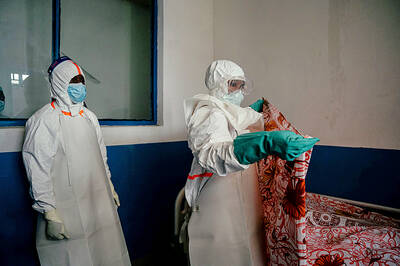
UPGRADED ALERT: The risk inside DR Congo is now considered ‘very high,’ while neighboring countries face a ‘high’ threat as the outbreak continues, the WHO said Ebola is spreading faster than responders can track it in eastern Congo, where health workers managed to follow up with barely one in five identified contacts in a single day. Authorities in the Democratic Republic of the Congo (DR Congo) reported 83 confirmed infections, 746 suspected cases and 1,603 identified contacts as of Thursday, but health workers were able to follow up on only 342 contacts that day — about 21 percent of the total under monitoring — data released by the DR Congo Ministry of Public Health on Friday showed. The figures suggest the response is falling behind the outbreak itself,

SEEKING ORDER: Rodrigo Paz said that ‘anyone who wants to destroy the nation will have to deal with this president and the full force of the constitution’ Bolivian President Rodrigo Paz on Wednesday said that the nation was at a “breaking point” after nearly a month of protests that have caused shortages of food, fuel and medicine. Paz, who took office six months ago amid the worst economic crisis there in four decades, is battling a groundswell of fury over his policies. The political capital, La Paz, has been besieged by low-income workers and members of the indigenous majority calling for his resignation. “The country needs order and is reaching breaking point,” the 58-year-old said at a public event in La Paz, renewing his appeal for dialogue. On Tuesday, the Bolivian


 RSS
RSS