


As he watched the Boston Celtics play from the stands of TD Garden, one noise kept catching Adel Djellouli’s ear.
“This squeaking sound when players are sliding on the floor is omnipresent,” he said. “It’s always there, right?”
Squeaky shoes are part of the symphony of a basketball game, when rubber soles rasp against the hardwood floors as players jab step, cut and pivot and defenders move their feet to stay in front of their assignment.
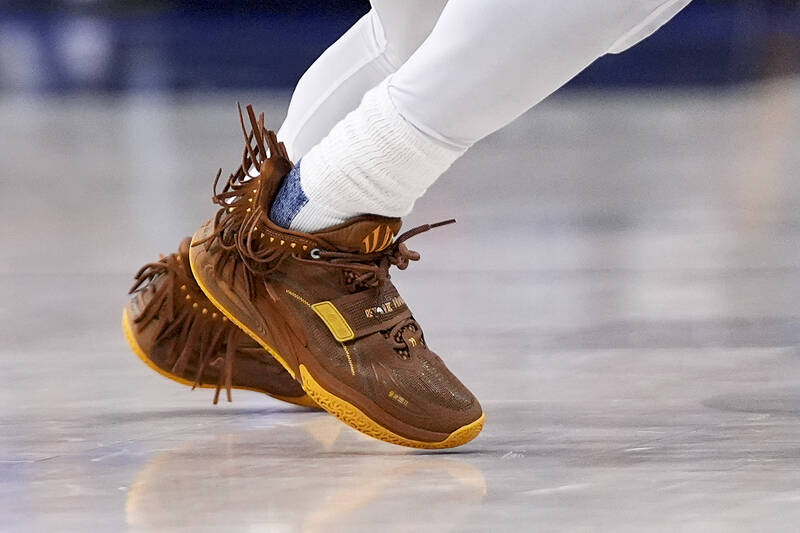
Photo: AP
Returning home from the game, Djellouli wondered how that sound was produced — and as a materials scientist at Harvard University, he had a way to find out.
Djellouli and colleagues slid a sneaker against a smooth glass plate repeatedly. They recorded the squeaks with a microphone and filmed it with a high speed camera to see what was happening under the shoe.
In a study published on Wednesday in the journal Nature, they described what they found. As the shoe works hard to keep its grip, tiny sections of the sole change shape as they momentarily lose and then regain contact with the floor thousands of times per second — at a frequency that matches the pitch of a loud squeak.
“That squeaking is basically your shoe rippling, or creating wrinkles that travel superfast. They repeat at a high frequency, and this is why you get that squeaky noise,” Djellouli said.
The grip patterns on the soles might also play a role. When researchers slid blocks of flat, featureless rubber against the glass, they saw a series of chaotic, disorganized ripples, but did not hear squeaks.
The ridge-like designs on the bottom of shoes might organize the bursts to produce a clear, high-pitched sound.
Other researchers have studied these kinds of bursts before, but this sneaker study examines friction happening at much faster speeds — and for the first time, it links the speedy pulses with the squeaking sound they produce.
The insights do not just serve to satisfy the curiosity of a basketball fan. They could also help answer important practical questions.
“Friction is one of the oldest and most intricate problems in physics,” wrote physicist Bart Weber in an editorial accompanying the new research.
Yet, despite its practical importance, “it is difficult to predict and control,” he wrote.
Understanding friction better could help scientists better understand how the Earth’s tectonic plates slide and grind during earthquakes, or to save energy by reducing friction and wear.
It could also help eliminate moments off the court when squeaky shoes can be a little awkward or embarrassing, such as in a quiet office hallway.
The research does not offer a fix, although the Internet has plenty of advice that might be risky, including rubbing soap or a dryer sheet on the soles. Nevertheless, some of the insights from the study could help to design squeak-free shoes.
For example, one additional experiment found that changing the thickness of the rubber could make the squeak sound lower or higher in pitch.
Could scientists eventually fine-tune shoes to squeak in a pitch so high human cannot even hear it?
“We can now start designing for it,” Weber said. “We can start making interfaces that either do it if we want to hear this sound, or don’t do it if we don’t want to hear it.”

South Korea’s air force yesterday apologized for a 2021 midair collision involving two fighter jets, a day after auditors said the pilots were taking selfies and filming during the flight and held them responsible for the accident. “We sincerely apologize to the public for the concern caused by the accident that occurred in 2021,” an air force spokesman told a news conference, adding that one of the pilots involved had been suspended from flying duties, received severe disciplinary action and has since left the military. The apology followed a report released on Wednesday by the South Korean Board of Audit and Inspection,

About 240 Indians claiming descent from a Biblical tribe landed at Tel Aviv airport on Thursday as part of a government operation to relocate them to Israel. The newcomers passed under a balloon arch in blue and white, the colors of the Israeli flag, as dozens of well-wishers welcomed them with a traditional Jewish song. They were the first “bnei Menashe” (“sons of Manasseh”) to arrive in Israel since the government in November last year announced funding for the immigration of about 6,000 members of the community from the states of Manipur and Mizoram in northeast India. The community claims to descend from

Indonesian police have arrested 13 people after shocking images of alleged abuse against small children at a daycare center went viral, sparking outrage across the nation, officials said on Monday. Police on Friday last week raided Little Aresha, a daycare center in Yogyakarta on Java island, following a report from a former employee. CCTV footage circulating on social media showed children, most younger than two, lying on the floor wearing only diapers, their hands and feet bound with rags. The police have confirmed that the footage is authentic. Police said they also found 20 children crammed into a room just 3m by 3m. “So
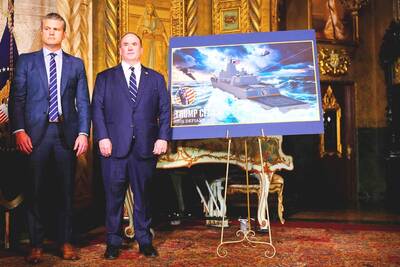
‘TROUBLING’: The firing of Phelan, who was an adviser to a nonprofit that supported the defense of Taiwan, was another example of ‘dysfunction’ under Trump, a US senator said US Secretary of the Navy John Phelan has been fired, a US official and a person familiar with the matter said on Wednesday, in another wartime shakeup at the Pentagon coming just weeks after US Secretary of Defense Pete Hegseth ousted the Army’s top general. The Pentagon announced his departure in a brief statement, saying he was leaving the administration “effective immediately,” but it did not provide a reason or say whether it was his decision to go. The sources, who spoke on condition of anonymity, said Phelan was dismissed in part because he was moving too slowly to implement reforms to


 RSS
RSS