


South Korea has relaunched a fact-finding commission into its past human rights violations, with a key focus on the extensive fraud and malfeasance that corrupted the nation’s historic foreign adoption program.
The Truth and Reconciliation Commission, the third in the country’s history, began accepting new cases yesterday, months after the previous one’s mandate ended in November with more than 2,100 complaints unresolved.
The new commission would inherit those cases, including 311 submissions by Korean adoptees from the West that were either deferred or incompletely reviewed before the second commission halted a landmark investigation into adoptions in April last year, following internal disputes over which cases warranted recognition as problematic.
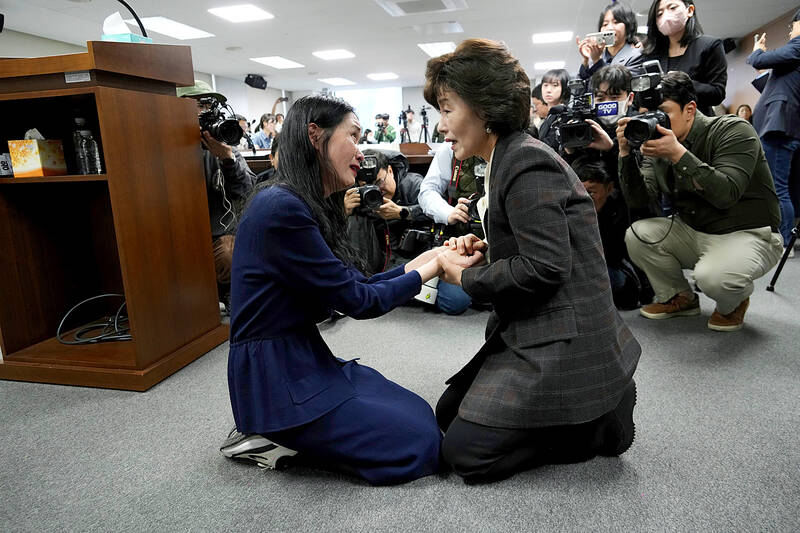
Photo: AP
Advocates said that interest among adoptees is far higher this time, with hundreds already seeking investigations, including many from the US, who were underrepresented in the previous inquiry even though American parents were by far the biggest recipients of Korean children over the past seven decades.
However, investigators who served on the previous commission said it could take months — possibly until May or June — for the new probes to actually get under way.
The government has yet to appoint a chair to lead the commission, which has not formed investigative teams and would initially be run by civil servants assigned to receive and register cases.
The new commission, established under a law passed last month expanding its investigative mandate, would also investigate other human rights abuses potentially attributable to the government, including civilian killings around the 1950 to 1953 Korean War, repression during the military dictatorships of the 1960s to 1980s, and decades-long abuses of inmates at welfare facilities.
Under the commission’s three-year mandate, applications for investigation must be submitted until Feb. 25, 2028, although the commission has the power to extend the deadline and mandate for up to five years. Adoptees could also submit their applications with the South Korean embassies or consulates in the countries they live in.
South Korea sent thousands of children annually to the West from the 1970s to the early 2000s, peaking at an average of more than 6,000 a year in the 1980s. The country was then ruled by a military government that saw population growth as a major threat to its economic goals and treated adoptions as a way to reduce the number of mouths to feed, contributing to what is now possibly the world’s largest diaspora of adoptees.
The suspension of the prior adoption probe last year followed a nearly three-year review of cases across Europe, the US and Australia, during which the second commission confirmed human rights violations in just 56 of 367 complaints filed by adoptees.
Still, the commission issued a significant interim report concluding that the government bears responsibility for a foreign adoption program riddled with fraud and abuse, driven by efforts to reduce welfare costs and carried out by private agencies that often manipulated children’s backgrounds and origins.
Boonyoung Han, an adoptee activist and coleader of the Danish Korean Rights Group, which led most adoptee applications to the previous commission, said the group yesterday submitted more than 300 cases to the newly launched commission.
While most of the new applications came from adoptees in Denmark, Han said US adoptees were the second-largest group.

SPEAKING OUT: After Siranudh Scott’s allegations surfaced, celebrities and public figures took to social media to share their own experiences of sexual misconduct and abuse A high-profile alleged sexual abuse case within a wealthy Thai beer brewing family has prompted a wave of painful accounts from survivors of unconnected abuse in the conservative nation. Siranudh Scott, a member of the billionaire Thai family that founded the ubiquitous Singha beer brand, posted an emotional video this month accusing his elder brother Sunit of repeatedly abusing him when he was a teenager. Sunit, who is in his 30s, later denied the allegations in a video posted online, but Singha parent Boonrawd dismissed him from his executive role with the company on Tuesday last week. “I felt I needed to speak

A Hong Kong astronaut is to join a Chinese space mission for the first time as part of a three-person crew launching today, as Beijing edges closer to its goal of landing people on the moon. The Tiangong space station — crewed by teams of three astronauts that are typically rotated every six months — is the crown jewel of China’s space program, boosted by billions in state investment in a bid to catch up with the US and Russia. The Shenzhou-23 mission is to blast off at 11:08pm from the Jiuquan Satellite Launch Center in northwestern China, carrying three astronauts to

SEEKING ORDER: Rodrigo Paz said that ‘anyone who wants to destroy the nation will have to deal with this president and the full force of the constitution’ Bolivian President Rodrigo Paz on Wednesday said that the nation was at a “breaking point” after nearly a month of protests that have caused shortages of food, fuel and medicine. Paz, who took office six months ago amid the worst economic crisis there in four decades, is battling a groundswell of fury over his policies. The political capital, La Paz, has been besieged by low-income workers and members of the indigenous majority calling for his resignation. “The country needs order and is reaching breaking point,” the 58-year-old said at a public event in La Paz, renewing his appeal for dialogue. On Tuesday, the Bolivian
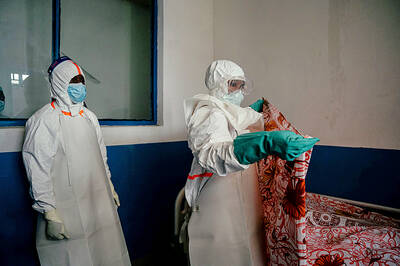
UPGRADED ALERT: The risk inside DR Congo is now considered ‘very high,’ while neighboring countries face a ‘high’ threat as the outbreak continues, the WHO said Ebola is spreading faster than responders can track it in eastern Congo, where health workers managed to follow up with barely one in five identified contacts in a single day. Authorities in the Democratic Republic of the Congo (DR Congo) reported 83 confirmed infections, 746 suspected cases and 1,603 identified contacts as of Thursday, but health workers were able to follow up on only 342 contacts that day — about 21 percent of the total under monitoring — data released by the DR Congo Ministry of Public Health on Friday showed. The figures suggest the response is falling behind the outbreak itself,


 RSS
RSS