


As the Philippine Coast Guard (PCG) plane descended toward the country’s most strategically important outpost in the disputed South China Sea, passengers’ phones lit up with a roaming alert: “Welcome to CHINA.”
Among those on board were Philippine Senator Risa Hontiveros and PCG spokesman Jay Tarriela, both outspoken critics of Beijing’s actions in the South China Sea.
After landing on Saturday, they spoke to island residents to reaffirm that Thitu Island “is ours,” even as Chinese coast guard vessels, a People’s Liberation Army Navy ship and some Chinese fishing boats lingered within sight of the shore.
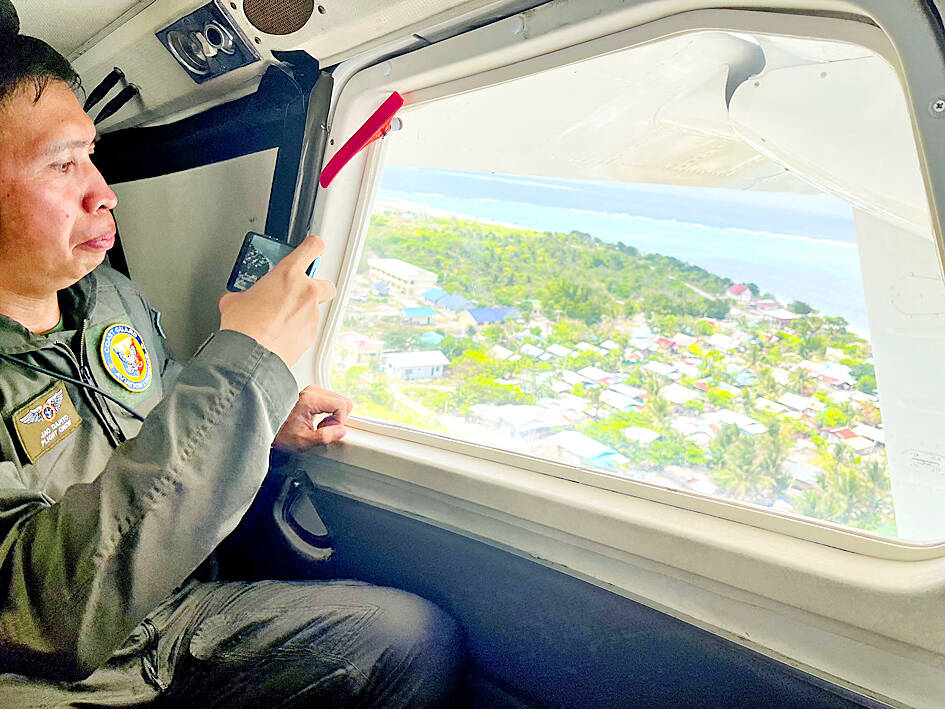
Photo: Reuters
China’s persistent presence has pushed islanders, who rely on those waters for their livelihood, farther from the sea they once freely navigated.
At just 37 hectares, the coral-fringed Thitu, known to Filipinos as Pag-asa, or “Hope,” is the largest and most prized of the nine Philippines-held features in the Spratly archipelago (南沙群島), known as Kalayaan Islands in Filipino, 450km from the mainland.
Its 400-odd residents live modestly, far from the trappings of city life. Yet their quiet presence reinforces the Philippines’ claim of sovereignty at a time of mounting Chinese pressure.
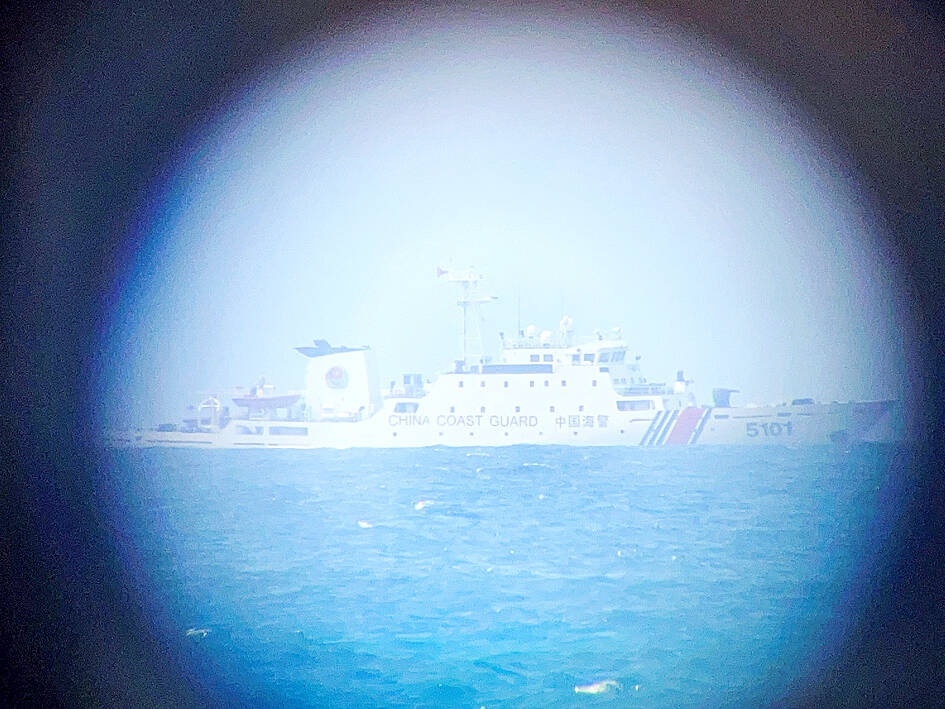
Photo: Reuters
The visit by Hontiveros and Tarriela, coming as rhetoric on both sides has sharpened, is likely to draw scrutiny from Beijing and add strain to an already tense territorial dispute.
“We will never give up the Kalayaan Island Group, including Pag-asa,” Hontiveros told residents.
Both officials have been repeatedly singled out in Chinese embassy statements and online messaging campaigns, part of a broader effort to shape narratives about the South China Sea.
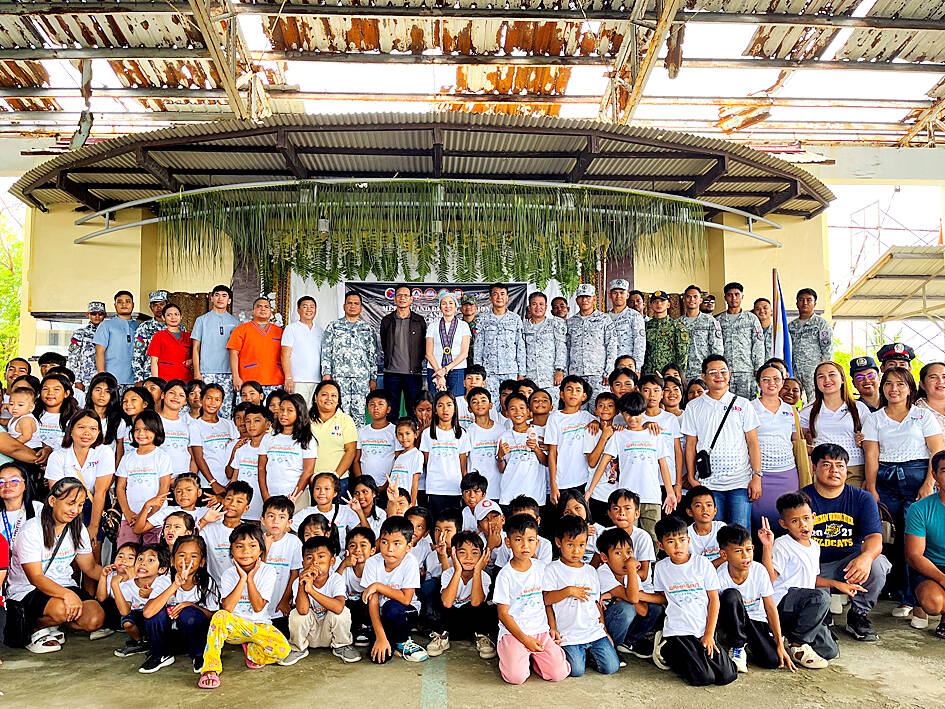
Photo: Reuters
Manila’s appointment of a dedicated foreign department spokesperson on maritime affairs reflects a growing sensitivity within government ranks as China’s physical and informational pressure intensifies.
On Pag-asa, China’s pressure is not abstract.
Among those listening to Hontiveros was 45-year-old fisherman Rando Asiado, who said the long-standing presence of Chinese vessels has kept him from venturing to rich fishing grounds near Subi Reef (Jhubi Reef, 渚碧礁) and the nearby Sandy Cays.
“There are times when Chinese coast guard vessels would chase us away, so we are forced to stay on one side of the island. And when we try to fish on the other side, Chinese drones fly over us,” said Asiado, who has been living on the island since 2012.
China claims most of the South China Sea, despite the Permanent Court of Arbitration in The Hague invalidating the claims in a 2016 ruling.
Just 14 nautical miles (26km) from Thitu, Subi Reef is one of seven artificial islands China has built in the Spratlys to support its sovereignty claims.
Some artificial islands are equipped with surface-to-air missiles, aircraft hangars and runways.
Approaches by the Chinese coast guard have become so routine that Filipino fishers now cast their nets in less productive waters to avoid confrontation.
Beijing’s actions in the South China Sea, which have included water-cannoning and close-quarter maneuvering of ships, have resulted in collisions and injury to Philippine crews.
China has maintained its actions are lawful and professional, accusing Manila’s vessels of intruding into its territory.
“We’re not afraid because we know we’re in the right, but they’re using ships while we only have small boats. We don’t stand a chance, so to avoid trouble, we just steer away,” 51-year-old fisher Ronnie Cojamco said.
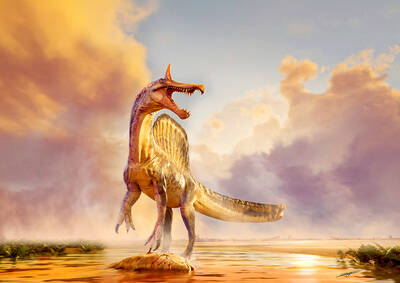
FEROCIOUS FISH-EATER Scientists have found a new species of dinosaur from the Cretaceous Period, a ‘hell heron’ that stalked the rivers, deep in the Saharan desert At a remote Sahara desert site in Niger, scientists have unearthed fossils of a new species of Spinosaurus, among the biggest of the meat-eating dinosaurs, notable for its large blade-shaped head crest and jaws bearing interlocking teeth for snaring fish. It prowled a forested inland environment and strode into rivers to catch sizable fish like a modern-day wading bird — a “hell heron,” as one of the researchers put it, considering it was about 12 meters long and weighed 5-7 tons. The dinosaur presented a striking profile on the Cretaceous Period landscape of Africa some 95 million years ago as it hunted
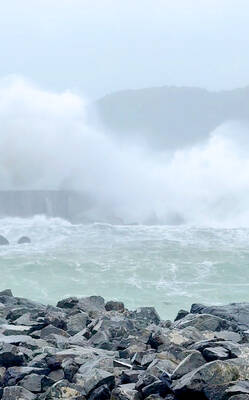
Heavy rain and strong winds yesterday disrupted flights, trains and ferries, forcing the closure of roads across large parts of New Zealand’s North Island, while snapping power links to tens of thousands. Domestic media reported a few flights had resumed operating by afternoon from the airport in Wellington, the capital, although cancelations were still widespread after airport authorities said most morning flights were disrupted. Air New Zealand said it hoped to resume services when conditions ease later yesterday, after it paused operations at Wellington, Napier and Palmerston North airports. Online images showed flooded semi-rural neighborhoods, inundated homes, trees fallen on vehicles and collapsed

‘COST OF DEFECTION’: Duterte’s announcement could be an effort to keep allies in line with the promise of a return to power amid political uncertainty, an analyst said Philippine Vice President Sara Duterte yesterday announced she would run for president of the Southeast Asian nation of 116 million in 2028. Duterte, who is embroiled in a bitter feud with Philippine President Ferdinand Marcos Jr, was impeached last year only to see the country’s Supreme Court throw the case out over procedural issues. Her announcement comes just days before her father, former Philippine president Rodrigo Duterte, begins a pretrial hearing at the International Criminal Court (ICC) in the Netherlands over crimes against humanity allegedly committed as part of a brutal crackdown on drugs. “I offer my life, my strength and my future

NOT YET THERE: While the show was impressive, it failed to demonstrate their ability to move in unstructured environments, such as a factory floor, an expert said Dancing humanoid robots on Monday took center stage during the annual China Media Group’s Spring Festival Gala, China’s most-watched official television broadcast. They lunged and backflipped (landing on their knees), they spun around and jumped. Not one fell over. The display was impressive, but if robots can now dance and perform martial arts, what else can they do? Experts have mixed opinions, with some saying the robots had limitations and that the display should be viewed through a lens of state propaganda. Developed by several Chinese robotics firms, the robots performed a range of intricate stunts, including martial arts, comedy sketches and choreographed


 RSS
RSS