


Cuba’s debilitated healthcare system has been pushed to the brink of collapse by the US blockading the country’s oil supply, a Cuban official said on Friday.
The country’s medical system was already perpetually crisis-stricken along with the island’s economy, with lack of supplies, staff and medicine long being the norm, but the turmoil has reached a new extreme in recent weeks. Ambulances are struggling to find fuel to respond to emergencies. Persistent outages have plagued deteriorated hospitals. Flights bringing vital supplies have been suspended, as the Cuban government said it is unable to refuel airplanes in its airports.
Experts and some leaders of other countries have warned that the island could be on the verge of a humanitarian crisis.
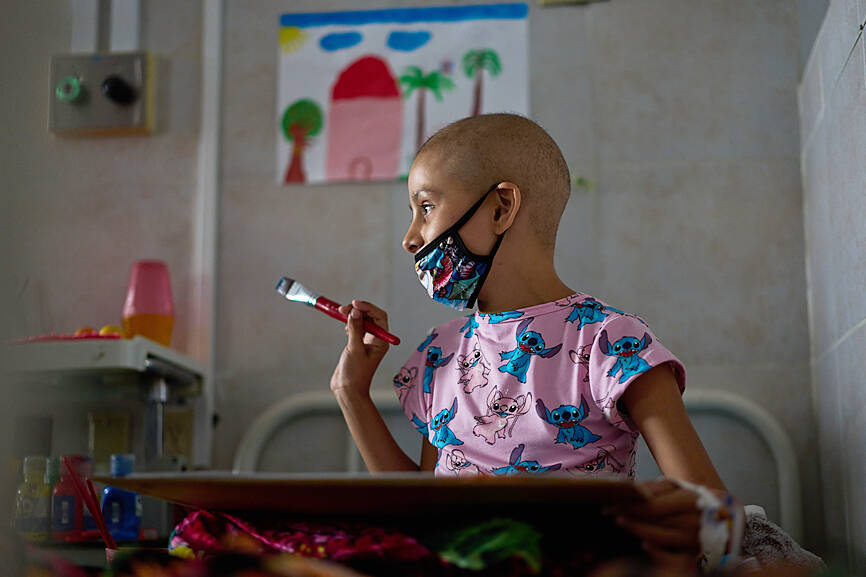
Photo: AP
US sanctions are no longer just crippling the island’s economy, they are threatening “basic human safety,” Cuban Minister of Public Health Jose Angel Portal Miranda said.
“You cannot damage a state’s economy without affecting its inhabitants,” Portal said. “This situation could put lives at risk.”
Five million people in Cuba living with chronic illnesses would see their medications or treatments affected, he said, adding that this included 16,000 cancer patients requiring radiotherapy and another 12,400 undergoing chemotherapy.
Cardiovascular care, orthopedics, oncology and treatment for critically ill people who require electrical backup are among the most impacted areas, he said.
Kidney disease treatments and emergency ambulance services have also been added to the list of impacted services.
Cuba’s energy crisis entered new extremes last month when US President Donald Trump signed an executive order that would impose a tariff on any country that sells or provides oil to Cuba.
Cubans — who the US said it seeks to defend — are the ones feeling the harsh ripple effects of the fuel blockade as hardship mounts every day. Buses have slashed routes, gas has been put under strict rationing and is only being sold in foreign currency, and endemic blackouts have reached a new extreme.
Cuba’s healthcare system has been in crisis in recent years. Thousands of doctors have emigrated from the country and hospitals have rapidly deteriorated, while medicine shortages have forced many to buy them on the black market.
Such problems are expected to worsen in the coming weeks, Portal said.
Solar panels have been installed in clinics while authorities prioritize care to children and the elderly, he said.
However, they have placed restrictions on some more energy-reliant technologies such as CT scans and laboratory tests, so doctors would have to rely on more basic methods to treat patients, effectively cutting many off from high levels of care, he added.
“We are facing an energy siege with direct implications for the lives of Cubans, for the lives of Cuban families,” Portal said.
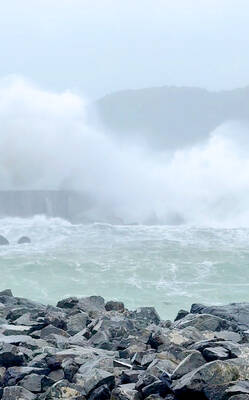
Heavy rain and strong winds yesterday disrupted flights, trains and ferries, forcing the closure of roads across large parts of New Zealand’s North Island, while snapping power links to tens of thousands. Domestic media reported a few flights had resumed operating by afternoon from the airport in Wellington, the capital, although cancelations were still widespread after airport authorities said most morning flights were disrupted. Air New Zealand said it hoped to resume services when conditions ease later yesterday, after it paused operations at Wellington, Napier and Palmerston North airports. Online images showed flooded semi-rural neighborhoods, inundated homes, trees fallen on vehicles and collapsed

‘COST OF DEFECTION’: Duterte’s announcement could be an effort to keep allies in line with the promise of a return to power amid political uncertainty, an analyst said Philippine Vice President Sara Duterte yesterday announced she would run for president of the Southeast Asian nation of 116 million in 2028. Duterte, who is embroiled in a bitter feud with Philippine President Ferdinand Marcos Jr, was impeached last year only to see the country’s Supreme Court throw the case out over procedural issues. Her announcement comes just days before her father, former Philippine president Rodrigo Duterte, begins a pretrial hearing at the International Criminal Court (ICC) in the Netherlands over crimes against humanity allegedly committed as part of a brutal crackdown on drugs. “I offer my life, my strength and my future

FEROCIOUS FISH-EATER Scientists have found a new species of dinosaur from the Cretaceous Period, a ‘hell heron’ that stalked the rivers, deep in the Saharan desert At a remote Sahara desert site in Niger, scientists have unearthed fossils of a new species of Spinosaurus, among the biggest of the meat-eating dinosaurs, notable for its large blade-shaped head crest and jaws bearing interlocking teeth for snaring fish. It prowled a forested inland environment and strode into rivers to catch sizable fish like a modern-day wading bird — a “hell heron,” as one of the researchers put it, considering it was about 12 meters long and weighed 5-7 tons. The dinosaur presented a striking profile on the Cretaceous Period landscape of Africa some 95 million years ago as it hunted

NOT YET THERE: While the show was impressive, it failed to demonstrate their ability to move in unstructured environments, such as a factory floor, an expert said Dancing humanoid robots on Monday took center stage during the annual China Media Group’s Spring Festival Gala, China’s most-watched official television broadcast. They lunged and backflipped (landing on their knees), they spun around and jumped. Not one fell over. The display was impressive, but if robots can now dance and perform martial arts, what else can they do? Experts have mixed opinions, with some saying the robots had limitations and that the display should be viewed through a lens of state propaganda. Developed by several Chinese robotics firms, the robots performed a range of intricate stunts, including martial arts, comedy sketches and choreographed


 RSS
RSS