


As South Korea’s global cultural influence expands in areas such as music, film and television, one form of entertainment struggling to attract attention even at home is Korea’s traditional style of wrestling, known as ssireum.
Ssireum — pronounced like “see room” — had its heyday in the 1980s and early 1990s, when there were as many as eight professional teams and the top wrestlers became household names.
Since then, it has been squeezed by tighter budgets and a public quick to move on to new trends.

Photo: Reuters
Twenty-year-old Lee Eun-soo, who began training at the age of nine, is taking part in this year’s Lunar New Year tournament, the showcase event for the more than 1,500-year-old sport.
Lee lamented that at his former high school, the ssireum team currently has no members and there is talk of disbanding it.
“I once tried to imagine my life if I hadn’t done ssireum,” Lee said. “I don’t think I could live without it.”
A ssireum match involves two wrestlers facing off in an 8m sandpit ring, gripping each other by a cloth belt called a satba and using strength, balance, timing and stamina to force the opponent to the ground.
Ssireum was inscribed on UNESCO’s Representative List of the Intangible Cultural Heritage of Humanity in 2018, but that international recognition has not translated into commercial success.
Its relative obscurity contrasts with the high profile of Japan’s sumo, another centuries-old form of wrestling. Unlike sumo, which is supported by a centralized professional ranking system and six major annual tournaments — or Olympic wrestling, with its global reach — ssireum remains largely domestic.
“Sport is something people won’t come to watch if they don’t know the wrestlers or even the sport itself,” said Lee Tae-hyun, a former ssireum wrestler and professor of martial arts at Yong In University, who has promoted the sport overseas and believes it has commercial potential with the right backing.
Lee Hye-soo, 25, a spectator at the Lunar New Year tournament, said many Koreans are now unfamiliar with ssireum.
“My grandfather liked watching ssireum, so I watched it with him a lot when I was young,” she said.
“I like it now too, but I think it would be even better if it became more famous,” she said.
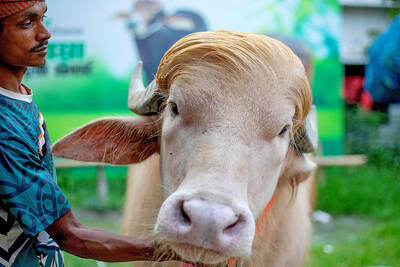
Crowds in Bangladesh are flocking to snap photographs with an unlikely social media star — an albino buffalo with flowing blond hair nicknamed “Donald Trump” that is due to be sacrificed within days. Owner Zia Uddin Mridha, 38, said his brother named the 700kg bull over its flowing helmet of hair resembling the signature look of the US president. “My younger brother picked this name because of the buffalo’s extraordinary hair,” he said at his farm in Narayanganj, just outside the capital, Dhaka. Mridha said that a constant stream of curious visitors — social media fans, onlookers and children — have come throughout

It began as a satirical online project. Now millions of young people in India are flocking to it as an outlet for their frustration. A parody political party called the Cockroach Janta Party, with the insect as its symbol, has exploded across India’s social media by turning absurdist humor into protest. Memes and short videos mocking corruption, joblessness and political dysfunction have flooded social media sites, where millions of users are embracing the cockroach — known for its ability to survive harsh conditions — as a tongue-in-cheek symbol of endurance. The online movement’s rise has been unusually rapid. The Cockroach Janta Party (CJP)

HOTTER: While Indians are accustomed to summer heat, climate change has caused northwestern India to warm faster than other parts of the country, an academic said Roads and markets have emptied during afternoons and some farmers have switched to nighttime work to avoid scorching temperatures as a heat wave grips large parts of India. The India Meteorological Department forecast maximum temperatures for yesterday of about 45°C in the capital, New Delhi, where authorities have opened temporary “cooling zones” to help people cope. The weather department warned that conditions would likely persist across several northern regions in the coming days, with temperatures staying well above seasonal averages. Authorities urged people to stay indoors during the hottest hours and take precautions against heat-related illnesses. India declares a heat wave whenever maximum temperatures

A Hong Kong astronaut is to join a Chinese space mission for the first time as part of a three-person crew launching today, as Beijing edges closer to its goal of landing people on the moon. The Tiangong space station — crewed by teams of three astronauts that are typically rotated every six months — is the crown jewel of China’s space program, boosted by billions in state investment in a bid to catch up with the US and Russia. The Shenzhou-23 mission is to blast off at 11:08pm from the Jiuquan Satellite Launch Center in northwestern China, carrying three astronauts to


 RSS
RSS