


A prince, an ambassador, senior diplomats, top politicians. All brought down by the Jeffrey Epstein files, and all in Europe, rather than the US.
The huge trove of Epstein documents released by the US Department of Justice has sent shock waves through Europe’s political, economic and social elites — dominating headlines, ending careers, and spurring political and criminal investigations.
Former British ambassador to the US Peter Mandelson was fired and could go to prison. British Prime Minister Keir Starmer faces a leadership crisis over the Mandelson appointment. Senior figures have fallen in Norway, Sweden and Slovakia. Even before the latest batch of files, Andrew Mountbatten-Windsor, brother of British King Charles III, lost his honors, princely title and taxpayer-funded mansion.
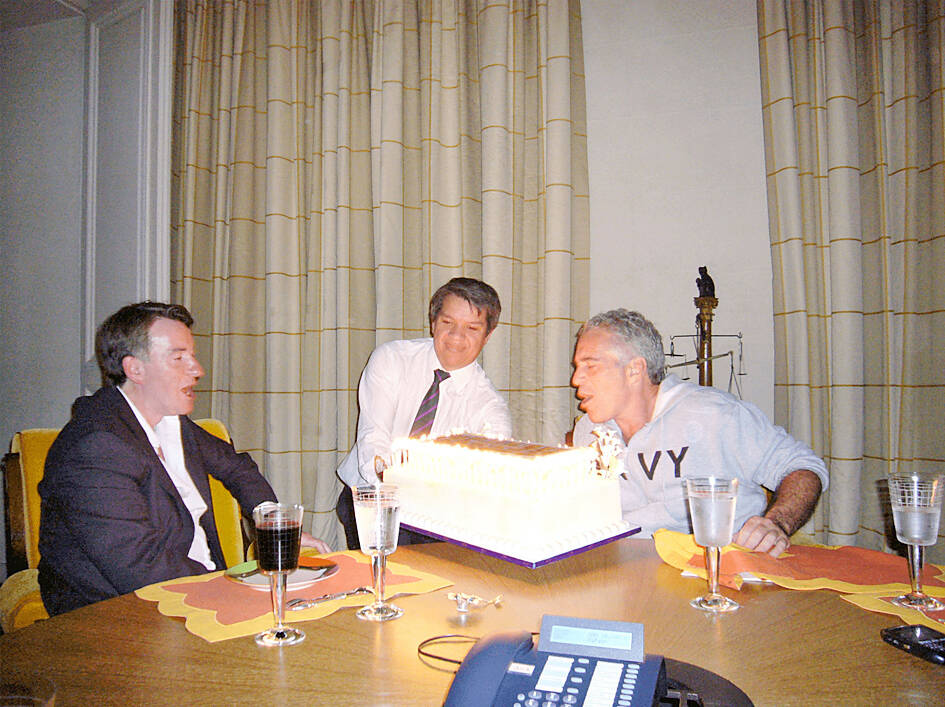
Photo: US Department of Justice via Reuters
Apart from the former Prince Andrew, none of them faces claims of sexual wrongdoing. They have been toppled for maintaining friendly relationships with Epstein after he became a convicted sex offender.
“Epstein collected powerful people the way others collect frequent flyer points,” said Mark Stephens, a specialist in international and human rights law at Howard Kennedy in London. “But the receipts are now in public, and some might wish they’d traveled less.”
The documents were published after a public frenzy over Epstein became a crisis for US President Donald Trump’s administration and led to a rare bipartisan effort to force the US government to open its investigative files. However, in the US, the long-sought publication has not brought the same public reckoning with Epstein’s associates — at least so far.
Rob Ford, a professor of political science at the University of Manchester, said that in Britain, “if you’re in those files, it’s immediately a big story.”
“It suggests to me we have a more functional media, we have a more functional accountability structure, that there is still a degree of shame in politics, in terms of people will say: ‘This is just not acceptable, this is just not done,’” he said.
British figures felled by their ties to Epstein include the former Prince Andrew — who paid millions to settle a lawsuit with one of Epstein’s victims and is facing pressure to testify in the US — and his ex-wife Sarah Ferguson, whose charity shut down this week.
Like others now ensnared, veteran politician Mandelson long downplayed his relationship with Epstein, despite calling him “my best pal” in 2003. The new files reveal contact continued for years after the financier’s 2008 prison term for sexual offenses involving a minor. In a July 2009 message, Mandelson appeared to refer to Epstein’s release from prison as “liberation day.”
Starmer fired Mandelson in September last year over revelations about his Epstein ties. British police are investigating whether Mandelson committed misconduct in public office by passing on sensitive information to Epstein.
Starmer has apologized to Epstein’s victims and pledged to release public documents that would show Mandelson lied when he was being vetted for the ambassador’s job. That might not be enough to stop furious lawmakers trying to eject the prime minister from office over his failure of judgement.
Experts caution that Britain should not be too quick to pat itself on the back over its rapid reckoning with Mandelson. The US has a better record than the UK when it comes to declassifying and publishing information.
However, Alex Thomas, executive director of the Institute for Government think tank, said that “there is something about parliamentary democracy,” with its need for a prime minister to retain the confidence of the parliament to stay in office, “that I think does help drive accountability.”
A few high-profile Americans have faced repercussions over their friendly ties with Epstein. Most prominent is former US secretary of Treasury Larry Summers, who went on leave from academic positions at Harvard University late last year.
Brad Karp quit last week as chair of top US law firm Paul Weiss after revelations in the latest batch of documents, and the NFL said it would investigate Epstein’s relationship with New York Giants co-owner Steve Tisch, who exchanged sometimes crude e-mails with Epstein about potential dates with adult women.
Other US Epstein associates have not yet faced severe sanction, including former Trump strategist Steve Bannon, who exchanged hundreds of texts with Epstein, US Secretary of Commerce Howard Lutnick, who accepted an invitation to visit Epstein’s island, and Elon Musk, who discussed visiting the island in e-mails, but says he never made the trip.
Former US president Bill Clinton has been compelled by Republicans to testify before US Congress about his friendship with Epstein. Trump, too, has repeatedly faced questions about his ties to Epstein. Neither he nor Clinton has ever been accused of wrongdoing by Epstein’s victims.
The Epstein files reveal the global network of royals, political leaders, billionaires, bankers and academics that the wealthy financier built around him.
Across Europe, officials have had or resign or face censure after the Epstein files revealed relationships that were more extensive than previously disclosed.
Joanna Rubinstein, a Swedish UN official, quit after the revelation of a 2012 visit to Epstein’s Caribbean island. Miroslav Lajcak, national security adviser to Slovakian Prime Minister Robert Fico, quit over his communications with Epstein, which included the pair discussing “gorgeous” girls.
Latvia, Lithuania and Poland have set up wide-ranging official investigations into the documents. Polish Prime Minister Donald Tusk said a team would scour the files for potential Polish victims, and any links between Epstein and Russian secret services.
Epstein took an interest in European politics, in one e-mail exchange with billionaire Peter Thiel calling Britain’s 2016 vote to leave the EU “just the beginning” and part of a return to “tribalism.”
Gregoire Roos, director of the Europe program at the think tank Chatham House, said the files uncover Epstein’s “far-reaching” network of contacts in Europe, “and the level of access among not just those who were already in power, but those who were getting there.
“It will be interesting to see whether in the correspondence he had an influence in policymaking,” Roos said.
Meanwhile, Norway’s economic crimes unit has opened a corruption investigation into former Norwegian prime minister Thorbjorn Jagland — who also once headed the committee that hands out the Nobel Peace Prize — over his ties with Epstein.
His lawyer said Jagland would cooperate with the probe.
Also ensnared are high-profile Norwegian diplomat couple Terje Rod-Larsen and Mona Juul, key players in the 1990s Israel-Palestinian peace efforts. Juul has been suspended as Norway’s ambassador to Jordan after revelations including that Epstein left the couple’s children US$10 million in a will drawn up shortly before his death by suicide in a New York prison in 2019.
Norwegians’ respect for their royal family has been dented by new details about Epstein’s friendship with Norwegian Crown Princess Mette-Marit, who is married to the heir to the throne, Prince Haakon. The files include jokey exchanges and e-mails planning visits to Epstein properties, teeth-whitening appointments and shopping trips.
The Norwegian princess on Friday apologized “to all of you whom I have disappointed.”
The disclosures came as her son from a previous relationship, Marius Borg Hoiby, stands trial in Oslo on rape charges, which he denies.
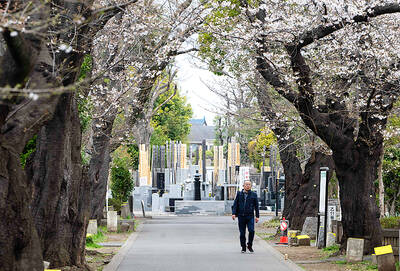
ROCKY RELATIONS: The figures on residents come as Chinese tourist numbers drop following Beijing’s warnings to avoid traveling to Japan The number of Chinese residents in Japan has continued to rise, even as ties between the two countries have become increasingly fractious, data released on Friday showed. As of the end of December last year, the number of Chinese residents had increased by 6.5 percent from the previous year to 930,428. Chinese people accounted for 22.6 percent of all foreign residents in Japan, making them by far the largest group, Japanese Ministry of Justice data showed. Beijing has criticized Tokyo in increasingly strident terms since Japanese Prime Minister Sanae Takaichi last year suggested that a military conflict around Taiwan could

Germany is considering Australia’s Ghost Bat robot fighter as it looks to select a combat drone to modernize its air force, German Minister of Defense Boris Pistorius said yesterday. Germany has said it wants to field hundreds of uncrewed fighter jets by 2029, and would make a decision soon as it considers a range of German, European and US projects developing so-called “collaborative combat aircraft.” Australia has said it will integrate the Ghost Bat, jointly developed by Boeing Australia and the Royal Australian Air Force, into its military after a successful weapons test last year. After inspecting the Ghost Bat in Queensland yesterday,
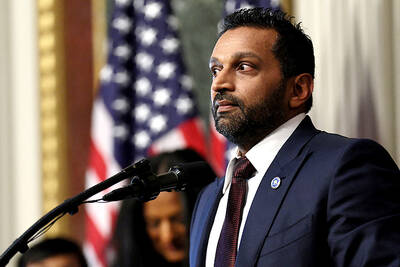
A pro-Iran hacking group claimed to breach FBI Director Kash Patel’s personal e-mail inbox and posted some of the contents online. The e-mails provided by the hacking group include travel details, correspondence with leasing agents in Washington and global entry, and loyalty account numbers. The e-mail address the hackers claim to have compromised has been previously tied to Patel’s personal details, and the leaked e-mails contain photos of Patel and others, in addition to correspondence with family members and colleagues. “The FBI is aware of malicious actors targeting Director Patel’s personal email information,” the agency said in a statement on
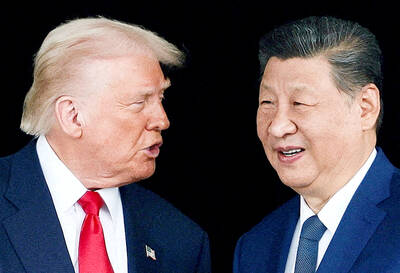
RIVALRY: ‘We know that these are merely symbolic investigations initiated by China, which is in fact the world’s most profligate disrupter of supply chains,’ a US official said China has started a pair of investigations into US trade practices, retaliating against similar probes by US President Donald Trump’s administration as the superpowers stake out positions before an expected presidential summit in May. The move, announced by the Chinese Ministry of Commerce on Friday, is a direct mirror of steps Trump took to revive his tariff agenda after the US Supreme Court last month struck down some of his duties. “China expresses its strong dissatisfaction and firm opposition to these actions,” a ministry spokesperson said in a statement, referring to the so-called Section 301 investigations initiated on March 11.


 RSS
RSS