


The Cuban government on Friday announced emergency measures to address a crippling energy crisis worsened by US sanctions, including the adoption of a four-day work week for state-owned companies and fuel sale restrictions.
Cuban Deputy Prime Minister Oscar Perez-Oliva Fraga blamed Washington for the crisis, telling Cuban television the government would “implement a series of decisions, first and foremost to guarantee the vitality of our country and essential services, without giving up on development.”
“Fuel will be used to protect essential services for the population and indispensable economic activities,” he said.
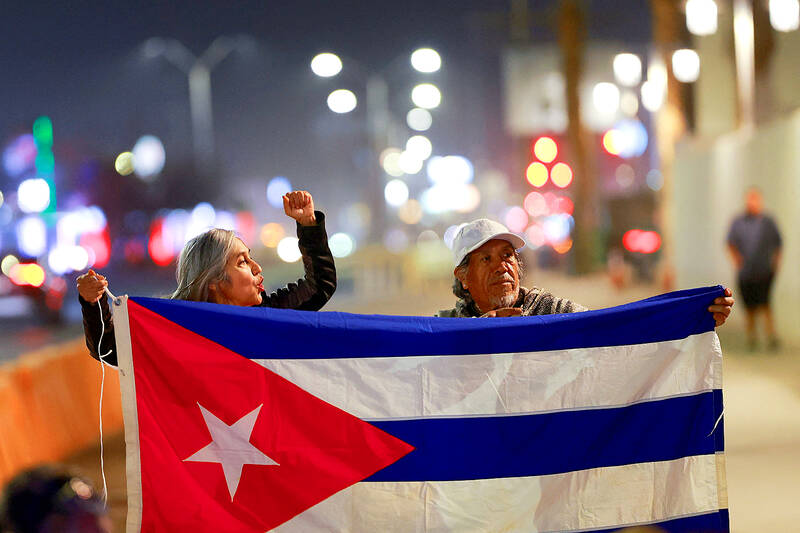
Photo: Reuters
Among the new measures are the reduction of the working week in state-owned companies to four days, from Monday to Thursday; restrictions on fuel sales; a reduction in bus and train services between provinces; and the closure of certain tourist establishments. School days would also be made shorter and universities would reduce the requirement of in-person attendance.
These measures are intended to save fuel to promote “food and electricity production,” and enable “the preservation of fundamental activities that generate foreign currency,” Fraga said.
Cuba has been mired in a severe economic crisis for six years and Washington has increased pressure on its government over the past few weeks.
The US cut off oil deliveries from Havana’s key ally, Venezuela, following its ouster of former Venezuelan president Nicolas Maduro last month.
US President Donald Trump also signed an executive order last week allowing his country to impose tariffs on countries selling oil to Havana.
Mexico, which has been supplying Cuba with oil since 2023, would stop doing so, Trump said.
The oil shortages have threatened to plunge Cuba into complete darkness, with power plants struggling to keep the lights on.
Washington has long sought to overthrow or weaken the communist-led Cuban government.
Havana accuses Trump of wanting to “strangle” the island’s economy, where power cuts and fuel shortages, already recurrent in recent years, have become even more acute.
Cuban President Miguel Diaz-Canel said his country was willing to hold talks with the US, but not under pressure.
Any talks must take place “from a position of equals, with respect for our sovereignty, our independence and our self-determination” and without “interference in our internal affairs,” he said.

SPEAKING OUT: After Siranudh Scott’s allegations surfaced, celebrities and public figures took to social media to share their own experiences of sexual misconduct and abuse A high-profile alleged sexual abuse case within a wealthy Thai beer brewing family has prompted a wave of painful accounts from survivors of unconnected abuse in the conservative nation. Siranudh Scott, a member of the billionaire Thai family that founded the ubiquitous Singha beer brand, posted an emotional video this month accusing his elder brother Sunit of repeatedly abusing him when he was a teenager. Sunit, who is in his 30s, later denied the allegations in a video posted online, but Singha parent Boonrawd dismissed him from his executive role with the company on Tuesday last week. “I felt I needed to speak

SEEKING ORDER: Rodrigo Paz said that ‘anyone who wants to destroy the nation will have to deal with this president and the full force of the constitution’ Bolivian President Rodrigo Paz on Wednesday said that the nation was at a “breaking point” after nearly a month of protests that have caused shortages of food, fuel and medicine. Paz, who took office six months ago amid the worst economic crisis there in four decades, is battling a groundswell of fury over his policies. The political capital, La Paz, has been besieged by low-income workers and members of the indigenous majority calling for his resignation. “The country needs order and is reaching breaking point,” the 58-year-old said at a public event in La Paz, renewing his appeal for dialogue. On Tuesday, the Bolivian

A Hong Kong astronaut is to join a Chinese space mission for the first time as part of a three-person crew launching today, as Beijing edges closer to its goal of landing people on the moon. The Tiangong space station — crewed by teams of three astronauts that are typically rotated every six months — is the crown jewel of China’s space program, boosted by billions in state investment in a bid to catch up with the US and Russia. The Shenzhou-23 mission is to blast off at 11:08pm from the Jiuquan Satellite Launch Center in northwestern China, carrying three astronauts to
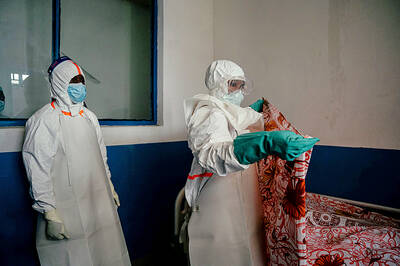
UPGRADED ALERT: The risk inside DR Congo is now considered ‘very high,’ while neighboring countries face a ‘high’ threat as the outbreak continues, the WHO said Ebola is spreading faster than responders can track it in eastern Congo, where health workers managed to follow up with barely one in five identified contacts in a single day. Authorities in the Democratic Republic of the Congo (DR Congo) reported 83 confirmed infections, 746 suspected cases and 1,603 identified contacts as of Thursday, but health workers were able to follow up on only 342 contacts that day — about 21 percent of the total under monitoring — data released by the DR Congo Ministry of Public Health on Friday showed. The figures suggest the response is falling behind the outbreak itself,


 RSS
RSS