


Architect Buse Ceren Gul is on a mission: Restore a 166-year-old Greek Orthodox church that was long a beacon of her hometown’s multicultural past. She believes restoring the church left mostly in ruins by the earthquakes in southern Turkey three years ago would help locals reconnect to their city.
The magnitude 7.8 earthquake on Feb. 6, 2023, and another hours later were among Turkey’s worst disasters. In Antakya, the quakes destroyed much of the historical town center.
After years of planning, campaigning and fundraising, Gul’s team recently uncovered St. Paul’s Church from the rubble that reached up to 5m.

Photo: AP
“The old city is central to the earliest memories of anyone who grew up here,” the 34-year-old Gul said. “’Have we vanished?’ I asked myself when I first saw the site in the aftermath of the quakes.”
The quakes destroyed or damaged hundreds of thousands of buildings in Turkey, leaving more than 53,000 people dead.
An estimated 10,000 Christians lived in Hatay Province before the earthquake, a tiny part of the overall population, but one of the largest Christian concentrations in Turkey outside Istanbul.
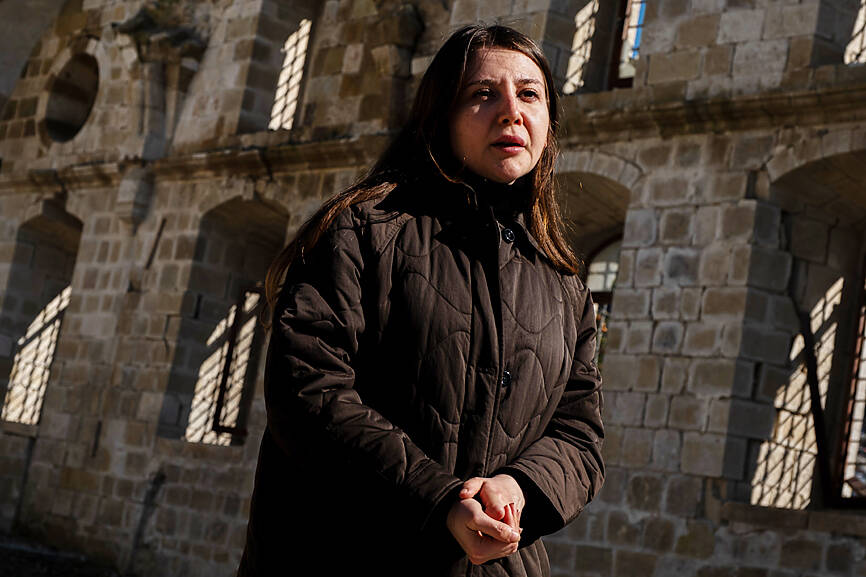
Photo: AP
Antakya was one of the hardest-hit cities, with the destruction threatening to erase one of its oldest streets, Saray Avenue, a hub for Christians, Muslims and Jews of different sects. The street is home to the Greek Orthodox St. Paul’s Church, which belongs to an Arabic-speaking community.
The neighborhood, like others in Antakya, has become “unrecognizable to its residents,” Gul said.
“But raising the old city on its feet might prove that Antakya’s roots can be preserved once again,” she added.
Gul was studying and working on the St. Paul’s Church’s renovation since before the earthquakes. Of the 293 cultural heritage sites damaged in the province, the church is among the few that already had approved architectural drawings, which Gul was drafting.
“When I was working on those plans, one of my mentors told me to draw in a way that the church can get rebuilt if it gets demolished,” Gul said. “I never thought this grand structure could actually be obliterated, but I drafted a point-by-point plan.”
After the quake, Gul secured the support of the World Monuments Fund, and with the fund’s technical and financial contributions, Gul’s team cleared tons of rubble and set aside the stones they recovered intact. The team continues project planning and technical assessments for the reconstruction stage, but the work on site has stalled until more funding arrives.
The main challenge for the Antioch Orthodox Christians is the return of people who once filled the St. Paul’s Church’s courtyard and the Saray Avenue district. With most houses in the historical city center still in ruins, the majority of the city’s Greek Orthodox community are displaced from their ancestral homes.
Fadi Hurigil, president of the Greek Orthodox Church Foundation of Antakya, which oversees the reconstruction project, said 370 to 400 families lived in central Antakya before the quakes, of whom only about 90 have returned.
Residents and community leaders who lived in the city for generations fear that the extended displacement would upend the long-established intercultural harmony that characterized Antakya.
“We grew up in Saray Avenue, now there is no Saray Avenue,” said Dimitri Dogum, a St. Paul’s Church official whose family lived in Antakya for the past 400 years. “So many people have left the city already and it could take another five years until Antakya recovers.”
Dogum, who is a Christian, said he fears his son and the children of his Sunni Muslim friends would not form the sort of friendships and interfaith dialogue he enjoyed when he spent long days of his boyhood playing on the street together.
“People are gone now,” said Dogum. “My fear is that we will lose the culture of living together.”

Young Chinese, many who fear age discrimination in their workplace after turning 35, are increasingly starting “one-person companies” that have artificial intelligence (AI) do most of the work. Smaller start-ups are already in vogue in Silicon Valley and elsewhere, with rapidly advancing AI tools seen as a welcome teammate even as they threaten layoffs at existing firms. More young people in China are subscribing to the model, as cities pledge millions of dollars in funding and rent subsidies for such ventures, in alignment with Beijing’s political goal of “technological self-reliance.” “The one-person company is a product of the AI era,” said Karen Dai

South Korea’s air force yesterday apologized for a 2021 midair collision involving two fighter jets, a day after auditors said the pilots were taking selfies and filming during the flight and held them responsible for the accident. “We sincerely apologize to the public for the concern caused by the accident that occurred in 2021,” an air force spokesman told a news conference, adding that one of the pilots involved had been suspended from flying duties, received severe disciplinary action and has since left the military. The apology followed a report released on Wednesday by the South Korean Board of Audit and Inspection,

About 240 Indians claiming descent from a Biblical tribe landed at Tel Aviv airport on Thursday as part of a government operation to relocate them to Israel. The newcomers passed under a balloon arch in blue and white, the colors of the Israeli flag, as dozens of well-wishers welcomed them with a traditional Jewish song. They were the first “bnei Menashe” (“sons of Manasseh”) to arrive in Israel since the government in November last year announced funding for the immigration of about 6,000 members of the community from the states of Manipur and Mizoram in northeast India. The community claims to descend from

‘TROUBLING’: The firing of Phelan, who was an adviser to a nonprofit that supported the defense of Taiwan, was another example of ‘dysfunction’ under Trump, a US senator said US Secretary of the Navy John Phelan has been fired, a US official and a person familiar with the matter said on Wednesday, in another wartime shakeup at the Pentagon coming just weeks after US Secretary of Defense Pete Hegseth ousted the Army’s top general. The Pentagon announced his departure in a brief statement, saying he was leaving the administration “effective immediately,” but it did not provide a reason or say whether it was his decision to go. The sources, who spoke on condition of anonymity, said Phelan was dismissed in part because he was moving too slowly to implement reforms to


 RSS
RSS