


China’s annual Spring Festival travel rush, a 40-day period commonly referred to as the world’s largest annual human migration, commenced yesterday ahead of an extended Lunar New Year holiday.
This year’s Lunar New Year, ushering in the Year of the Horse, falls on Feb. 17 and will be accompanied by an extra-long nine-day public holiday in China, running from Feb. 15 to 23.
It is hoped a longer holiday (last year’s break was eight days) might prompt Chinese consumers to boost consumption by spending more on travel and meals this festival period.
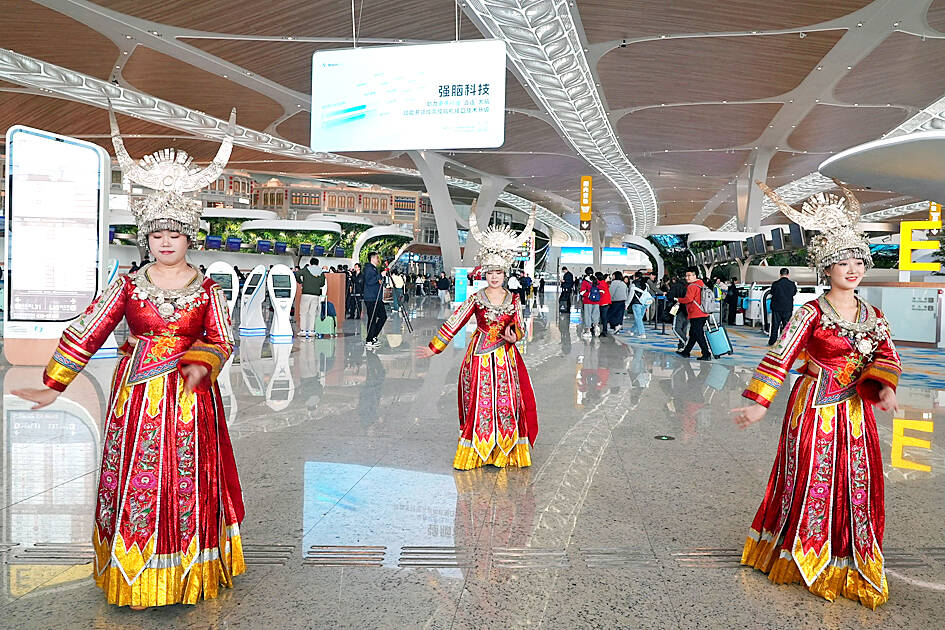
Photo: Reuters
Many Chinese consumers have been shaken by the nation’s uncertain economic outlook and would rather save than spend. Homeowners have seen their assets depreciate in a years-long property market slump, while weaker growth momentum since the COVID-19 pandemic has added to job insecurity.
That said, a state planning official last week said that China expects a record 9.5 billion passenger trips to be made during the period, surpassing the 9.02 billion trips made last year.
“Why do I feel it’s even more stressful to buy tickets this year compared with last year? For example, the flight back to my home is already sold out,” said 32-year-old Liu, a traveler flying out of Guangzhou airport yesterday. “If you don’t buy early, the price range fluctuates a lot, and can even double.”
Major travel platforms reported Lunar New Year bookings already surpassing last year’s levels. According to data from Flight Master, as of the middle of last month, bookings for domestic flights during the holiday exceeded 4.13 million, up about 21 percent year-on-year.
Popular outbound destinations are concentrated in Southeast Asia, with those flights accounting for nearly 50 percent of the total and Thailand among the leading destinations.
Following a geopolitical spat between China and Japan late last year, routes to Japan have dropped sharply, down more than 40 percent, according to Flight Master.
Domestically, culturally rich “intangible heritage towns,” such as such as Huangshan in Anhui Province, Jingdezhen in Jiangxi Province, Quanzhou in Fujian Province, Foshan in Guangdong Province and Zigong in Sichuan Province have emerged as popular destinations, online travel agency Qunar said.

Crowds in Bangladesh are flocking to snap photographs with an unlikely social media star — an albino buffalo with flowing blond hair nicknamed “Donald Trump” that is due to be sacrificed within days. Owner Zia Uddin Mridha, 38, said his brother named the 700kg bull over its flowing helmet of hair resembling the signature look of the US president. “My younger brother picked this name because of the buffalo’s extraordinary hair,” he said at his farm in Narayanganj, just outside the capital, Dhaka. Mridha said that a constant stream of curious visitors — social media fans, onlookers and children — have come throughout

It began as a satirical online project. Now millions of young people in India are flocking to it as an outlet for their frustration. A parody political party called the Cockroach Janta Party, with the insect as its symbol, has exploded across India’s social media by turning absurdist humor into protest. Memes and short videos mocking corruption, joblessness and political dysfunction have flooded social media sites, where millions of users are embracing the cockroach — known for its ability to survive harsh conditions — as a tongue-in-cheek symbol of endurance. The online movement’s rise has been unusually rapid. The Cockroach Janta Party (CJP)

HOTTER: While Indians are accustomed to summer heat, climate change has caused northwestern India to warm faster than other parts of the country, an academic said Roads and markets have emptied during afternoons and some farmers have switched to nighttime work to avoid scorching temperatures as a heat wave grips large parts of India. The India Meteorological Department forecast maximum temperatures for yesterday of about 45°C in the capital, New Delhi, where authorities have opened temporary “cooling zones” to help people cope. The weather department warned that conditions would likely persist across several northern regions in the coming days, with temperatures staying well above seasonal averages. Authorities urged people to stay indoors during the hottest hours and take precautions against heat-related illnesses. India declares a heat wave whenever maximum temperatures

A Hong Kong astronaut is to join a Chinese space mission for the first time as part of a three-person crew launching today, as Beijing edges closer to its goal of landing people on the moon. The Tiangong space station — crewed by teams of three astronauts that are typically rotated every six months — is the crown jewel of China’s space program, boosted by billions in state investment in a bid to catch up with the US and Russia. The Shenzhou-23 mission is to blast off at 11:08pm from the Jiuquan Satellite Launch Center in northwestern China, carrying three astronauts to


 RSS
RSS