


Separatists launched “coordinated” attacks across Pakistan’s Balochistan province on Saturday, killing at least 15 security personnel and 18 civilians, the military said — the latest violence in the insurgency-hit southwestern region.
Officials said 92 militants, including “three suicide bombers,” were also killed.
Pakistan has been battling a separatist insurgency in Balochistan for decades, with frequent attacks on security forces, foreign nationals and non-locals in the mineral-rich province bordering Afghanistan and Iran.
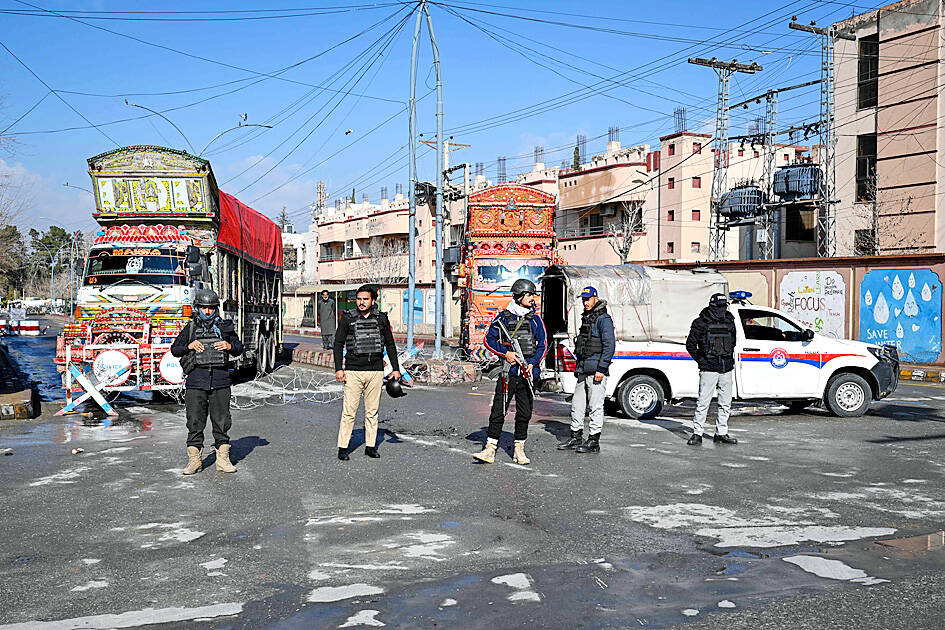
Photo: AF
The military’s media wing said in a statement that attacks had taken place in multiple locations including the provincial capital, Quetta, and Gwadar.
“Eighteen innocent civilians” and 15 security personnel were killed, the military’s media wing, ISPR, said in a statement, putting the death toll among the militants at 92.
The circumstances surrounding the deaths of the civilians were not immediately clear. Baloch separatists have previously targeted civilians believed to have collaborated with state agencies.
A senior military official in Islamabad said the attacks were “coordinated, but poorly executed,” adding that they had “failed due to poor planning and rapid collapse under effective security response.”
Pakistani Prime Minister Shehbaz Sharif praised security forces for “foiling” the attacks.
“We will continue the war against terrorism until its complete eradication,” he said in a statement, in which he accused India of backing the separatists.
Police officials in four districts earlier told reporters that the attacks were not yet completely under control.
In Quetta, Balochistan’s provincial capital, a reporter heard several explosions as heavy security was deployed across the city, with major roads deserted and businesses shut.
“Since morning, there have been explosions one after another,” Abdul Wali, 38, told reporters as he struggled to find blood for his hospitalized mother. “The police point guns at us and say ‘go back,’ otherwise they beat us. What should we do?”
A senior official in Quetta said that militants had abducted a deputy district commissioner.
A senior government official in another district said militants had “freed at least 30 inmates from a district jail, seizing firearms and ammunition. They also attacked a police station and took ammunition with them.”
Mobile phone services have been jammed and traffic disrupted in the affected districts, while train services have been suspended across the province.
The Baloch Liberation Army (BLA), the most active militant separatist group in the province, claimed responsibility for the attacks in a statement.
The group said it had targeted military installations and police and civil administration officials in gun attacks and suicide bombings.
It said major highways were blocked to disrupt military operations.
Several women were involved in the attacks, according to statements and videos released by the BLA.
Saturday’s attacks came a day after the military said it had killed 41 insurgents in two separate operations in the province.
“Over the past 12 months, security forces in Balochistan have sent more than 700 terrorists to hell, with around 70 terrorists eliminated in just the last two days alone,” Balochistan Chief Minister Sarfraz Bugti said. “These attacks cannot weaken our resolve against terrorism.”
Balochistan is Pakistan’s poorest province, despite an abundance of untapped natural resources, and lags behind the rest of the country in education, employment and economic development.
Baloch separatists have intensified attacks on Pakistanis from other provinces working in the region in recent years, as well as foreign energy firms that they believe are exploiting its riches.
The separatists attacked a train with 450 passengers on board last year, sparking a two-day siege during which dozens of people were killed.
In August 2024, militants blew up bridges, stormed hotels and targeted security installations in assaults across the province that killed dozens.

SPEAKING OUT: After Siranudh Scott’s allegations surfaced, celebrities and public figures took to social media to share their own experiences of sexual misconduct and abuse A high-profile alleged sexual abuse case within a wealthy Thai beer brewing family has prompted a wave of painful accounts from survivors of unconnected abuse in the conservative nation. Siranudh Scott, a member of the billionaire Thai family that founded the ubiquitous Singha beer brand, posted an emotional video this month accusing his elder brother Sunit of repeatedly abusing him when he was a teenager. Sunit, who is in his 30s, later denied the allegations in a video posted online, but Singha parent Boonrawd dismissed him from his executive role with the company on Tuesday last week. “I felt I needed to speak

A Hong Kong astronaut is to join a Chinese space mission for the first time as part of a three-person crew launching today, as Beijing edges closer to its goal of landing people on the moon. The Tiangong space station — crewed by teams of three astronauts that are typically rotated every six months — is the crown jewel of China’s space program, boosted by billions in state investment in a bid to catch up with the US and Russia. The Shenzhou-23 mission is to blast off at 11:08pm from the Jiuquan Satellite Launch Center in northwestern China, carrying three astronauts to
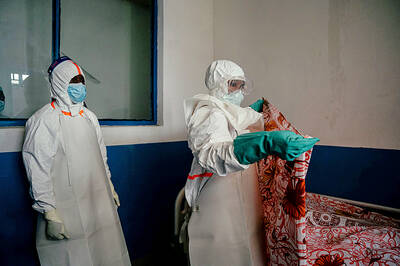
UPGRADED ALERT: The risk inside DR Congo is now considered ‘very high,’ while neighboring countries face a ‘high’ threat as the outbreak continues, the WHO said Ebola is spreading faster than responders can track it in eastern Congo, where health workers managed to follow up with barely one in five identified contacts in a single day. Authorities in the Democratic Republic of the Congo (DR Congo) reported 83 confirmed infections, 746 suspected cases and 1,603 identified contacts as of Thursday, but health workers were able to follow up on only 342 contacts that day — about 21 percent of the total under monitoring — data released by the DR Congo Ministry of Public Health on Friday showed. The figures suggest the response is falling behind the outbreak itself,

SEEKING ORDER: Rodrigo Paz said that ‘anyone who wants to destroy the nation will have to deal with this president and the full force of the constitution’ Bolivian President Rodrigo Paz on Wednesday said that the nation was at a “breaking point” after nearly a month of protests that have caused shortages of food, fuel and medicine. Paz, who took office six months ago amid the worst economic crisis there in four decades, is battling a groundswell of fury over his policies. The political capital, La Paz, has been besieged by low-income workers and members of the indigenous majority calling for his resignation. “The country needs order and is reaching breaking point,” the 58-year-old said at a public event in La Paz, renewing his appeal for dialogue. On Tuesday, the Bolivian


 RSS
RSS