


A landslide earlier this week collapsed several mines at a major coltan mining site in the Democratic Republic of the Congo (DR Congo), leaving at least 200 people dead, rebel authorities said yesterday.
The collapse took place on Wednesday at the Rubaya mines, which are controlled by the M23 rebels, said Lumumba Kambere Muyisa, the spokesperson of the rebel-appointed governor of North Kivu Province.
The landslide was caused by heavy rains, he said.
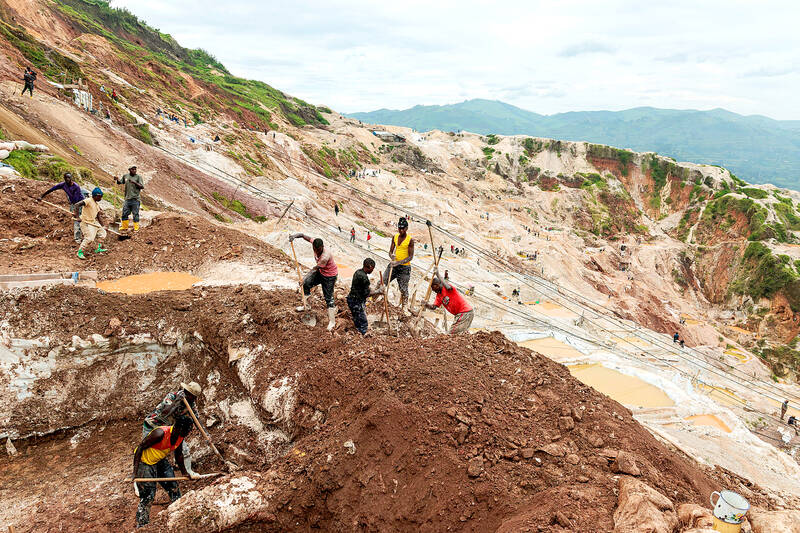
Photo: Reuters
“For now, there are more than 200 dead, some of whom are still in the mud and have not yet been recovered,” Muyisa said.
Several others were injured and taken to three health facilities in Rubaya, and ambulances were expected to transfer the wounded yesterday to Goma, the nearest city about 50km away, he added.
Artisanal mining on the side has been temporarily halted and residents who built shelters near the mine are to be relocated, Muyisa said.
A former miner at the site said there have been repeated landslides because the tunnels are dug by hand, poorly constructed and left without maintenance, he said.
“People dig everywhere, without control or safety measures. In a single pit, there can be as many as 500 miners, and because the tunnels run parallel, one collapse can affect many pits at once,” Clovis Mafare said.
DR Congo is a major supplier of coltan, a black metallic ore that contains the rare metal tantalum, a key component in the production of smartphones, computers and aircraft engines.
The country produced about 40 percent of the world’s coltan in 2023, according to the US Geological Survey, with Australia, Canada and Brazil being other big suppliers.
More than 15 percent of the world’s supply of tantalum come from Rubaya’s mines.
In May 2024, the M23 seized the town and took control of its mines.
A UN report said that since seizing Rubaya, the rebels have imposed taxes on the trade and transport of coltan, generating at least US$800,000 a month.
Eastern DR Congo has been in and out of crisis for decades. Various conflicts have created one of the world’s largest humanitarian crises, with more than 7 million people displaced, including 100,000 who fled homes this year.

ROCKY RELATIONS: The figures on residents come as Chinese tourist numbers drop following Beijing’s warnings to avoid traveling to Japan The number of Chinese residents in Japan has continued to rise, even as ties between the two countries have become increasingly fractious, data released on Friday showed. As of the end of December last year, the number of Chinese residents had increased by 6.5 percent from the previous year to 930,428. Chinese people accounted for 22.6 percent of all foreign residents in Japan, making them by far the largest group, Japanese Ministry of Justice data showed. Beijing has criticized Tokyo in increasingly strident terms since Japanese Prime Minister Sanae Takaichi last year suggested that a military conflict around Taiwan could

Germany is considering Australia’s Ghost Bat robot fighter as it looks to select a combat drone to modernize its air force, German Minister of Defense Boris Pistorius said yesterday. Germany has said it wants to field hundreds of uncrewed fighter jets by 2029, and would make a decision soon as it considers a range of German, European and US projects developing so-called “collaborative combat aircraft.” Australia has said it will integrate the Ghost Bat, jointly developed by Boeing Australia and the Royal Australian Air Force, into its military after a successful weapons test last year. After inspecting the Ghost Bat in Queensland yesterday,
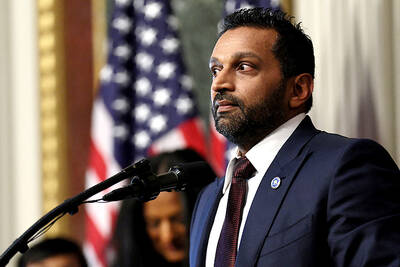
A pro-Iran hacking group claimed to breach FBI Director Kash Patel’s personal e-mail inbox and posted some of the contents online. The e-mails provided by the hacking group include travel details, correspondence with leasing agents in Washington and global entry, and loyalty account numbers. The e-mail address the hackers claim to have compromised has been previously tied to Patel’s personal details, and the leaked e-mails contain photos of Patel and others, in addition to correspondence with family members and colleagues. “The FBI is aware of malicious actors targeting Director Patel’s personal email information,” the agency said in a statement on
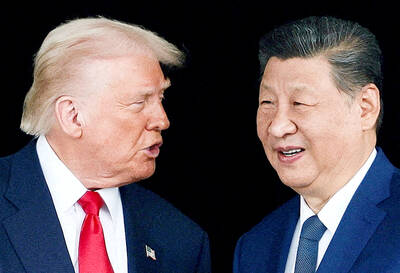
RIVALRY: ‘We know that these are merely symbolic investigations initiated by China, which is in fact the world’s most profligate disrupter of supply chains,’ a US official said China has started a pair of investigations into US trade practices, retaliating against similar probes by US President Donald Trump’s administration as the superpowers stake out positions before an expected presidential summit in May. The move, announced by the Chinese Ministry of Commerce on Friday, is a direct mirror of steps Trump took to revive his tariff agenda after the US Supreme Court last month struck down some of his duties. “China expresses its strong dissatisfaction and firm opposition to these actions,” a ministry spokesperson said in a statement, referring to the so-called Section 301 investigations initiated on March 11.


 RSS
RSS