


Two giants stared each other down before colliding with a dull thud. After years on the sidelines, sumo is back center stage as part of Japan’s soft power arsenal overseas.
Behind the scenes at the New Year Grand Sumo Tournament that ended on Sunday last week in Tokyo, preparations were already being made for a tour of Paris in June, following a stop in London last year.
The last time sumo wrestlers traveled to France was in 1995, when such tours were common, but they have become something of a rarity in recent years.
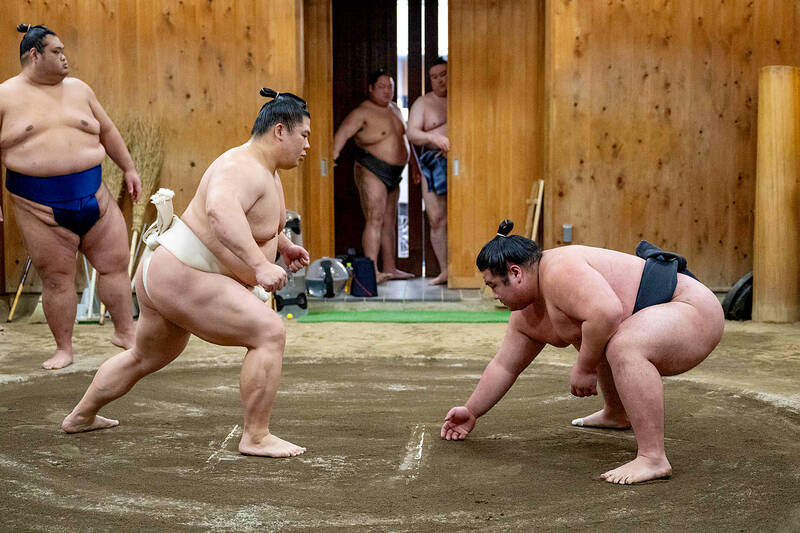
Photo: AFP
Before last year’s visit to London’s Royal Albert Hall, the previous time the Japan Sumo Association (JSA) held a tournament overseas was in Las Vegas in 2005.
Using the hulking wrestlers as ambassadors is a long-established practice.
As early as 1854, they displayed their strength before Commodore Matthew Perry, sent by the US to secure Japan’s diplomatic and commercial opening after two centuries of isolation.
In his journal, Perry described the performance as “barbaric,” performed by wrestlers “more like bulls than humans.”
Perry “observed everything about Japan from a position of almost total ignorance of the country,” Penn State University Asian studies professor Jessamyn Abel said.
Today, by contrast, “for a spectator who already thinks Japan is ‘cool’, sumo just reinforces” that idea, she added.
Japan has understood this well, Waseda University School of Sport Sciences associate professor Kosuke Takata said.
“Government agencies for sport and tourism are seeking to promote ‘martial arts tourism,’ not only sumo, but also kendo and karate,” he said.
Such tours continued throughout the 20th century in the US, Europe, the Soviet Union and China, complementing Japanese diplomacy during the Cold War.
In 1973, wrestlers traveled to Beijing to celebrate the previous year’s establishment of diplomatic relations between Japan and Mao Zedong’s (毛澤東) China.
China, in turn, exercised its “panda diplomacy” by sending two bears to Tokyo.
With relations now at a low point — Japan’s last two pandas returned to China on Tuesday — a sumo tour would no longer have the same impact, University of Vermont history professor Erik Esselstrom said.
At the time, China “was relatively weak and Japan quite strong” economically, and the two countries were “in a moment of rediscovery,” he said.
Overseas trips became rare over the past two decades as the sumo association refocused on its domestic audiences while the sport’s popularity waned, partly due to a series of scandals.
Yasutoshi Nakadachi, a former wrestler and organizer of the Paris trip, said the JSA was in a “complicated situation,” and also had a lack of interest from foreign countries.
The context is now very different, with Japan welcoming a record number of tourists last year.
Overseas visitors are increasingly eager to see sumo, and tournaments in Japan are regularly sold out.
David Rothschild, promoter of the Paris tournament, recalled approaching the sumo association about 10 years ago, but received no response until 2023.
“After many exchanges, everything sped up: In a month we had practically done everything,” he said.
The JSA’s requirement?
“Sumo must always be considered a tradition. It’s not just a sport and it’s not entertainment,” Rothschild said. “In every discussion they wanted to make sure I wouldn’t do anything inappropriate, that I would be respectful.”
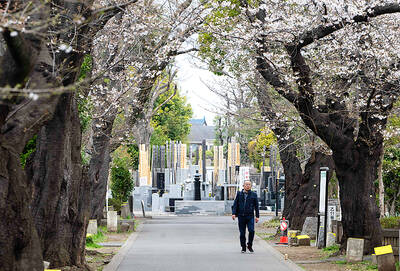
ROCKY RELATIONS: The figures on residents come as Chinese tourist numbers drop following Beijing’s warnings to avoid traveling to Japan The number of Chinese residents in Japan has continued to rise, even as ties between the two countries have become increasingly fractious, data released on Friday showed. As of the end of December last year, the number of Chinese residents had increased by 6.5 percent from the previous year to 930,428. Chinese people accounted for 22.6 percent of all foreign residents in Japan, making them by far the largest group, Japanese Ministry of Justice data showed. Beijing has criticized Tokyo in increasingly strident terms since Japanese Prime Minister Sanae Takaichi last year suggested that a military conflict around Taiwan could

Germany is considering Australia’s Ghost Bat robot fighter as it looks to select a combat drone to modernize its air force, German Minister of Defense Boris Pistorius said yesterday. Germany has said it wants to field hundreds of uncrewed fighter jets by 2029, and would make a decision soon as it considers a range of German, European and US projects developing so-called “collaborative combat aircraft.” Australia has said it will integrate the Ghost Bat, jointly developed by Boeing Australia and the Royal Australian Air Force, into its military after a successful weapons test last year. After inspecting the Ghost Bat in Queensland yesterday,
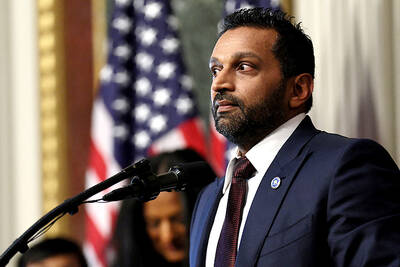
A pro-Iran hacking group claimed to breach FBI Director Kash Patel’s personal e-mail inbox and posted some of the contents online. The e-mails provided by the hacking group include travel details, correspondence with leasing agents in Washington and global entry, and loyalty account numbers. The e-mail address the hackers claim to have compromised has been previously tied to Patel’s personal details, and the leaked e-mails contain photos of Patel and others, in addition to correspondence with family members and colleagues. “The FBI is aware of malicious actors targeting Director Patel’s personal email information,” the agency said in a statement on
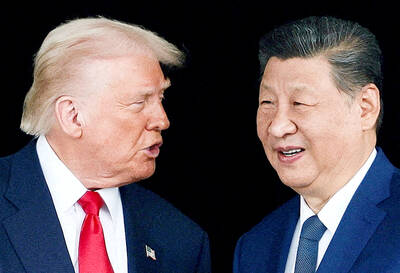
RIVALRY: ‘We know that these are merely symbolic investigations initiated by China, which is in fact the world’s most profligate disrupter of supply chains,’ a US official said China has started a pair of investigations into US trade practices, retaliating against similar probes by US President Donald Trump’s administration as the superpowers stake out positions before an expected presidential summit in May. The move, announced by the Chinese Ministry of Commerce on Friday, is a direct mirror of steps Trump took to revive his tariff agenda after the US Supreme Court last month struck down some of his duties. “China expresses its strong dissatisfaction and firm opposition to these actions,” a ministry spokesperson said in a statement, referring to the so-called Section 301 investigations initiated on March 11.


 RSS
RSS