


The leadership of CBS News was on Monday facing accusations of political meddling over a last-minute decision to not air a report on the notorious Salvadoran prison where US President Donald Trump has sent deported migrants.
CBS had been due to air the investigation late on Sunday about alleged abuses at the Terrorism Containment Center (CECOT) in El Salvador on its flagship 60 Minutes program, seen by many as one of the most prestigious and hard-hitting institutions in US journalism.
However, the broadcaster quietly announced hours before showtime that the segment would “air in a future broadcast,” replacing it with a piece on the sherpas working on Mount Everest.
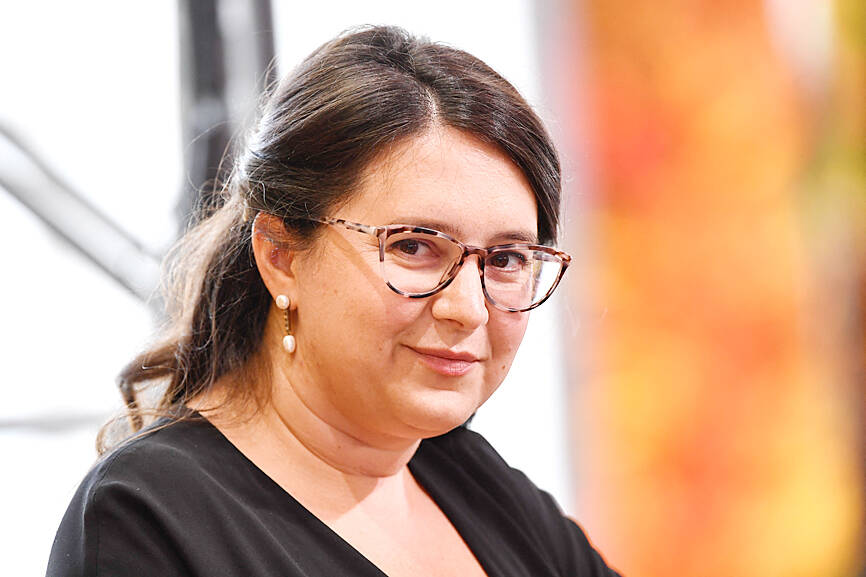
Photo: AFP
A 13-minute video about CECOT bearing the 60 Minutes logo was widely circulated on social media platforms X and Reddit late on Monday after the segment was reportedly aired on Canadian station Global TV.
The segment being circulated, titled: “Inside Cecot,” featured Sharyn Alfonsi as correspondent and listed Oriana Zill de Granados as producer.
CBS, which was purchased by the Trump-linked Ellison family earlier this year, said that the prison report needed “additional reporting.”
Multiple US media outlets quoted the 60 Minutes correspondent who oversaw the report as saying it had been pulled for political reasons.
“Pulling it now, after every rigorous internal check has been met, is not an editorial decision, it is a political one,” Alfonsi said in a note to CBS staff that was first leaked by the Wall Street Journal.
CECOT is a huge, maximum security facility touted by Salvadoran President Nayib Bukele as the centerpiece of his attempt to rid the Central American country of narco-gangs.
Human rights activists say inmates there are treated brutally.
The facility has been at the center of a major US legal case since March, when the Trump administration sent hundreds of Venezuelan and other migrants there despite a judge’s order that they be returned to the US.
Several deportees who have since been released have described repeated abuse at the facility.
CBS’ decision to shelve a high-profile story on the Trump administration comes as the broadcaster’s parent company, Paramount Skydance, is in a multibillion-dollar bidding war with Netflix to buy Warner Bros Discovery.
Trump has made clear he is taking a keen interest in the merger, which would likely need regulatory approval.
Paramount was purchased by the Ellison family earlier this year. Larry Ellison is one of the world’s richest people and a major Trump donor.
The Republican president has frequently criticized 60 Minutes and sued CBS last year over his claim that the news program had edited an interview with then-Democratic presidential candidate and US vice president Kamala Harris to help her.
Paramount chief David Ellison — son of Larry Ellison — in October brought in Bari Weiss as a new editor in chief, leading to expectations that she would steer the renowned broadcaster to be more friendly to Trump.
In her note to colleagues, Alfonsi said the CECOT segment had been cleared by corporate lawyers before being “spiked.”
“If the administration’s refusal to participate becomes a valid reason to spike a story, we have effectively handed them a ‘kill switch’ for any reporting they find inconvenient,” she said.
Weiss told the New York Times in a statement that she would be “airing this important piece when it’s ready.”
“Holding stories that aren’t ready for whatever reason — that they lack sufficient context, say, or that they are missing critical voices — happens every day in every newsroom,” Weiss said.
The executive producer of 60 Minutes, Tanya Simon, told fellow employees that she had resisted Weiss’ order, but “ultimately had to comply.”
“We pushed back, we defended our story, but she wanted changes,” Simon was quoted as saying by the Washington Post in a transcript of the producer’s private meeting with colleagues.

An American scientist convicted of lying to US authorities about payments from China while he was at Harvard University has rebuilt his research lab in Shenzhen, China, to pursue technology the Chinese government has identified as a national priority: embedding electronics into the human brain. Charles Lieber, 67, is among the world’s leading researchers in brain-computer interfaces. The technology has shown promise in treating conditions such as amyotrophic lateral sclerosis and restoring movement in paralyzed people. It also has potential military applications: Scientists at the Chinese People’s Liberation Army have investigated brain interfaces as a way to engineer super soldiers by boosting

Indonesian police have arrested 13 people after shocking images of alleged abuse against small children at a daycare center went viral, sparking outrage across the nation, officials said on Monday. Police on Friday last week raided Little Aresha, a daycare center in Yogyakarta on Java island, following a report from a former employee. CCTV footage circulating on social media showed children, most younger than two, lying on the floor wearing only diapers, their hands and feet bound with rags. The police have confirmed that the footage is authentic. Police said they also found 20 children crammed into a room just 3m by 3m. “So
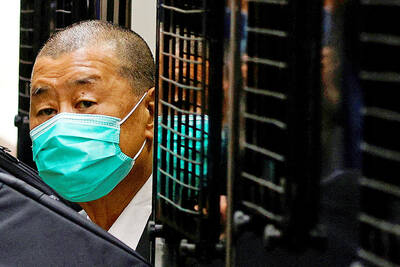
Jailed media entrepreneur Jimmy Lai (黎智英) has been awarded Deutsche Welle’s (DW) freedom of speech award for his contribution to Hong Kong’s pro-democracy movement. The German public broadcaster on Thursday said Lai would be presented in absentia with the 12th iteration of the award on June 23 at the DW Global Media Forum in Bonn. Deutsche Welle director-general Barbara Massing praised the 78-year-old founder of the now-shuttered news outlet Apple Daily for standing “unwaveringly for press freedom in Hong Kong at great personal risk.” “With Apple Daily, he gave journalists a platform for free reporting and a voice to the democracy movement in

PHILIPPINE COMMITTEE: The head of the committee that made the decision said: ‘If there is nothing to hide, there is no reason to hide, there is no reason to obstruct’ A Philippine congressional committee on Wednesday ruled that there was “probable cause” to impeach Philippine Vice President Sara Duterte after hearing allegations of unexplained wealth, misuse of state funds and threats to have the president assassinated. The unanimous decision of the 53-member committee in the Philippine House of Representatives sends the two impeachment complaints to deliberations and voting by the entire lower chamber, which has more than 300 lawmakers. The complaints centered on Duterte’s alleged illegal use and mishandling of intelligence funds from the vice president’s office, and from her time as education secretary under Philippine President Ferdinand Marcos Jr. Duterte and the


 RSS
RSS