


A glittering exhibition of royal jewels opened in Paris yesterday even as the city reels from the brazen crown-jewel heist at the nearby Louvre.
The four-minute operation in October emptied cases in the Louvre’s Apollo Gallery, forced its closure and rattled public confidence in France’s cultural security.
With the plundered gallery still sealed off, another museum nearby is showcasing diamonds and tiaras that endured revolutions, exile and empire: treasures that have escaped the type of plunder now afflicting the Louvre’s own jewels.
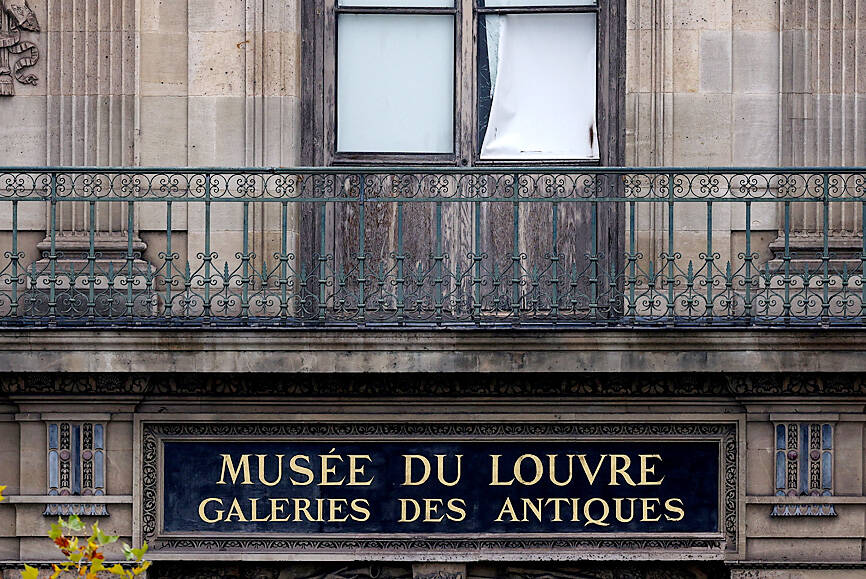
Photo: Reuters
The “Dynastic Jewels” exhibition at the Hotel de la Marine — itself the site of an infamous 1792 crown-jewel theft — opened at a moment of national sensitivity.
Spread across four galleries, the exhibition unfurls more than a hundred pieces that dazzle in sparkle and scale. Its objects are drawn from the Al Thani Collection, the Victoria and Albert Museum, and major lenders including Britain’s King Charles III, the Duke of Fife, Cartier, Chaumet and France’s own national collections.
Some of the most striking loans include the giant 57-carat Star of Golconda diamond; a sapphire coronet and emerald tiara designed by Britain’s Prince Albert for Queen Victoria, reunited for the first time in more than 150 years; and Catherine the Great’s diamond-encrusted dress ornaments.
A Cartier necklace created for an Indian ruler blends European platinum-age design with centuries-old gems.
Curators did not comment on details of operational security, but the Hotel de la Marine said that it was rebuilt with modern, high-grade security when it reopened in 2021, and that its galleries were conceived with robust protections in mind.
The museum did not say whether any measures had been boosted in response to the Louvre heist.
Still, the latest exhibition unfolds at a moment when Paris is urgently tightening museum protections.
Last month, Louvre director Laurence des Cars announced that about 100 new surveillance cameras and upgraded anti-intrusion systems would be installed, with the first measures rolled out in weeks and the full network expected by the end of next year.
The Louvre investigation remains active and none of the stolen pieces have been recovered.
With the Apollo Gallery closed, the Hotel de la Marine is suddenly poised to become a prime stop for jewel-lovers — an unfortunate coincidence, or unexpected advantage — a place where visitors shut out of the Louvre’s Crown Jewels displays might naturally gravitate.
“We show how great gemstones, tiaras and objects of virtuosity reflected identity in the 18th, 19th and 20th centuries,” said Amin Jaffer, director of the Al Thani Collection and one of the exhibition’s curators. “They were expressions of power, reflections of prestige and markers of passion.”
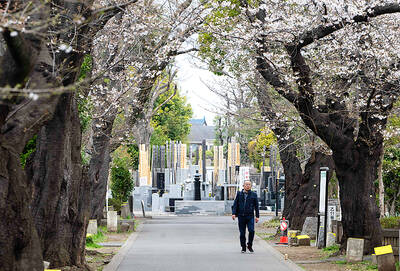
ROCKY RELATIONS: The figures on residents come as Chinese tourist numbers drop following Beijing’s warnings to avoid traveling to Japan The number of Chinese residents in Japan has continued to rise, even as ties between the two countries have become increasingly fractious, data released on Friday showed. As of the end of December last year, the number of Chinese residents had increased by 6.5 percent from the previous year to 930,428. Chinese people accounted for 22.6 percent of all foreign residents in Japan, making them by far the largest group, Japanese Ministry of Justice data showed. Beijing has criticized Tokyo in increasingly strident terms since Japanese Prime Minister Sanae Takaichi last year suggested that a military conflict around Taiwan could

A retired US colonel behind a privately financed rocket launch site in the Dominican Republic sees the project as a response to China’s dominance of the space race in Latin America. Florida-based Launch on Demand is slated to begin building a US$600 million facility in a remote region near the border with Haiti late this year. The project is designed to meet surging demand for the heavy-lift rockets needed to put clusters of satellites into orbit. It is also an answer to China’s growing presence in the region, said CEO Burton Catledge, a former commander of the US Air Force’s 45th Operations

Germany is considering Australia’s Ghost Bat robot fighter as it looks to select a combat drone to modernize its air force, German Minister of Defense Boris Pistorius said yesterday. Germany has said it wants to field hundreds of uncrewed fighter jets by 2029, and would make a decision soon as it considers a range of German, European and US projects developing so-called “collaborative combat aircraft.” Australia has said it will integrate the Ghost Bat, jointly developed by Boeing Australia and the Royal Australian Air Force, into its military after a successful weapons test last year. After inspecting the Ghost Bat in Queensland yesterday,
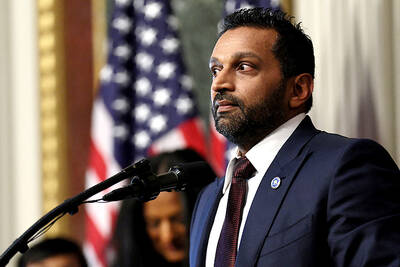
A pro-Iran hacking group claimed to breach FBI Director Kash Patel’s personal e-mail inbox and posted some of the contents online. The e-mails provided by the hacking group include travel details, correspondence with leasing agents in Washington and global entry, and loyalty account numbers. The e-mail address the hackers claim to have compromised has been previously tied to Patel’s personal details, and the leaked e-mails contain photos of Patel and others, in addition to correspondence with family members and colleagues. “The FBI is aware of malicious actors targeting Director Patel’s personal email information,” the agency said in a statement on


 RSS
RSS