


India has ordered smartphone makers to pre-install a government-run cybersecurity app that cannot be removed, a move that has raised concerns about users’ privacy.
The nation has 1.16 billion mobile phone users, according to government data from last year, and authorities say the app would better protect them from fraud.
Late on Monday, New Delhi gave manufacturers 90 days to comply with new rules, saying the app, Sanchar Saathi — meaning communication partner in Hindi — must be “pre-installed on all mobile handsets manufactured or imported for use in India.”
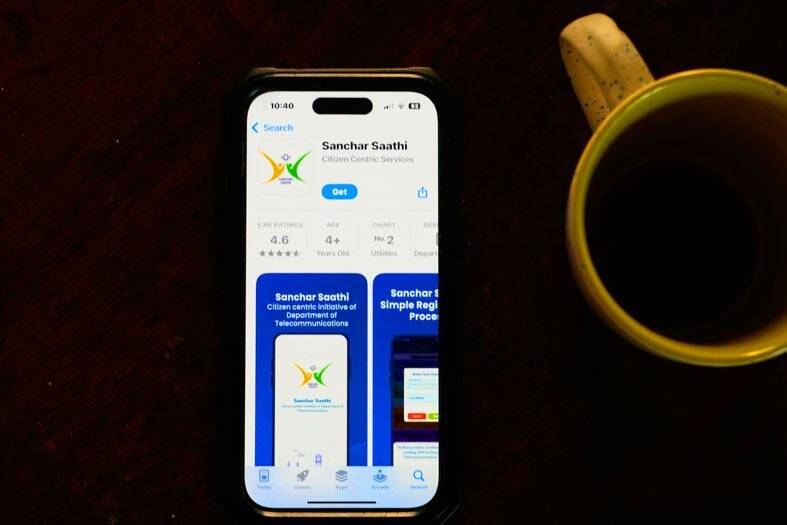
Photo: AP
The order, detailed in a press release, also asked phone makers to ensure the app was “readily visible and accessible to the end users at the time of first use or device setup and that its functionalities are not disabled or restricted.”
The government said the app was designed to allow users to block and track lost or stolen phones. It also lets them identify and disconnect fake mobile subscriptions made in their name, among other functions.
Government figures show the app has already helped trace more than 2.6 million phones. However, rights advocates and politicians have sounded the alarm over potentially serious consequences.
Advocacy group Internet Freedom Foundation yesterday said it was concerned about the new directive.
The order “represents a sharp and deeply worrying expansion of executive control over personal digital devices,” it said in a statement on X.
“The state is asking every smartphone user in India to accept an open-ended, updatable surveillance capability on their primary personal device, and to do so without the basic guardrails that a constitutional democracy should insist on,” the foundation said.
For devices that have already been manufactured and exist in the market across the country, the government mandated that “the manufacturer and importers of mobile handsets shall make an endeavour to push the App through software updates.”
Cybersecurity analyst Nikhil Pahwa said the rules were “clearly” an invasion of privacy.
“How do we know this app isn’t used to access files and messaging on our device, which is unencrypted on device? Or a future update won’t do that?” he wrote on X.
“This is clearly an invasion of our privacy,” he added.
Indian Prime Minister Narendra Modi’s opponents in the Congress party demanded an immediate rollback of the order, calling the move unconstitutional.
“Big Brother cannot watch us,” Congress politician KC Venugopal wrote on X.
“A pre-loaded government app that cannot be uninstalled is a dystopian tool to monitor every Indian,” he added.
“It is a means to watch over every movement, interaction and decision of each citizen,” he said.
In August, Russia issued a similar directive ordering manufacturers to include a new messaging platform called Max on all new phones and tablets, but rights advocates warned the app could be used as a powerful surveillance tool.

SPEAKING OUT: After Siranudh Scott’s allegations surfaced, celebrities and public figures took to social media to share their own experiences of sexual misconduct and abuse A high-profile alleged sexual abuse case within a wealthy Thai beer brewing family has prompted a wave of painful accounts from survivors of unconnected abuse in the conservative nation. Siranudh Scott, a member of the billionaire Thai family that founded the ubiquitous Singha beer brand, posted an emotional video this month accusing his elder brother Sunit of repeatedly abusing him when he was a teenager. Sunit, who is in his 30s, later denied the allegations in a video posted online, but Singha parent Boonrawd dismissed him from his executive role with the company on Tuesday last week. “I felt I needed to speak

A Hong Kong astronaut is to join a Chinese space mission for the first time as part of a three-person crew launching today, as Beijing edges closer to its goal of landing people on the moon. The Tiangong space station — crewed by teams of three astronauts that are typically rotated every six months — is the crown jewel of China’s space program, boosted by billions in state investment in a bid to catch up with the US and Russia. The Shenzhou-23 mission is to blast off at 11:08pm from the Jiuquan Satellite Launch Center in northwestern China, carrying three astronauts to
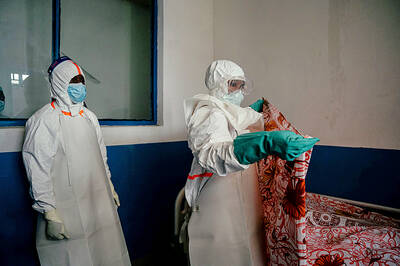
UPGRADED ALERT: The risk inside DR Congo is now considered ‘very high,’ while neighboring countries face a ‘high’ threat as the outbreak continues, the WHO said Ebola is spreading faster than responders can track it in eastern Congo, where health workers managed to follow up with barely one in five identified contacts in a single day. Authorities in the Democratic Republic of the Congo (DR Congo) reported 83 confirmed infections, 746 suspected cases and 1,603 identified contacts as of Thursday, but health workers were able to follow up on only 342 contacts that day — about 21 percent of the total under monitoring — data released by the DR Congo Ministry of Public Health on Friday showed. The figures suggest the response is falling behind the outbreak itself,

SEEKING ORDER: Rodrigo Paz said that ‘anyone who wants to destroy the nation will have to deal with this president and the full force of the constitution’ Bolivian President Rodrigo Paz on Wednesday said that the nation was at a “breaking point” after nearly a month of protests that have caused shortages of food, fuel and medicine. Paz, who took office six months ago amid the worst economic crisis there in four decades, is battling a groundswell of fury over his policies. The political capital, La Paz, has been besieged by low-income workers and members of the indigenous majority calling for his resignation. “The country needs order and is reaching breaking point,” the 58-year-old said at a public event in La Paz, renewing his appeal for dialogue. On Tuesday, the Bolivian


 RSS
RSS