


The new military leader of Guinea-Bissau appointed an ally of the ousted president as prime minister on Friday, as international criticism grew of this week’s coup.
The military took “total control” of the west African country on Wednesday — a day before the provisional results of national elections were due to be announced — and Guinea-Bissau President Umaro Sissoco Embalo took refuge in neighboring Senegal.
The true motives for the coup, the fifth Guinea-Bissau has suffered in 45 years, remain unclear.
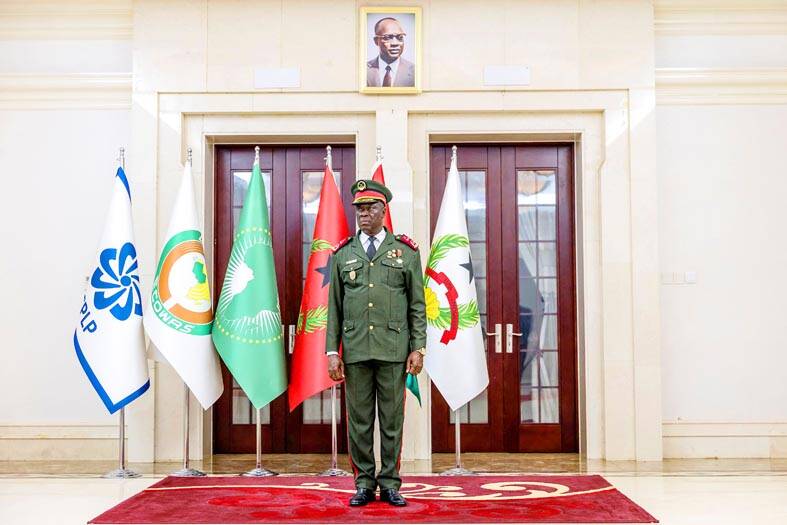
Photo: AFP
On Friday, the country’s new military leader, General Horta N’Tam, named as his prime minister Ilidio Vieira Te, the finance minister in Embalo’s government.
N’Tam, who has been appointed to run the small, volatile country for a one-year transitional period, is also seen as an ally of Embalo’s.
The people of Guinea-Bissau “expect a lot” of their new leaders, he told Te during a brief swearing-in ceremony, saying he hoped the junta and the new prime minister would “continue to work hand-in-hand.”
Outside the country, international condemnation of the coup continued to mount.
The African Union on Friday said it was suspending Guinea-Bissau “with immediate effect,” shortly after the Economic Community of West African States (ECOWAS) froze Guinea-Bissau out of “all decision-making bodies.”
UN Secretary-General Antonio Guterres condemned the military’s “unacceptable violation of democratic principles,” while the EU urged “a swift return to the constitutional order and the resumption of the electoral process.”
In Dakar, Senegalese Prime Minister Ousmane Sonko on Friday said he thought the coup was a stitch-up, echoing suspicions voiced by political analysts.
“Everyone knows that what happened in Guinea-Bissau was a scam,” Sonko told the Senegalese parliament in Dakar, without elaborating.
Opposition candidate Fernando Dias da Costa on Thursday said he believed he had beaten Embalo in last Sunday’s presidential election.
He alleged that Embalo, who also claimed victory, had “organized” the power grab to prevent him from taking office.
Former Nigerian president Goodluck Jonathan, who was part of a delegation observing the elections, also voiced doubt about the veracity of the coup.
“For want of a better word I would say maybe it was a ceremonial coup,” he told Nigerian media.
Jonathan said it was “strange” that “Embalo, while the coup took place was using his phone and addressing media organizations across the world that he has been arrested.”
“How does this happen, who is fooling who?” he asked.
A west African analyst said the coup was “the ideal scenario for Mr Embalo.”
It could allow the ousted president to “potentially reposition himself for the next elections,” the analyst said on condition of anonymity.
Other political researchers say a high-level turf war to control illegal drug smuggling networks might have also played a part in Guinea-Bissau’s instability.
General Denis N’Canha, head of the presidential military office, alluded to the trafficking on Thursday when he said a plan involving “drug lords” had been uncovered, including “the introduction of weapons into the country to alter the constitutional order.”
Crippling poverty, chaotic administration and political tumult have made Guinea-Bissau a fertile ground for corruption and drug smuggling.
It is a key transit point for Latin American cocaine destined for Europe to the point that some analysts have dubbed it a “narco-state.”
Senior politicians and military brass are suspected of implication in the illicit hard drugs trade.
Sandwiched between Senegal and Guinea, Guinea-Bissau had already undergone four coups and a host of attempted takeovers since its independence from Portugal in 1974. Among the world’s poorest countries, it has now joined the list of states suspended from the African Union following coups, alongside Burkina Faso, Mali, Madagascar, Niger and Sudan.

An American scientist convicted of lying to US authorities about payments from China while he was at Harvard University has rebuilt his research lab in Shenzhen, China, to pursue technology the Chinese government has identified as a national priority: embedding electronics into the human brain. Charles Lieber, 67, is among the world’s leading researchers in brain-computer interfaces. The technology has shown promise in treating conditions such as amyotrophic lateral sclerosis and restoring movement in paralyzed people. It also has potential military applications: Scientists at the Chinese People’s Liberation Army have investigated brain interfaces as a way to engineer super soldiers by boosting

Indonesian police have arrested 13 people after shocking images of alleged abuse against small children at a daycare center went viral, sparking outrage across the nation, officials said on Monday. Police on Friday last week raided Little Aresha, a daycare center in Yogyakarta on Java island, following a report from a former employee. CCTV footage circulating on social media showed children, most younger than two, lying on the floor wearing only diapers, their hands and feet bound with rags. The police have confirmed that the footage is authentic. Police said they also found 20 children crammed into a room just 3m by 3m. “So
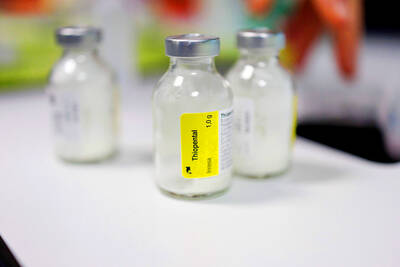
A grieving mother has ended her life at a clinic in Switzerland four years after the death of her only child. Wendy Duffy, 56, a physically healthy woman, died at the Pegasos clinic in Basel after struggling to cope with the death of her 23-year-old son, Marcus. The former care worker, from the West Midlands, England, had previously attempted to take her own life. The case comes as assisted dying would not become law in England and Wales after proposed legislation, branded “hopelessly flawed” by opponents, ran out of time. Ruedi Habegger, the founder of Pegasos, described Duffy’s death as
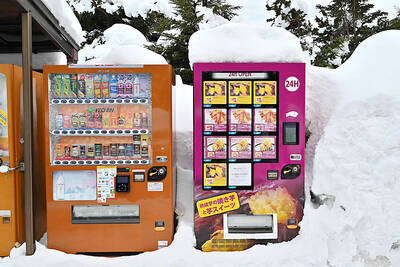
From post offices and parks to stations and even the summit of Mount Fuji, Japan’s vending machines are ubiquitous, but with the rapid pace of inflation cooling demand for their drinks, operators are being forced to rethink the business. Last month beverage giant DyDo Group Holdings announced it would remove about 20,000 vending machines — about 7 percent of their stock nationwide — by January next year, to “reconstruct a profitable network.” Pokka Sapporo Food & Beverage, based in Nagoya, also said last month it would sell its 40,000-machine operation to Osaka-based Lifedrink Co. “The strength of the vending machine


 RSS
RSS