


Israeli forces on Monday killed three Palestinians in Gaza near the line demarcating areas of Israeli control, underlining the struggle to broaden a fragile ceasefire deal approved more than six weeks ago to global acclaim.
Palestinian medics said the incidents involved an Israeli drone firing a missile at a group of people east of Khan Younis, killing two and wounding another, and a tank shell killing a person on the eastern side of Gaza City.
Israel’s military said it had fired after identifying what it called “terrorists” crossing what is known as the yellow line and approaching its troops, posing an immediate threat to them.

Photo: EPA
The armed wing of the Palestinian Islamic Jihad group in a statement later on Monday said that it had located the body of a hostage in an area controlled by the Israeli army in the Gaza Strip. It did not say when the handover would take place.
The hostage’s body is one of three still in Gaza.
Palestinian militant group Hamas and Israel signed a truce on Oct. 9, halting two years of devastating warfare, but the agreement left the most intractable disputes for further talks, freezing the conflict without resolving it.
Hamas released all 20 surviving hostages still held in Gaza in exchange for nearly 2,000 Palestinian prisoners and wartime detainees held by Israel.
The agreement also provided for the return of the remains of 28 hostages in exchange for the remains of 360 militants.
Both sides have, since the deal, accused each other of deadly breaches of existing commitments in the agreement and of pushing back against later steps required by US President Donald Trump’s 20-point peace plan for Gaza.
The health ministry in Gaza on Monday said that at least 342 Palestinians had been killed by Israeli fire since the start of the truce on Oct. 10. Israel says three of its soldiers have been killed by militant gunfire in the same period.
The UN Security Council last week gave formal backing to Trump’s plan, which calls for an interim technocratic Palestinian government in Gaza, overseen by an international “board of peace” and backed by an international security force.
Trump’s plan also requires reform of the Palestinian Authority, based in the Israeli-occupied West Bank.
Former British prime minister Tony Blair, who helped the US develop the plan and who Trump has said might join the board of peace, met Palestinian Authority Deputy Leader Hussein al-Sheikh in the West Bank on Sunday.
Al-Sheikh on social media said that they had discussed developments following the UN Security Council resolution and requirements for Palestinian self-determination.
A Hamas delegation in Cairo, led by its exiled chief Khalil al-Hayya, held talks with Egyptian officials on exploring the next phase of the ceasefire, Hamas spokesperson Hazem Qassem said.
Qassem acknowledged that the path to the second phase of the ceasefire was complex and said the Islamist group had told Egypt, a mediator in the conflict, that Israeli violations were undermining the agreement.
Agreeing on the makeup and mandate of the international security force has been particularly challenging.
Israel has said the multinational force must disarm Hamas, a step the group has so far resisted without Palestinian statehood, which Trump’s plan broadly envisages as the ultimate stage, but which Israel has ruled out.
Qassem said the force must have a role in keeping Israel’s military away from Palestinian civilians.
“There is complete uncertainty; the Americans haven’t put forward a detailed plan. It is unclear what kind of forces, what their tasks are, what their roles are, and where they will be stationed,” said a Palestinian official close to the Cairo talks who spoke on condition that he was not further identified. “Any deployment of forces without a political track, without an understanding with all Palestinian factions and powers in Gaza, would complicate things even further.”

SPEAKING OUT: After Siranudh Scott’s allegations surfaced, celebrities and public figures took to social media to share their own experiences of sexual misconduct and abuse A high-profile alleged sexual abuse case within a wealthy Thai beer brewing family has prompted a wave of painful accounts from survivors of unconnected abuse in the conservative nation. Siranudh Scott, a member of the billionaire Thai family that founded the ubiquitous Singha beer brand, posted an emotional video this month accusing his elder brother Sunit of repeatedly abusing him when he was a teenager. Sunit, who is in his 30s, later denied the allegations in a video posted online, but Singha parent Boonrawd dismissed him from his executive role with the company on Tuesday last week. “I felt I needed to speak

A Hong Kong astronaut is to join a Chinese space mission for the first time as part of a three-person crew launching today, as Beijing edges closer to its goal of landing people on the moon. The Tiangong space station — crewed by teams of three astronauts that are typically rotated every six months — is the crown jewel of China’s space program, boosted by billions in state investment in a bid to catch up with the US and Russia. The Shenzhou-23 mission is to blast off at 11:08pm from the Jiuquan Satellite Launch Center in northwestern China, carrying three astronauts to

SEEKING ORDER: Rodrigo Paz said that ‘anyone who wants to destroy the nation will have to deal with this president and the full force of the constitution’ Bolivian President Rodrigo Paz on Wednesday said that the nation was at a “breaking point” after nearly a month of protests that have caused shortages of food, fuel and medicine. Paz, who took office six months ago amid the worst economic crisis there in four decades, is battling a groundswell of fury over his policies. The political capital, La Paz, has been besieged by low-income workers and members of the indigenous majority calling for his resignation. “The country needs order and is reaching breaking point,” the 58-year-old said at a public event in La Paz, renewing his appeal for dialogue. On Tuesday, the Bolivian
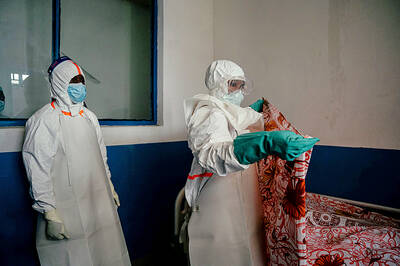
UPGRADED ALERT: The risk inside DR Congo is now considered ‘very high,’ while neighboring countries face a ‘high’ threat as the outbreak continues, the WHO said Ebola is spreading faster than responders can track it in eastern Congo, where health workers managed to follow up with barely one in five identified contacts in a single day. Authorities in the Democratic Republic of the Congo (DR Congo) reported 83 confirmed infections, 746 suspected cases and 1,603 identified contacts as of Thursday, but health workers were able to follow up on only 342 contacts that day — about 21 percent of the total under monitoring — data released by the DR Congo Ministry of Public Health on Friday showed. The figures suggest the response is falling behind the outbreak itself,


 RSS
RSS