


US President Donald Trump touted relations with China as "extremely strong" yesterday following a call with Chinese President Xi Jinping (習近平), who told Trump that Taiwan's "return to China" is a key part of Beijing's vision for the world order.
The call, not previously flagged by either country, came weeks after the two leaders met in South Korea, where they agreed to a framework for a trade deal that has yet to be finalized.
China is locked in its biggest diplomatic crisis for years with US ally Japan. This month, Japanese Prime Minister Sanae Takaichi said any Chinese attack on democratically governed Taiwan could trigger a Japanese military response.
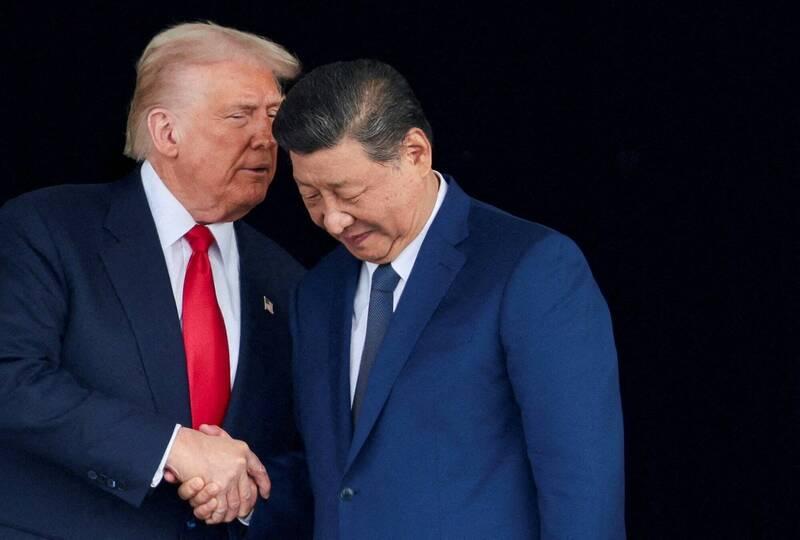
Photo: Reuters
"China and the United States once fought side by side against fascism and militarism, and should now work together to safeguard the outcomes of World War Two," Xi was quoted as saying by China's official Xinhua news agency, adding that "Taiwan's return to China is an integral part of the post-war international order."
Trump made no mention of Taiwan in a Truth Social post on his "very good" call with Xi, which he said covered many topics, including Ukraine, fentanyl, and US farm products.
"Our relationship with China is extremely strong! This call was a follow-up to our highly successful meeting in South Korea, three weeks ago. Since then, there has been significant progress on both sides in keeping our agreements current and accurate," Trump said.
He said he accepted Xi's invitation to visit Beijing in April, and had invited Xi for a state visit to the US later in the year.
White House Press Secretary Karoline Leavitt told reporters the call with Xi was focused on trade and lasted about an hour.
"We are pleased with what we've seen from the Chinese, and they feel the same way," Leavitt said.
Following months of trade tensions triggered by Trump's tariffs, Xi and Trump reached the framework agreement in South Korea on October 30. Washington agreed not to impose 100% tariffs on Chinese imports and China would hold off on an export licensing regime for crucial rare earths minerals and magnets.
US Treasury Secretary Scott Bessent has said he hoped a final deal on rare earths would be done by Thanksgiving, which is next week.
China has resumed purchases of US soybeans and halted its expanded curbs on rare earths exports. The US lowered tariffs on China by 10 percent in exchange for Beijing's pledge to help curb the flow of chemicals used to make the synthetic opioid fentanyl to North America.
Xi said that China-US ties have stabilized and improved since the meeting.
"The facts again show that cooperation benefits both sides while confrontation hurts both," he told Trump, urging the two countries to maintain positive momentum.
Xi reiterated that China supports all efforts conducive to peace in Ukraine.
China's readout of the call emphasized Taiwan, an issue neither side mentioned in statements following the South Korea meeting. Trump had said after that meeting that they did not speak about Taiwan, which Beijing consistently raises as a red line in relations with Washington. Weeks later, the US approved a US$330 million arms sale to Taipei.
Taiwan expert Bonnie Glaser, of the German Marshall Fund of the US, said Xi's Taiwan statement reprised one he made on a visit to Russia in May.
"Xi likely used the opportunity to set out his stance on Taiwan, perhaps because there was a lot of media [reports] on the Busan meeting which noted that Taiwan was not discussed," Glaser said.
Trump has not directly waded into the simmering diplomatic row between Japan and China over Taiwan, though his ambassador to Japan, George Glass, has said the US supports Tokyo in the face of China's "coercion."
Earlier yesterday, Beijing criticized Tokyo's plan to deploy a medium-range surface-to-air missile unit on Yonaguni, an island about 110km (68 miles) off Taiwan, calling it an attempt to "create regional tension and provoke military confrontation."
Marvin Park, a former director for Taiwan on the US National Security Council, said the missiles were clearly defensive in nature, with a range of only about 50km (30 miles), and could not even reach Taiwan.
"China's deeper fear is about the potential of future Japanese militarization. If they bring in this purely defensive system now, that could make it easier on the Japanese side to advocate for more advanced capabilities in the southwest islands," said Park, now with the American Global Strategies consultancy.

An American scientist convicted of lying to US authorities about payments from China while he was at Harvard University has rebuilt his research lab in Shenzhen, China, to pursue technology the Chinese government has identified as a national priority: embedding electronics into the human brain. Charles Lieber, 67, is among the world’s leading researchers in brain-computer interfaces. The technology has shown promise in treating conditions such as amyotrophic lateral sclerosis and restoring movement in paralyzed people. It also has potential military applications: Scientists at the Chinese People’s Liberation Army have investigated brain interfaces as a way to engineer super soldiers by boosting
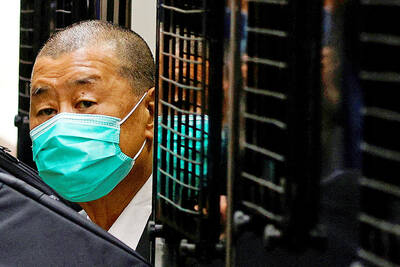
Jailed media entrepreneur Jimmy Lai (黎智英) has been awarded Deutsche Welle’s (DW) freedom of speech award for his contribution to Hong Kong’s pro-democracy movement. The German public broadcaster on Thursday said Lai would be presented in absentia with the 12th iteration of the award on June 23 at the DW Global Media Forum in Bonn. Deutsche Welle director-general Barbara Massing praised the 78-year-old founder of the now-shuttered news outlet Apple Daily for standing “unwaveringly for press freedom in Hong Kong at great personal risk.” “With Apple Daily, he gave journalists a platform for free reporting and a voice to the democracy movement in
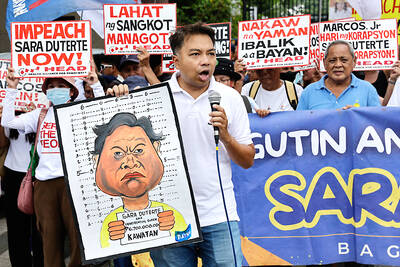
PHILIPPINE COMMITTEE: The head of the committee that made the decision said: ‘If there is nothing to hide, there is no reason to hide, there is no reason to obstruct’ A Philippine congressional committee on Wednesday ruled that there was “probable cause” to impeach Philippine Vice President Sara Duterte after hearing allegations of unexplained wealth, misuse of state funds and threats to have the president assassinated. The unanimous decision of the 53-member committee in the Philippine House of Representatives sends the two impeachment complaints to deliberations and voting by the entire lower chamber, which has more than 300 lawmakers. The complaints centered on Duterte’s alleged illegal use and mishandling of intelligence funds from the vice president’s office, and from her time as education secretary under Philippine President Ferdinand Marcos Jr. Duterte and the

Burmese President Min Aung Hlaing yesterday cut all prisoners’ sentences by one-sixth, a blanket measure that a source close to deposed leader Aung San Suu Kyi said would further shorten her detention. Aung San Suu Kyi has been sequestered since a 2021 military coup, but the senior member of her dissolved National League for Democracy (NLD) party said that while her term had been reduced, her remaining sentence is still unclear. “We also don’t know exactly how many years she has left,” the source told reporters, speaking on condition of anonymity for security reasons. The military toppled Aung San Suu Kyi’s elected government


 RSS
RSS