


US President Donald Trump’s Department of Government Efficiency (DOGE) has disbanded with eight months left to its mandate, ending an initiative launched with fanfare as a symbol of Trump’s pledge to slash the government’s size, but which critics say delivered few measurable savings.
“That doesn’t exist,” US Office of Personnel Management Director Scott Kupor said earlier this month when asked about DOGE’s status.
It is no longer a “centralized entity,” Kupor added, in the first public comments from the Trump administration on the end of DOGE.
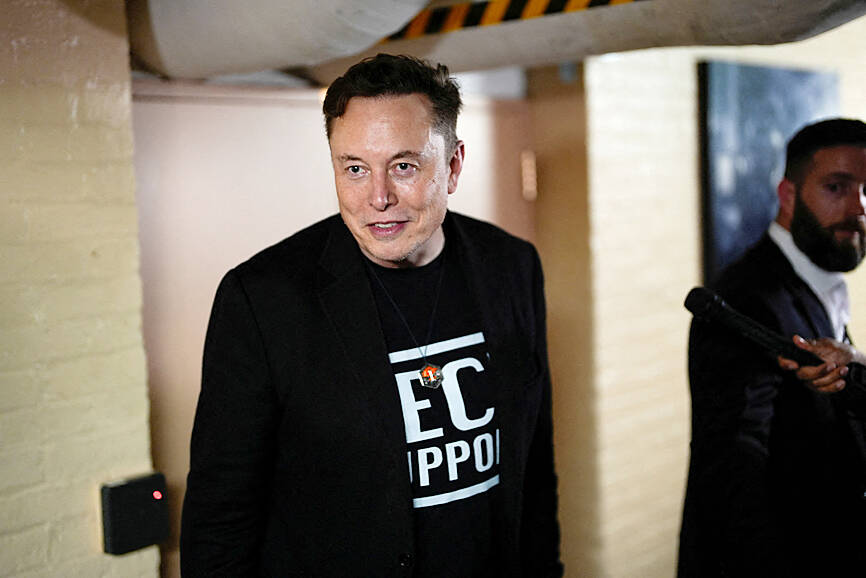
Photo: Reuters
The agency, set up in January, made dramatic forays across Washington in the early months of Trump’s second term to rapidly shrink federal agencies, cut their budgets or redirect their work to Trump priorities.
The US Office of Personnel Management, the federal government’s human resources office, has since taken over many of DOGE’s functions, Kupor said.
At least two prominent DOGE employees are now involved with the National Design Studio, a new body created through an executive order signed by Trump in August. That body is headed by Joe Gebbia, cofounder of Airbnb, and Trump’s order directed him to beautify government Web sites.
Gebbia was part of billionaire Elon Musk’s DOGE team, while DOGE employee Edward Coristine, nicknamed “Big Balls,” encouraged his social media followers to apply to join.
The fading away of DOGE is in sharp contrast to the government-wide effort over months to draw attention to it, with Trump, his advisers and Cabinet secretaries posting about it on social media. Musk, who led DOGE initially, regularly touted its work on social media and at one point brandished a chainsaw to advertise his efforts to cut government jobs.
“This is the chainsaw for bureaucracy,” Musk said, holding the tool above his head at the Conservative Political Action Conference in National Harbor, Maryland, in February.
DOGE claimed to have slashed tens of billions of dollars in expenditures, but it was impossible for outside financial experts to verify that because the unit did not provide detailed public accounting of its work.
“President Trump was given a clear mandate to reduce waste, fraud and abuse across the federal government, and he continues to actively deliver on that commitment,” White House spokeswoman Liz Huston said in an e-mail.
Trump administration officials have not openly said that DOGE no longer exists, even after Musk’s public feud with Trump in May. Musk has since left Washington.
Trump and his team have nevertheless signaled its demise in public since this summer, even though the US president signed an executive order earlier in his term decreeing that DOGE would last through July next year. In statements to reporters, Trump often talks about DOGE in the past tense.
Acting DOGE Administrator Amy Gleason, whose background is in healthcare technology, formally became an adviser to US Health and Human Services Secretary Robert Kennedy in March, according to a court filing, in addition to her role with DOGE. Her public statements have largely focused on her Health and Human Services role.
Republican-led states, including Idaho and Florida, are creating local entities similar to DOGE.
A government-wide hiring freeze — another hallmark of DOGE — is also over, Kupor said.
Trump on his first day in office barred federal agencies from bringing in new employees, with exceptions for positions his team deemed necessary to enforce immigration laws and protect public safety. He later said DOGE representatives must approve any other exceptions, adding that agencies should hire “no more than one employee for every four” that depart.
“There is no target around reductions” anymore, Kupor said.
DOGE staff have also taken on other roles in the administration. As well as Gebbia, Zachary Terrell, part of the DOGE team given access to government health systems in the early days of Trump’s second term, is now chief technology officer at the US Department of Health and Human Services. Rachel Riley, who had the same access according to court filings, is now chief of the US Office of Naval Research, according to the office’s Web site.
Jeremy Lewin, who helped Musk and the Trump administration dismantle the US Agency for International Development, now oversees foreign assistance at the US Department of State, according to the agency’s Web site.

‘CROSSING THE LINE’: China’s embassy in Seoul criticized US Forces Korea Commander General Xavier Brunson, asking if his ‘hostile’ remarks were authorized by Washington South Korea and the US are in talks over recent public remarks by the commander of US Forces Korea, Seoul’s presidential office said yesterday, after the comments drew sharp criticism from China. In a recent podcast interview, US Forces Korea Commander General Xavier Brunson described South Korea as “the dagger in the heart of Asia” from China’s east coast, prompting the Chinese embassy in Seoul to say that he had “truly crossed the line.” The interview came amid growing speculation that Washington might seek to expand the role of US Forces Korea in countering the growing regional influence of China, a key

SEEKING ORDER: Rodrigo Paz said that ‘anyone who wants to destroy the nation will have to deal with this president and the full force of the constitution’ Bolivian President Rodrigo Paz on Wednesday said that the nation was at a “breaking point” after nearly a month of protests that have caused shortages of food, fuel and medicine. Paz, who took office six months ago amid the worst economic crisis there in four decades, is battling a groundswell of fury over his policies. The political capital, La Paz, has been besieged by low-income workers and members of the indigenous majority calling for his resignation. “The country needs order and is reaching breaking point,” the 58-year-old said at a public event in La Paz, renewing his appeal for dialogue. On Tuesday, the Bolivian

Australian researchers have trained lab-grown brain cells on a silicon computer chip to play the 1990s shooter game Doom and said they are just scratching the surface of what the neurons could be capable of doing. It is the science-fiction work of biotech boffins at Cortical Labs, who researched and developed the technology that harnesses the workings of the brain’s networking system. Each so-called “biological computer” contains about 200,000 living human brain cells, grown from stem cells that were harvested from blood donations. Having mastered the simple computer game Pong, where a paddle is moved up and down to send a ball

Through the noise of rushing papers and whirring belts at a print factory in Kyoto, two creators watch their photo essay come to life in broadsheet form — part of an effort to win new audiences in the age of artificial intelligence (AI). Despite the decline of the publishing industry, self-publication and handmade “zine” magazines are growing in popularity in Japan, reflecting the nation’s enduring love of paper in the digital era. While speaking to Agence France-Presse at the plant, his hands black with ink, one of the creators, Kazuma Obara, said: “I think [paper] is a medium that engages all five


 RSS
RSS