


When conductor Paniz Faryoussefi mounts the podium and reaches for her baton, she represents more than just the hope of a thrilling orchestral performance.
The eyes turned toward her in Tehran’s renowned Vahdat Hall include those of many young female musicians inspired by her taking her place as Iran’s first female philharmonic conductor.
Women’s professional and cultural lives are still heavily restricted in the conservative Islamic republic, particularly in terms of public performance before mixed-gender audiences.
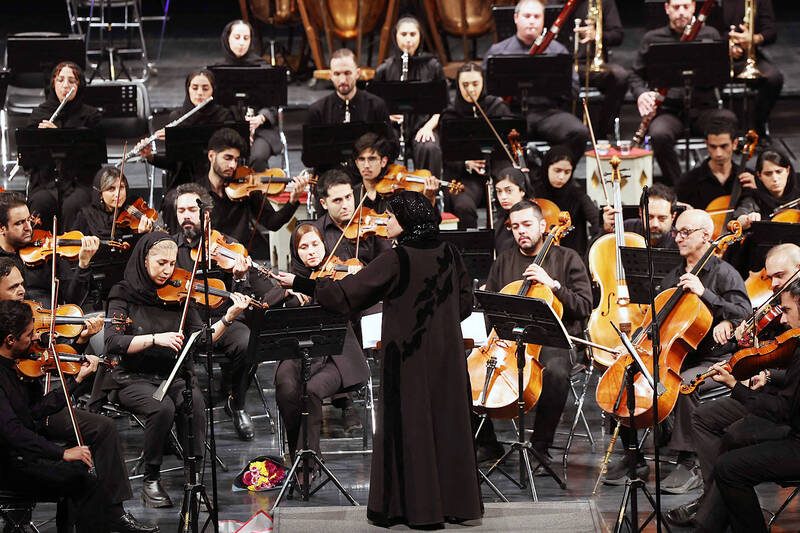
Photo: AFP
Women, for example, are not allowed to sing solo in front of men.
However, as exemplified by 42-year-old Faryoussefi, they can now conduct an orchestra.
“When I stepped onto the stage, I noticed that all eyes were on a woman conducting the orchestra, and I felt an immense responsibility,” she said after a performance.
Widespread street protests shook Iran for several months following the death in 2022 of a young woman arrested for contravening the country’s strict dress code for women.
In the wake of the disturbances, the government has relaxed certain restrictions, and young women have become more prominent in some areas of social and cultural life.
Analysts said the authorities have shown greater tolerance, while keeping as close an eye as ever for any signals of political dissent.
Several women in the audience at the concert did not wear their scarves. The conductor wore hers, covering her hair as the law demands, but her arrival at the podium was in itself a sign of greater openness.
The crowd shared Faryoussefi’s enthusiasm, particularly the young women, who seemed aware that they were witnessing a historic moment.
In some Iranian cities, female musicians are not allowed to perform on stage, and even in Tehran, they cannot raise their voices in song in public.
Faryoussefi was born into an artistic family and her mother dreamed of her becoming a conductor, but Iranian performing arts academies do not teach conducting. She briefly attended classes in Armenia before returning to build a trailblazing career.
“Young women need to persevere and follow their dreams,” Faryoussefi said.
At the podium, Faryoussefi led the 50-person orchestra through works by Austria’s Franz Schubert, Finland’s Jean Sibelius and Soviet-Armenian composer Aram Khachaturian.
“I hope this marks a new era for young Iranian women and that they will understand that... they should not be afraid,” she said. “It is the only gateway to emancipation.
“A friend saw a little girl in the audience mimicking my movements. He thought a dream was already taking root in her, that she was thinking she, too, could one day achieve the same thing.”
The concerts took place over two days and attracted large crowds.
Said Shourabi, 53, who works in metal fabrication said he was not a big concertgoer until his daughter bought him the tickets and insisted he go along.
“In Iran, women have always been held back and haven’t been able to fully express their talents, even if I’m sure they’re just as capable as men,” he said.
Hairdresser Fariba Aghai, 44, was delighted to see a woman take up the baton at the orchestra, lamenting that women singers still cannot perform at concerts or publish their own songs.
“They shouldn’t have to sell themselves short and should know that they’re capable of anything,” she said.

An American scientist convicted of lying to US authorities about payments from China while he was at Harvard University has rebuilt his research lab in Shenzhen, China, to pursue technology the Chinese government has identified as a national priority: embedding electronics into the human brain. Charles Lieber, 67, is among the world’s leading researchers in brain-computer interfaces. The technology has shown promise in treating conditions such as amyotrophic lateral sclerosis and restoring movement in paralyzed people. It also has potential military applications: Scientists at the Chinese People’s Liberation Army have investigated brain interfaces as a way to engineer super soldiers by boosting
Indonesian police have arrested 13 people after shocking images of alleged abuse against small children at a daycare center went viral, sparking outrage across the nation, officials said on Monday. Police on Friday last week raided Little Aresha, a daycare center in Yogyakarta on Java island, following a report from a former employee. CCTV footage circulating on social media showed children, most younger than two, lying on the floor wearing only diapers, their hands and feet bound with rags. The police have confirmed that the footage is authentic. Police said they also found 20 children crammed into a room just 3m by 3m. “So

Jailed media entrepreneur Jimmy Lai (黎智英) has been awarded Deutsche Welle’s (DW) freedom of speech award for his contribution to Hong Kong’s pro-democracy movement. The German public broadcaster on Thursday said Lai would be presented in absentia with the 12th iteration of the award on June 23 at the DW Global Media Forum in Bonn. Deutsche Welle director-general Barbara Massing praised the 78-year-old founder of the now-shuttered news outlet Apple Daily for standing “unwaveringly for press freedom in Hong Kong at great personal risk.” “With Apple Daily, he gave journalists a platform for free reporting and a voice to the democracy movement in

PHILIPPINE COMMITTEE: The head of the committee that made the decision said: ‘If there is nothing to hide, there is no reason to hide, there is no reason to obstruct’ A Philippine congressional committee on Wednesday ruled that there was “probable cause” to impeach Philippine Vice President Sara Duterte after hearing allegations of unexplained wealth, misuse of state funds and threats to have the president assassinated. The unanimous decision of the 53-member committee in the Philippine House of Representatives sends the two impeachment complaints to deliberations and voting by the entire lower chamber, which has more than 300 lawmakers. The complaints centered on Duterte’s alleged illegal use and mishandling of intelligence funds from the vice president’s office, and from her time as education secretary under Philippine President Ferdinand Marcos Jr. Duterte and the


 RSS
RSS