


More than 1,000 flights were canceled across the US on Friday after US President Donald Trump’s administration ordered reductions to ease strain on air traffic controllers working without pay amid a federal government shutdown.
Forty airports were slated for the cuts, including major hubs in Atlanta, Georgia; Newark, New Jersey; Denver, Colorado; Chicago; Houston, Texas; and Los Angeles.
With Republicans and Democrats in a bitter standoff, particularly over health insurance subsidies, federal agencies have been grinding to halt since funding lapsed on Oct. 1.
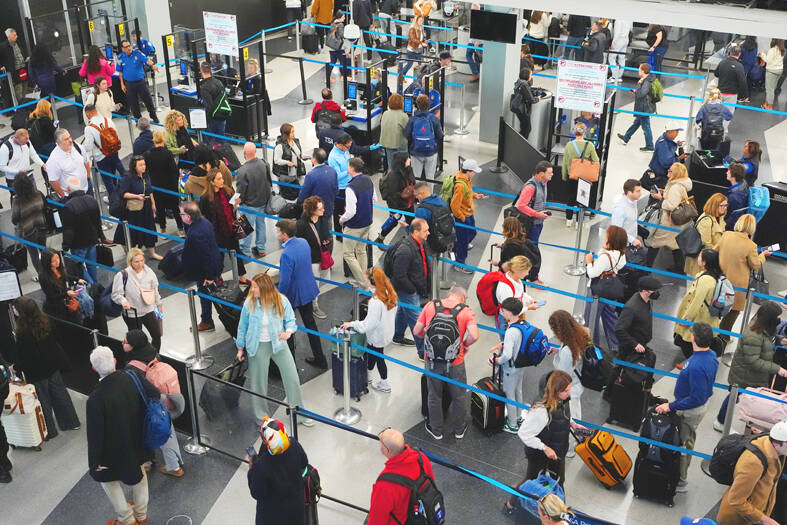
Photo: AP
Many US government employees, including vital airport staff, are either working without pay or furloughed at home, waiting for the now nearly six-week crisis to end.
The flight reductions are taking effect gradually, starting at 4 percent and rising to 10 percent next week if US Congress still has not reached a funding deal.
More than 1,000 flights scheduled for Friday were canceled, according to tracking Web site FlightAware.
The most affected airports late Friday were Reagan National in Washington, Denver International and Hartsfield-Jackson in Atlanta, data showed.
Travelers at Reagan National were seeing average delays of four hours, with 90-minute waits in Phoenix, Arizona, and one hour delays in Chicago and San Francisco, the US Federal Aviation Administration said.
“This is frustrating. We don’t need to be in this position,” American Airlines CEO Robert Isom told CNBC.
The upheaval means ordinary Americans are now directly feeling the impacts of the Washington budget fight that has shut down much of the government.
US Secretary of Transportation Duffy blamed Democrats for the shutdown, saying they should vote to reopen the government.
“If Democrats are going to go home this weekend, and they’ve kept the government shut down, that’s shameful,” Duffy told reporters at Reagan National Airport.
In a post on Truth Social, Trump on Friday also called on US Senate lawmakers to remain in Washington until an agreement to end the shutdown.
Republicans control the US Congress, but Democrats have said they would refuse to sign off on the majority party’s budget plans, including severe healthcare cuts.
The flight reduction measures come as the country enters its busiest travel time of the year, with the Thanksgiving holiday just weeks away.
“This will get serious if things drag on to Thanksgiving,” retiree Werner Buchi said at New York’s LaGuardia airport as he waited for his daughter to arrive on a flight from Wilmington, North Carolina.
Rhonda, 65 — who arrived at LaGuardia without a hitch from Portland, Maine — worried about holiday plans “that could be ruined, because people won’t talk to each other. This is hurting a lot of people,” she said.
American Airlines said in a statement that its scheduled reduction amounted to 220 flight cancelations each day.
Delta Air Lines said it was cutting about 170 flights scheduled for Friday, while broadcaster CNN reported Southwest Airlines axed about 100 flights set for that day.
More than 6,800 US flights were delayed on Thursday with about 200 cancelations, FlightAware data showed, with passengers facing long lines at security checkpoints.
The Trump administration sought to reassure people that flying remains safe.
“It’s safe to fly today, tomorrow, and the day after because of the proactive actions we are taking,” Duffy said on social media late on Thursday.
However, many in high-stress aviation-related jobs are now calling in sick and potentially working second jobs to pay their bills.

SPEAKING OUT: After Siranudh Scott’s allegations surfaced, celebrities and public figures took to social media to share their own experiences of sexual misconduct and abuse A high-profile alleged sexual abuse case within a wealthy Thai beer brewing family has prompted a wave of painful accounts from survivors of unconnected abuse in the conservative nation. Siranudh Scott, a member of the billionaire Thai family that founded the ubiquitous Singha beer brand, posted an emotional video this month accusing his elder brother Sunit of repeatedly abusing him when he was a teenager. Sunit, who is in his 30s, later denied the allegations in a video posted online, but Singha parent Boonrawd dismissed him from his executive role with the company on Tuesday last week. “I felt I needed to speak

A Hong Kong astronaut is to join a Chinese space mission for the first time as part of a three-person crew launching today, as Beijing edges closer to its goal of landing people on the moon. The Tiangong space station — crewed by teams of three astronauts that are typically rotated every six months — is the crown jewel of China’s space program, boosted by billions in state investment in a bid to catch up with the US and Russia. The Shenzhou-23 mission is to blast off at 11:08pm from the Jiuquan Satellite Launch Center in northwestern China, carrying three astronauts to

SEEKING ORDER: Rodrigo Paz said that ‘anyone who wants to destroy the nation will have to deal with this president and the full force of the constitution’ Bolivian President Rodrigo Paz on Wednesday said that the nation was at a “breaking point” after nearly a month of protests that have caused shortages of food, fuel and medicine. Paz, who took office six months ago amid the worst economic crisis there in four decades, is battling a groundswell of fury over his policies. The political capital, La Paz, has been besieged by low-income workers and members of the indigenous majority calling for his resignation. “The country needs order and is reaching breaking point,” the 58-year-old said at a public event in La Paz, renewing his appeal for dialogue. On Tuesday, the Bolivian
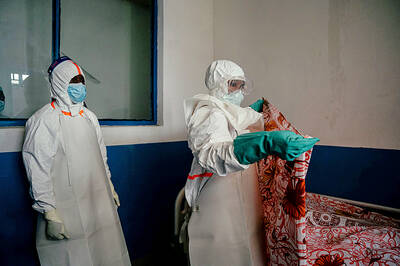
UPGRADED ALERT: The risk inside DR Congo is now considered ‘very high,’ while neighboring countries face a ‘high’ threat as the outbreak continues, the WHO said Ebola is spreading faster than responders can track it in eastern Congo, where health workers managed to follow up with barely one in five identified contacts in a single day. Authorities in the Democratic Republic of the Congo (DR Congo) reported 83 confirmed infections, 746 suspected cases and 1,603 identified contacts as of Thursday, but health workers were able to follow up on only 342 contacts that day — about 21 percent of the total under monitoring — data released by the DR Congo Ministry of Public Health on Friday showed. The figures suggest the response is falling behind the outbreak itself,


 RSS
RSS