


Japanese Prime Minister Sanae Takaichi’s new hardline coalition partner unshackles her security ambitions and gives US President Donald Trump room to press for military spending, but her fragile government might put a brake on what she can do.
Takaichi, an admirer of conservative former British prime minister Margaret Thatcher, was sworn in on Tuesday as head of a government that is two votes shy of a majority in the decisionmaking 465-seat lower house.
“She is conservative, wants to increase defense spending, and has styled herself the Japan First candidate. If she has a vulnerability with Trump, it is her relative weakness at home,” said Michael Green, professor and chief executive officer at the United States Studies Centre at the University of Sydney, Australia, and a former senior US National Security Council official.
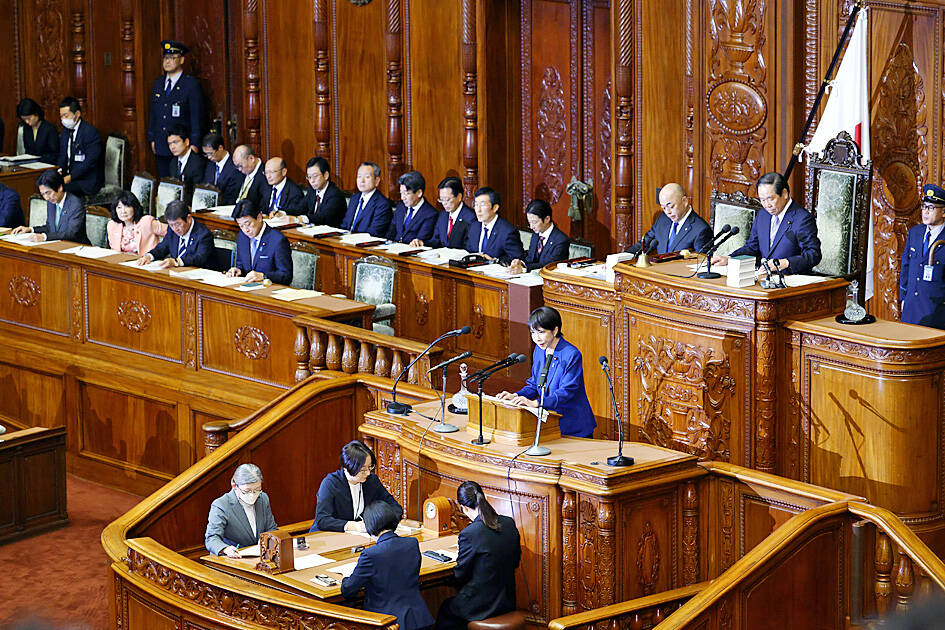
Photo: EPA
Takaichi has only a few days to prepare for her first face-to-face talks with Trump since becoming Japan’s first female prime minister on Tuesday. They might cross paths at the ASEAN regional bloc summit in Malaysia tomorrow before holding formal talks in Tokyo early next week.
“She certainly will be experiencing a baptism of fire on the diplomatic front,” said a senior US diplomat, asking not to be identified because he is not authorized to speak publicly.
A follower of former Japanese prime minister and Trump confidant Shinzo Abe, Takaichi ended the ruling Liberal Democratic Party’s (LDP) 26-year coalition with the pacifist-leaning Komeito, replacing it with the right-wing Japan Innovation Party, known as Ishin.
“Komeito always served as a brake, and now you have two coalition partners that are pretty much aligned,” said Jeffrey Hornung, an expert on Japanese security policy at the RAND Corp.
The shift frees Takaichi to push Abe-era security reforms further.
Like her, Ishin wants to revise Japan’s pacifist constitution, strengthen the military to deter China and loosen restrictions on arms exports.
Ishin has even floated a US-style nuclear-sharing deal that would give Tokyo a say over any US weapons deployed in Japan. That would be a radical departure from Japan’s long-held three non-nuclear principles of not developing, deploying or hosting such weapons.
Takaichi has signaled she would accelerate Japan’s largest military buildup since World War II, doubling defense spending to 2 percent of GDP.
She has said that a “contingency” in Taiwan would be a contingency for Japan and the US.
“Managing relations with China will be a major hurdle for her,” said Kenji Minemura, a senior research fellow at the Tokyo-based think tank Canon Institute for Global Studies. “The loss of Komeito, which maintained ties with Beijing, is another setback.”
China’s response to Takaichi, a frequent visitor to the Yasukuni war shrine that Beijing views as a symbol of militarism, expressed concern about Japan’s commitment to peace and self-defense.
“We urge Japan to reflect on its history of aggression, adhere to the path of peace, and exercise caution in its words and deeds in the field of military and security,” Chinese Ministry of Foreign Affairs spokesman Guo Jiakun (郭嘉昆) said in a news briefing.
The upcoming Trump meeting gives Takaichi a chance to outline her regional security goals before Trump meets Chinese President Xi Jinping (習近平) next week, ahead of the annual APEC summit in South Korea.
However, Takaichi’s political weakness would limit how much she can promise Trump on defense spending, Tokyo University professor Ryo Sahashi said.
“Speeding up the buildup was always on the cards, but the real issue is the budget,” he said. “It’s doubtful a government with such a weak footing can decide to jump to 3 percent.”
While Takaichi won enough votes to become prime minister, her bloc would still have to shop around for opposition support to pass key bills, a challenge Abe never faced.
“If Trump pushes her for a specific number, it could cause early friction,” Hornung said.
To win Trump’s favor, which could bolster her standing at home, Takaichi instead plans to present a package of US purchases, including Ford F-150 pickup trucks, soybeans, natural gas and a list of potential US investments, sources said.
While Takaichi and the LDP would miss the presence of Abe, who was assassinated in 2022, his widow, Akie, would be there to meet Trump.
Takaichi’s officials might even take the US leader to the golf course he and Abe played at in 2019 during his last visit, local media reported.
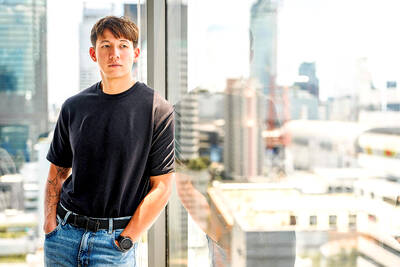
SPEAKING OUT: After Siranudh Scott’s allegations surfaced, celebrities and public figures took to social media to share their own experiences of sexual misconduct and abuse A high-profile alleged sexual abuse case within a wealthy Thai beer brewing family has prompted a wave of painful accounts from survivors of unconnected abuse in the conservative nation. Siranudh Scott, a member of the billionaire Thai family that founded the ubiquitous Singha beer brand, posted an emotional video this month accusing his elder brother Sunit of repeatedly abusing him when he was a teenager. Sunit, who is in his 30s, later denied the allegations in a video posted online, but Singha parent Boonrawd dismissed him from his executive role with the company on Tuesday last week. “I felt I needed to speak
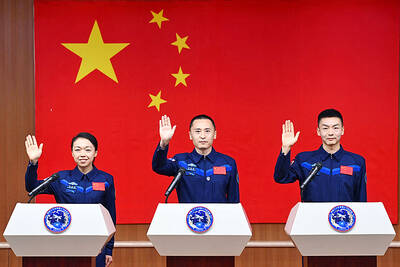
A Hong Kong astronaut is to join a Chinese space mission for the first time as part of a three-person crew launching today, as Beijing edges closer to its goal of landing people on the moon. The Tiangong space station — crewed by teams of three astronauts that are typically rotated every six months — is the crown jewel of China’s space program, boosted by billions in state investment in a bid to catch up with the US and Russia. The Shenzhou-23 mission is to blast off at 11:08pm from the Jiuquan Satellite Launch Center in northwestern China, carrying three astronauts to

UPGRADED ALERT: The risk inside DR Congo is now considered ‘very high,’ while neighboring countries face a ‘high’ threat as the outbreak continues, the WHO said Ebola is spreading faster than responders can track it in eastern Congo, where health workers managed to follow up with barely one in five identified contacts in a single day. Authorities in the Democratic Republic of the Congo (DR Congo) reported 83 confirmed infections, 746 suspected cases and 1,603 identified contacts as of Thursday, but health workers were able to follow up on only 342 contacts that day — about 21 percent of the total under monitoring — data released by the DR Congo Ministry of Public Health on Friday showed. The figures suggest the response is falling behind the outbreak itself,

SEEKING ORDER: Rodrigo Paz said that ‘anyone who wants to destroy the nation will have to deal with this president and the full force of the constitution’ Bolivian President Rodrigo Paz on Wednesday said that the nation was at a “breaking point” after nearly a month of protests that have caused shortages of food, fuel and medicine. Paz, who took office six months ago amid the worst economic crisis there in four decades, is battling a groundswell of fury over his policies. The political capital, La Paz, has been besieged by low-income workers and members of the indigenous majority calling for his resignation. “The country needs order and is reaching breaking point,” the 58-year-old said at a public event in La Paz, renewing his appeal for dialogue. On Tuesday, the Bolivian


 RSS
RSS