


Escalating attempts to remove works featuring themes such as LGBTQ lifestyles and race relations from US bookshelves are facing growing resistance from publishers and rights groups, a major topic at this year’s Frankfurt Book Fair in Germany.
Spearheaded by right-wing conservative groups, there has been an explosion in efforts to get books that are viewed as overly progressive banned in US schools and public libraries over the past few years.
In 2020 just under 300 titles faced “challenges” — demands to restrict access to them or remove them entirely — across the US, the American Library Association (ALA) said.
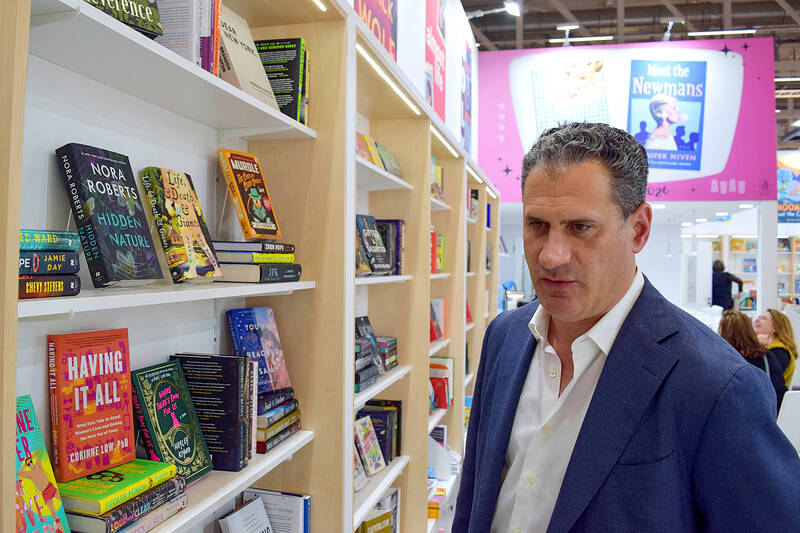
Photo: AFP
That number began surging the following year, and reached more than 9,000 in 2023, said the non-governmental organization (NGO), whose office for intellectual freedom has been tracking challenges since 1990.
“It’s an ideological mission from people on the right,” said Jon Yaged, CEO of Macmillan Publishers, whose books are among those that have been targeted in the US.
“This is just the most recent instance of hate demonstrating itself in culture,” Yaged said last week at the Frankfurt event, the world’s biggest book fair, where the subject was hotly debated.
It is part of what PEN International says is a growing global trend, with the literary freedom NGO reporting a “dramatic increase in book bans and censorship” lately, from Afghanistan to Russia.
In the US conservative groups and politicians pushing to get certain books removed reject accusations of censorship, insisting their aim is to limit access to inappropriate material.
US conservatives have for some years been pushing back against what they view as a progressive agenda in education, a drive that has won support from US President Donald Trump’s administration.
The most common reasons for challenging books last year were claims of obscenity in books for minors, LGBTQ characters or themes and discussion of sensitive topics such as race, the ALA said.
Among the most targeted titles were All Boys Aren’t Blue, a collection of essays about author George M. Johnson’s experiences growing up as a gay black man in the US.
Others included The Bluest Eye, a Toni Morrison work featuring depictions of sexual abuse and racial themes, and The Perks of Being a Wallflower, a coming-of-age novel featuring drug use and sex.
Conservative activists and local politicians, particularly in Republican-led states, often pressure school boards for book bans, but efforts to get works removed are increasingly taking on different forms, PEN’s US branch said.
Legislatures in some states have passed laws seeking to restrict access to certain titles, elected politicians have issued lists of books containing “explicit” material and some school districts have issued “do not buy” lists, targeting particular works, the group said.
The highest number of instances of access to school books being restricted last year was documented in Florida, where Republican Governor Ron DeSantis has pushed conservative education policies that have also included banning classroom discussion of sexuality and gender identity, PEN said.
Those campaigning to limit access typically argue they are seeking to protect youngsters.
Conservative group Moms for Liberty said that “challenging the placement of obscene materials in school libraries is not censorship or banning.”
“It is a reasonable demand to prevent children from being exposed to age-inappropriate materials,” the group said in a statement cited by an affiliate of CBS News.
Macmillan and other major publishers including Penguin Random House and HarperCollins, alongside authors and advocacy groups, have lodged legal challenges against attempts to restrict access to books, and have had some successes.
In some school districts, community members, from parents to authors and students, have also fought back against book bans.
Authors sense a worsening climate for works depicting minority groups beyond the US.
“It is getting worse globally,” said US author Lawrence Schimel, whose books featuring children with same-sex parents have run into problems in Russia and Hungary over the past few years.
However, Schimel said that he believed it was crucial for kids to be able to continue seeing such works.
“It helps them to be accepting of other people’s diversity,” he added.
Despite the mounting challenges, Yaged sounded determined.
“As long as there have been books, there have been people trying to ban books,” he said. “And they haven’t won as long as we keep up the fight.”

SPEAKING OUT: After Siranudh Scott’s allegations surfaced, celebrities and public figures took to social media to share their own experiences of sexual misconduct and abuse A high-profile alleged sexual abuse case within a wealthy Thai beer brewing family has prompted a wave of painful accounts from survivors of unconnected abuse in the conservative nation. Siranudh Scott, a member of the billionaire Thai family that founded the ubiquitous Singha beer brand, posted an emotional video this month accusing his elder brother Sunit of repeatedly abusing him when he was a teenager. Sunit, who is in his 30s, later denied the allegations in a video posted online, but Singha parent Boonrawd dismissed him from his executive role with the company on Tuesday last week. “I felt I needed to speak

SEEKING ORDER: Rodrigo Paz said that ‘anyone who wants to destroy the nation will have to deal with this president and the full force of the constitution’ Bolivian President Rodrigo Paz on Wednesday said that the nation was at a “breaking point” after nearly a month of protests that have caused shortages of food, fuel and medicine. Paz, who took office six months ago amid the worst economic crisis there in four decades, is battling a groundswell of fury over his policies. The political capital, La Paz, has been besieged by low-income workers and members of the indigenous majority calling for his resignation. “The country needs order and is reaching breaking point,” the 58-year-old said at a public event in La Paz, renewing his appeal for dialogue. On Tuesday, the Bolivian

COMMUNITY CONFLICT: Concerns about disease spread from corpses has run up against friends and families’ desire to bury their dead as infection spreads in the area Angry residents of a town at the epicenter of the Ebola outbreak in the Democratic Republic of the Congo (DR Congo) attacked and burned a tent that was part of a health center where people are being treated for the virus, the staff there said Saturday. It was the second such attack in the region in a week. No one was hurt in the attack, according to reports but as patients ran out to escape the fire, 18 people with suspected Ebola infections fled the facility and are unaccounted for, a hospital director said. Angry residents arrived at the clinic in the

Forecasters in Europe yesterday warned of exceptional heat as record temperatures driven by a “heat dome” push temperatures well above seasonal norms across the continent. The surge follows a record-breaking Monday, with France logging its hottest day in the month of May on record, its weather agency said, and the UK also posting unprecedented highs. A so-called “heat dome” of warm air from northern Africa trapped under a high-pressure system over western Europe is behind the high temperatures not usually seen until high summer. Restrictions on outdoor work were imposed in parts of Italy, beaches in southwest France filled earlier than usual and


 RSS
RSS