


A missing fingertip offers a clue to Mako Nishimura’s criminal past as one of Japan’s few female yakuza, but after clawing her way out of the underworld, she now spends her days helping other retired gangsters reintegrate into society.
The multibillion-dollar yakuza organized crime network has long ruled over Japan’s drug rings, illicit gambling dens and sex trade. In the past few years, the empire has started to crumble as members have dwindled and laws targeting mafia are tightened.
An intensifying police crackdown has shrunk yakuza forces nationwide, with their numbers dipping below 20,000 last year for the first time since records began in 1958.
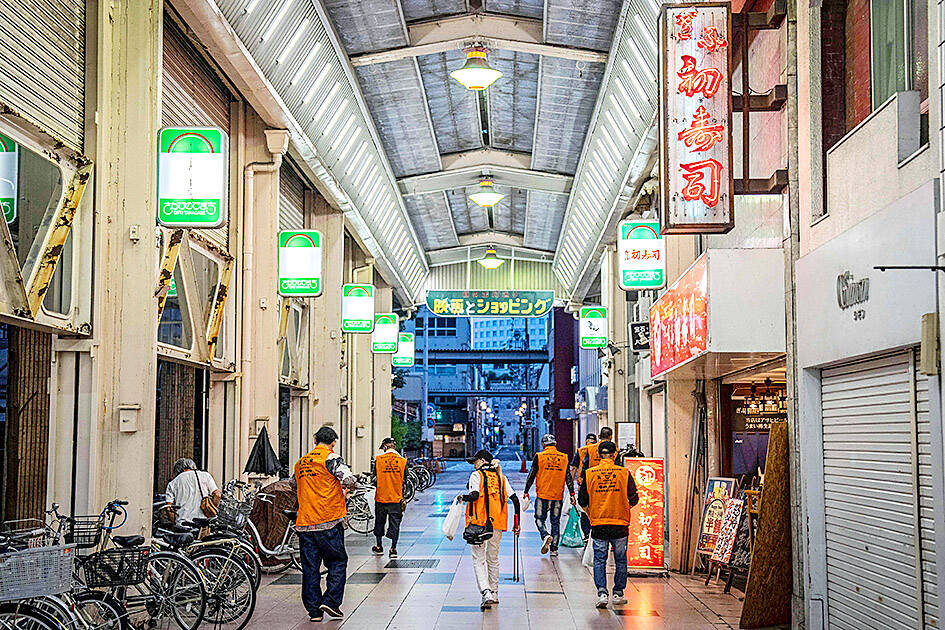
Photo: AFP
Heavily inked with dragon and tiger tattoos, 58-year-old Nishimura navigated the yakuza’s patriarchal hierarchy — where brute force and authoritarian leadership reign — on and off for three decades.
Rival gangsters “looked down on me just because I was a woman, which I hated,” she told reporters at her cramped apartment in central Japan’s Gifu Prefecture.
“I wanted to be acknowledged as a yakuza,” she said. “So I learned to speak, look and fight like a man.”
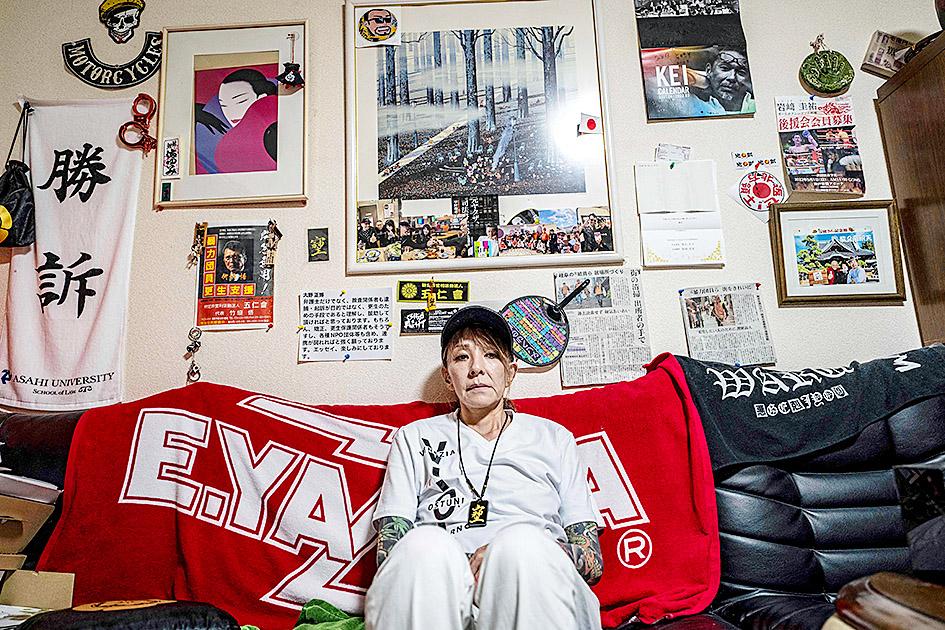
Photo: AFP
Nishimura said that she was officially recognized by authorities as the first female yakuza after she was jailed for drug possession when she was 22.
While no official police data verify that, experts say that female members are extremely rare.
Retired anti-mob detective Yuichi Sakurai said he had never seen a female yakuza in his 40-year career, but “it was possible a few are included” in the annual numbers tracked by police, which do not give a breakdown by sex.
Nishimura, skinny with dyed-blonde hair, finally put the syndicate behind her about five years ago. She now ekes out a living at demolition sites — one of the few jobs that tolerates her full-sleeve tattoos.
She also supports other mafia retirees, taking huge pride in leading the Gifu branch of Gojinkai, a nonprofit dedicated to helping people with a criminal past.
Yuji Moriyama is among the posse of middle-aged tough guys — one has a prominent knife scar across his belly — that Nishimura takes out for monthly litter-picking trips.
“She’s like a big sister. She scolds us when we deserve it,” 55-year-old Moriyama said, recalling a time he skipped the trash collection and she made him kneel on the ground to apologize.
“She scared the hell out of me,” he said, laughing.
For Nishimura, “the idea I’m doing something good for other people gives me confidence,” she said about the cleanup program.
“I’m slowly returning to a normal human being,” she added.
Nishimura grew up in a strict family, with a civil servant father who heavily pressured her academically. As a teen, she ran away from home and fell into crime, joining a major yakuza clan by the age of 20.
Brawls, extortions and selling illegal drugs soon became routine. She even cut off her own finger tip as part of the yakuza’s ritualistic self-punishment for blunders.
However, in her late 20s, Nishimura absconded from the syndicate and was “excommunicated,” putting gangsterism behind her to marry and raise her son.
“For the first time, I felt a gush of maternal instinct. He was so cute, I thought I could die for him,” she said.
The determined new mother studied her way into the care and medical industries, only to be fired over her tattoos.
Unsure where else to turn, she relapsed into selling stimulants.
In her late 40s, she rejoined her old yakuza organization, but found it poor and bereft of “dignity.”
The yakuza had thrived in the post-World War II bedlam of Japan, when it was at times seen as a necessary evil to bring order to the streets. It still exists in a semi-legal gray area, but harsher laws have left fewer people willing to do business with mobsters.
“Yakuza used to be the king of villains,” she said, but seeing her old boss struggling to scrape money together disillusioned her to the extent that she quit the underworld shortly after her 50th birthday.
Today, Nishimura has found a new mentor — Gojinkai chairman and prominent former gangster Satoru Takegaki — with proceeds from her recently published autobiography helping her make ends meet.
“I think yakuza will keep shrinking,” she said. “I hope they will become extinct.”

It began as a satirical online project. Now millions of young people in India are flocking to it as an outlet for their frustration. A parody political party called the Cockroach Janta Party, with the insect as its symbol, has exploded across India’s social media by turning absurdist humor into protest. Memes and short videos mocking corruption, joblessness and political dysfunction have flooded social media sites, where millions of users are embracing the cockroach — known for its ability to survive harsh conditions — as a tongue-in-cheek symbol of endurance. The online movement’s rise has been unusually rapid. The Cockroach Janta Party (CJP)
SPEAKING OUT: After Siranudh Scott’s allegations surfaced, celebrities and public figures took to social media to share their own experiences of sexual misconduct and abuse A high-profile alleged sexual abuse case within a wealthy Thai beer brewing family has prompted a wave of painful accounts from survivors of unconnected abuse in the conservative nation. Siranudh Scott, a member of the billionaire Thai family that founded the ubiquitous Singha beer brand, posted an emotional video this month accusing his elder brother Sunit of repeatedly abusing him when he was a teenager. Sunit, who is in his 30s, later denied the allegations in a video posted online, but Singha parent Boonrawd dismissed him from his executive role with the company on Tuesday last week. “I felt I needed to speak

A Hong Kong astronaut is to join a Chinese space mission for the first time as part of a three-person crew launching today, as Beijing edges closer to its goal of landing people on the moon. The Tiangong space station — crewed by teams of three astronauts that are typically rotated every six months — is the crown jewel of China’s space program, boosted by billions in state investment in a bid to catch up with the US and Russia. The Shenzhou-23 mission is to blast off at 11:08pm from the Jiuquan Satellite Launch Center in northwestern China, carrying three astronauts to
UPGRADED ALERT: The risk inside DR Congo is now considered ‘very high,’ while neighboring countries face a ‘high’ threat as the outbreak continues, the WHO said Ebola is spreading faster than responders can track it in eastern Congo, where health workers managed to follow up with barely one in five identified contacts in a single day. Authorities in the Democratic Republic of the Congo (DR Congo) reported 83 confirmed infections, 746 suspected cases and 1,603 identified contacts as of Thursday, but health workers were able to follow up on only 342 contacts that day — about 21 percent of the total under monitoring — data released by the DR Congo Ministry of Public Health on Friday showed. The figures suggest the response is falling behind the outbreak itself,


 RSS
RSS