


China’s plan to expand its single-entry visa-on-arrival service to Taiwanese would be of limited interest to Taiwanese and is a feeble attempt by Chinese administrators to demonstrate that they are doing something, the Mainland Affairs Council said yesterday.
China’s Taiwan Affairs Office (TAO) spokesman Chen Binhua (陳斌華) said the program aims to facilitate travel to China for Taiwanese compatriots, regardless of whether they are arriving via direct flights or are entering mainland China through Hong Kong, Macau or other countries, and they would be able to apply for a single-entry visa-on-arrival at all eligible entry points in China.
The policy aims to create a more open, convenient and safe environment to foster greater interaction and travel between Taiwan and China, thereby facilitating the development of peaceful cross-strait relations, Chen said.
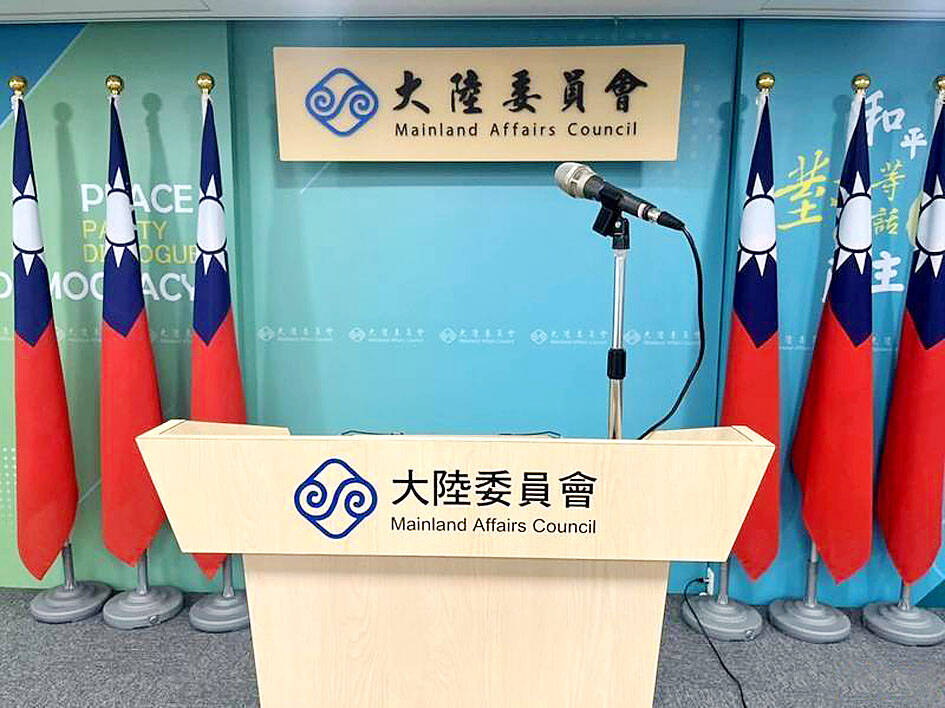
Photo: Chung Li-hua, Taipei Times
Asked whether the number of people applying for a “Taiwan compatriot permit” was increasing, Chen said yes, adding that China welcomes all visitors from Taiwan, whether they are tourists, concertgoers, competing athletes or first-time visitors.
However, the MAC offered a different view, saying it would not rule out that the measure was put out by China’s Taiwan-related departments to show that they are hard at work, as Chinese policies on Taiwan have been lacking this year.
The council warned that reports of Taiwanese being detained in China or have gone missing have increased and urged the public to be aware that the risk to their personal safety has risen if they plan to travel to China.
National Cheng Kung University political science professor Hung Ching-fu (洪敬富) said that the expanded visa-on-arrival program targets Taiwanese youth, trying to lure them to visit China and expose them to “united front” rhetoric.
It aims to create the impression that “the motherland is welcoming” Taiwanese compatriots, Hung said.
Media reports about Taiwanese YouTubers, such as Holger Chen (陳之漢), praising China’s modernization and encouraging Taiwanese to visit China are a weak attempt by Chinese Taiwan-relations offices to demonstrate that the “united front” rhetoric is working, he added.
The TAO yesterday also announced that it would be holding news conferences on a weekly basis — instead of every two weeks.
Hung said the move underscores Beijing’s need to control the discourse on the “united front” rhetoric against Taiwan.
Beijing is stepping up its “united front” rhetoric against Taiwan because the TAO wants to be in control of the cross-strait discourse — not the MAC, Hung added.
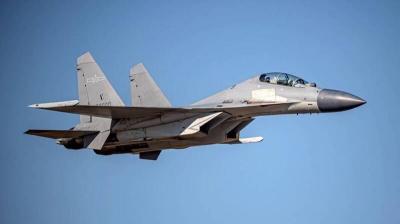
Eight Chinese naval vessels and 24 military aircraft were detected crossing the median line of the Taiwan Strait between 6am yesterday and 6am today, the Ministry of National Defense said this morning. The aircraft entered Taiwan’s northern, central, southwestern and eastern air defense identification zones, the ministry said. The armed forces responded with mission aircraft, naval vessels and shore-based missile systems to closely monitor the situation, it added. Eight naval vessels, one official ship and 36 aircraft sorties were spotted in total, the ministry said.
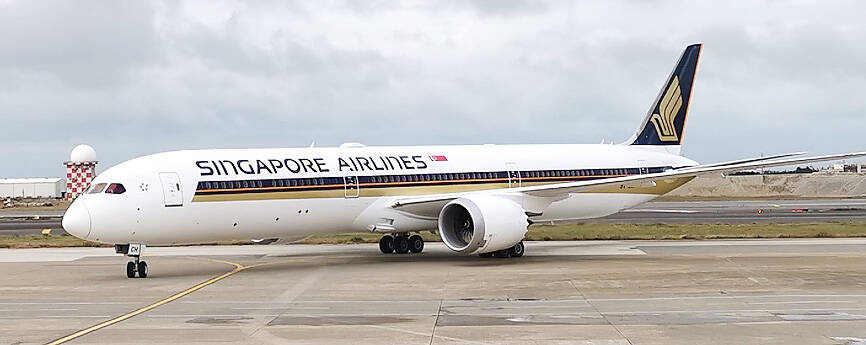
INCREASED CAPACITY: The flights on Mondays, Wednesdays, Fridays and Sundays would leave Singapore in the morning and Taipei in the afternoon Singapore Airlines is adding four supplementary flights to Taipei per week until May to meet increased tourist and business travel demand, the carrier said on Friday. The addition would raise the number of weekly flights it operates to Taipei to 18, Singapore Airlines Taiwan general manager Timothy Ouyang (歐陽漢源) said. The airline has recorded a steady rise in tourist and business travel to and from Taipei, and aims to provide more flexible travel arrangements for passengers, said Ouyang, who assumed the post in July last year. From now until Saturday next week, four additional flights would depart from Singapore on Monday, Wednesday, Friday
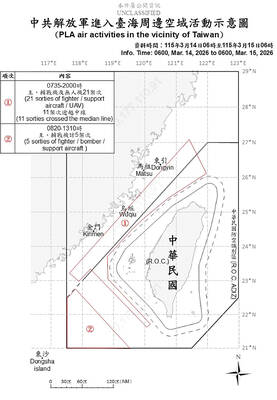
The Ministry of National Defense yesterday reported the return of large-scale Chinese air force activities after their unexplained absence for more than two weeks, which had prompted speculation regarding Beijing’s motives. China usually sends fighter jets, drones and other military aircraft around the nation on a daily basis. Interruptions to such routine are generally caused by bad weather. The Ministry of National Defense said it had detected 26 Chinese military aircraft in the Taiwan Strait over the previous 24 hours. It last reported that many aircraft on Feb. 25, when it spotted 30 aircraft, saying Beijing was carrying out another “joint combat

Taiwan successfully defended its women’s 540 kilogram title and won its first-ever men’s 640 kg title at the 2026 World Indoor Tug of War Championships in Taipei yesterday. In the women’s event, Taiwan’s eight-person squad reached the final following a round-robin preliminary round and semifinals featuring teams from Ukraine, Japan, Thailand, Vietnam, the Basque Country and South Korea. In the finals, they swept the Basque team 2-0, giving the team composed mainly of National Taiwan Normal University students and graduates its second championship in a row, and its fourth in five years. Team captain


 RSS
RSS