


The bitter tribalism that drove the US into a government shutdown is putting compromise out of reach, analysts said — and threatening to turn a staring contest between the Democrats and US President Donald Trump’s Republicans into a protracted crisis.
As the nation enters its second week with federal agencies paralyzed, multiple strategists with vivid memories of previous standoffs said the president and his foes could be in it for the long haul.
“It’s possible this shutdown drags on for weeks, not just days,” said Andrew Koneschusky, a former press secretary for US Senator Chuck Schumer, the Democratic leader at the center of the latest deadlock.
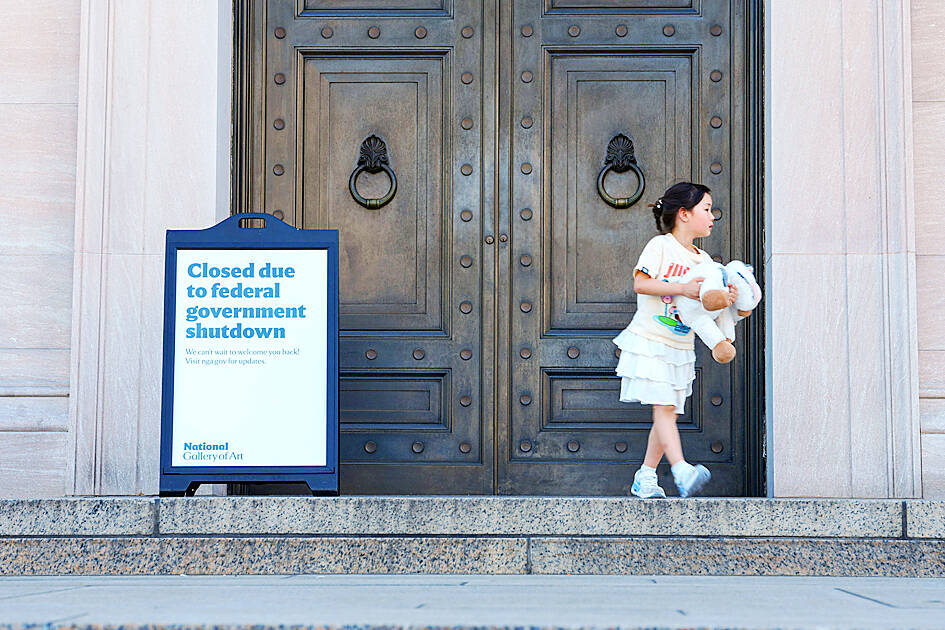
Photo: Reuters
“Right now, both sides are dug in and there’s very little talk of compromise,” he said.
At the heart of the showdown is a Democratic demand for an extension of healthcare subsidies that are due to expire — meaning sharply increased costs for millions of low-income Americans.
On Sunday, Trump blamed minority Democrats for blocking his funding resolution, which needs a handful of their votes.
“They’re causing it. We’re ready to go back,” Trump told reporters at the White House, sounding resigned to a shutdown dragging on.
Trump also told reporters his administration has already started to permanently fire — not merely furlough — federal workers, again blaming his rivals for “causing the loss of a lot of jobs.”
In March, when the threat of a shutdown last loomed, Democrats blinked first, voting for a six-month Republican resolution to keep the coffers stacked despite policy misgivings.
However, Schumer was lambasted by the party’s base, and will be reluctant to cave this time around as he faces potential primary challenges from the left.
For now, Senate Republicans are banking on their Democratic opponents giving in as they repeatedly force votes.
“I could see a temporary agreement coming from both parties by the end of October,” said Jeff Le, a former senior official in California state politics who negotiated with the first Trump administration.
“Anything beyond two months would halt government operations seriously and potentially impact national and homeland security considerations, casting blame on both parties,” he said.
A shift in the strategy would likely depend on either side noticing public sentiment turning against them, analysts said.
Polling so far has been mixed, although Republicans have been taking more flak than Democrats overall. Trump presided over the longest shutdown in history in 2018 and 2019, when federal agencies stopped work for five weeks.
This time around, the president has been ratcheting up pressure by threatening liberal policy priorities and mass layoffs of public sector workers.
James Druckman, a politics professor at the University of Rochester, sees Trump’s intransigence as a reason to believe this standoff could rival the 2019 record.
“The Trump administration views itself as having an unchecked mandate and thus generally does not compromise,” he said.
“Democrats have been critiqued for not standing strongly enough and the last compromise did not result in any positive outcome for Democrats. Thus, politically, they are inclined to stand firm,” he said.
The 2018 and 2019 shutdown cost the economy US$11 billion in the short term, according to the nonpartisan Congressional Budget Office — and US$3 billion was never recovered.
US Secretary of the Treasury Scott Bessent has warned that the latest shutdown could wreak its own havoc on GDP growth.
For California-based financial analyst Michael Ashley Schulman, the economic realities of the shutdown might be what end up forcing compromise.
“If Wall Street gets spooked and Treasury yields spike, even the most ideologically caffeinated will suddenly discover a deep commitment to bipartisan solutions,” he said.
Not all analysts are gloomy about the prospects for a quick resolution.
Aaron Cutler, head of the congressional oversight and investigations practice at global law firm Hogan Lovells, and a former staffer in the House, sees the shutdown lasting 12 days at most.
“Senate Democrats will blink first... While the shutdown continues, there will be no congressional hearings and a lot of work at the agencies will be paused,” he said.
“That’s a win for many Democrats in Congress, but they don’t want the blame for it,” he said.

SPEAKING OUT: After Siranudh Scott’s allegations surfaced, celebrities and public figures took to social media to share their own experiences of sexual misconduct and abuse A high-profile alleged sexual abuse case within a wealthy Thai beer brewing family has prompted a wave of painful accounts from survivors of unconnected abuse in the conservative nation. Siranudh Scott, a member of the billionaire Thai family that founded the ubiquitous Singha beer brand, posted an emotional video this month accusing his elder brother Sunit of repeatedly abusing him when he was a teenager. Sunit, who is in his 30s, later denied the allegations in a video posted online, but Singha parent Boonrawd dismissed him from his executive role with the company on Tuesday last week. “I felt I needed to speak

SEEKING ORDER: Rodrigo Paz said that ‘anyone who wants to destroy the nation will have to deal with this president and the full force of the constitution’ Bolivian President Rodrigo Paz on Wednesday said that the nation was at a “breaking point” after nearly a month of protests that have caused shortages of food, fuel and medicine. Paz, who took office six months ago amid the worst economic crisis there in four decades, is battling a groundswell of fury over his policies. The political capital, La Paz, has been besieged by low-income workers and members of the indigenous majority calling for his resignation. “The country needs order and is reaching breaking point,” the 58-year-old said at a public event in La Paz, renewing his appeal for dialogue. On Tuesday, the Bolivian

A Hong Kong astronaut is to join a Chinese space mission for the first time as part of a three-person crew launching today, as Beijing edges closer to its goal of landing people on the moon. The Tiangong space station — crewed by teams of three astronauts that are typically rotated every six months — is the crown jewel of China’s space program, boosted by billions in state investment in a bid to catch up with the US and Russia. The Shenzhou-23 mission is to blast off at 11:08pm from the Jiuquan Satellite Launch Center in northwestern China, carrying three astronauts to

UPGRADED ALERT: The risk inside DR Congo is now considered ‘very high,’ while neighboring countries face a ‘high’ threat as the outbreak continues, the WHO said Ebola is spreading faster than responders can track it in eastern Congo, where health workers managed to follow up with barely one in five identified contacts in a single day. Authorities in the Democratic Republic of the Congo (DR Congo) reported 83 confirmed infections, 746 suspected cases and 1,603 identified contacts as of Thursday, but health workers were able to follow up on only 342 contacts that day — about 21 percent of the total under monitoring — data released by the DR Congo Ministry of Public Health on Friday showed. The figures suggest the response is falling behind the outbreak itself,


 RSS
RSS