


A man on Sunday opened fire in a Mormon church in Michigan and set the building ablaze, killing at least four people in the latest deadly tragedy that US President Donald Trump called part of a national “epidemic of violence.”
Police in the northern US state said the shooter first rammed the church with his vehicle before opening fire with an assault rifle, and then set the building on fire.
The attacker was killed by police in the parking lot eight minutes after the first emergency call came in, Grand Blanc Police Chief William Renye told a news conference.
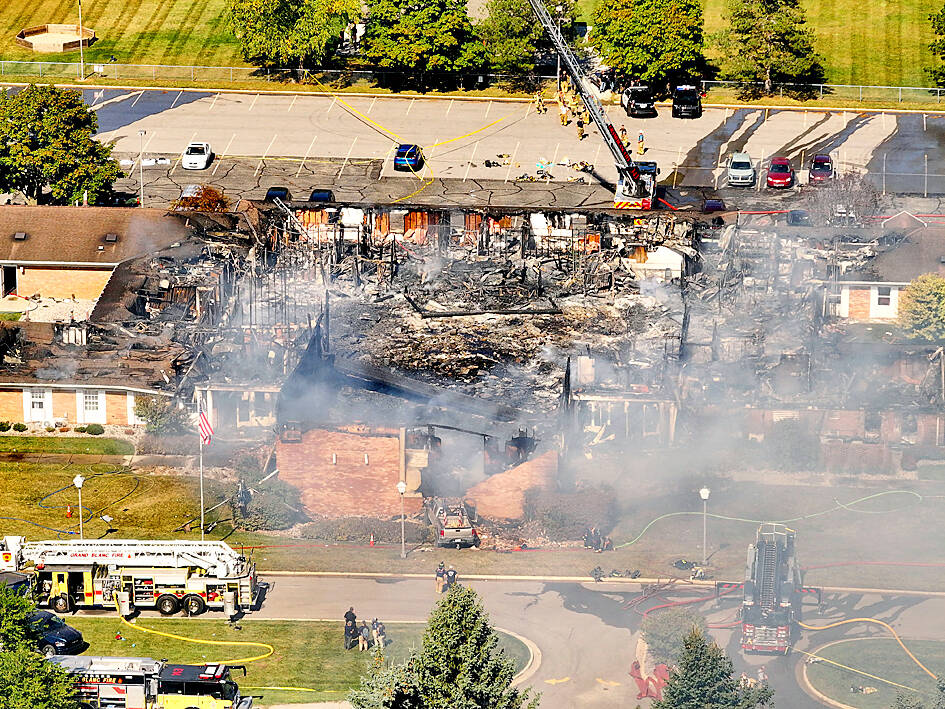
Photo: AP
Renye said that, in addition to two deceased victims announced earlier in the day, two more bodies had been recovered among debris at the burned-down church, with search efforts ongoing.
He said earlier that eight people had also been wounded in the attack, one of whom was in critical condition.
Journalists in the adjacent town of Burton saw a large police presence outside the home of the suspected shooter, whom Renye identified as Thomas Jacob Sanford, aged 40.
Renye and other officials did not provide any further details on Sanford.
US media reports said that he had grown up in the area and was a military veteran.
Images of the aftermath at the Church of Jesus Christ of Latter-day Saints in Grand Blanc, a suburb of the city of Flint, showed most of the building reduced to ashes.
Authorities said the suspect used an accelerant, believed to be gasoline, and set fire to the church “deliberately.”
Some suspected explosive devices were found, but it was unclear if they were used to start the fire, officials said.
Photographs also showed the truck apparently driven by the attacker into the side of the building, with two US flags on poles in the vehicle’s rear.
FBI Special Agent Reuben Coleman told the news conference that the FBI was now leading the investigation and was looking at the attack “as an act of targeted violence.”
Renye earlier said that hundreds were inside when the attack began and that more victims might be found among the debris.
Trump called the shooting “horrendous” and said it was “yet another targeted attack on Christians in the United States of America.”
The Church of Jesus Christ of Latter-day Saints, whose leader died the previous night aged 101, called Sunday’s attack a “tragic act of violence.”
“Places of worship are meant to be sanctuaries of peacemaking, prayer and connection. We pray for peace and healing for all involved,” it wrote on social media.
Founded in 1830, the Mormon church considers itself a Christian body, but bases its doctrines on the Book of Mormon, a text its followers say contains a fuller version of the words of Jesus Christ than that recorded in the Bible.
Based in the western US state of Utah, there are Mormon churches all over the world, with millions of adherents.
The US, where firearms are readily available, has a long history of gun violence, but tensions have soared after a series of high-profile attacks, including the assassination of right-wing activist Charlie Kirk in Utah and a deadly shooting at a federal immigration enforcement facility in Texas.
Sunday’s attack also comes a month after a mass shooting at a Catholic church and school in Minnesota, in which two children were killed while attending Mass, and several others were severely wounded.
Political divisions have grown deeper in the wake of the attacks, with Trump launching a campaign targeting left-wing groups he accuses of being “domestic terrorists.”

SPEAKING OUT: After Siranudh Scott’s allegations surfaced, celebrities and public figures took to social media to share their own experiences of sexual misconduct and abuse A high-profile alleged sexual abuse case within a wealthy Thai beer brewing family has prompted a wave of painful accounts from survivors of unconnected abuse in the conservative nation. Siranudh Scott, a member of the billionaire Thai family that founded the ubiquitous Singha beer brand, posted an emotional video this month accusing his elder brother Sunit of repeatedly abusing him when he was a teenager. Sunit, who is in his 30s, later denied the allegations in a video posted online, but Singha parent Boonrawd dismissed him from his executive role with the company on Tuesday last week. “I felt I needed to speak

A Hong Kong astronaut is to join a Chinese space mission for the first time as part of a three-person crew launching today, as Beijing edges closer to its goal of landing people on the moon. The Tiangong space station — crewed by teams of three astronauts that are typically rotated every six months — is the crown jewel of China’s space program, boosted by billions in state investment in a bid to catch up with the US and Russia. The Shenzhou-23 mission is to blast off at 11:08pm from the Jiuquan Satellite Launch Center in northwestern China, carrying three astronauts to
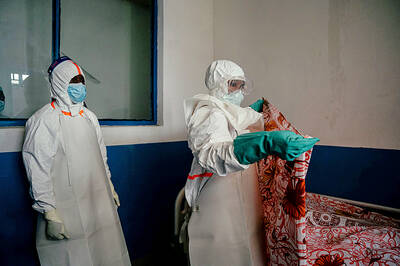
UPGRADED ALERT: The risk inside DR Congo is now considered ‘very high,’ while neighboring countries face a ‘high’ threat as the outbreak continues, the WHO said Ebola is spreading faster than responders can track it in eastern Congo, where health workers managed to follow up with barely one in five identified contacts in a single day. Authorities in the Democratic Republic of the Congo (DR Congo) reported 83 confirmed infections, 746 suspected cases and 1,603 identified contacts as of Thursday, but health workers were able to follow up on only 342 contacts that day — about 21 percent of the total under monitoring — data released by the DR Congo Ministry of Public Health on Friday showed. The figures suggest the response is falling behind the outbreak itself,

SEEKING ORDER: Rodrigo Paz said that ‘anyone who wants to destroy the nation will have to deal with this president and the full force of the constitution’ Bolivian President Rodrigo Paz on Wednesday said that the nation was at a “breaking point” after nearly a month of protests that have caused shortages of food, fuel and medicine. Paz, who took office six months ago amid the worst economic crisis there in four decades, is battling a groundswell of fury over his policies. The political capital, La Paz, has been besieged by low-income workers and members of the indigenous majority calling for his resignation. “The country needs order and is reaching breaking point,” the 58-year-old said at a public event in La Paz, renewing his appeal for dialogue. On Tuesday, the Bolivian


 RSS
RSS