


Another tropical storm barreled across Philippine islands yesterday, causing at least four deaths and the evacuations of more than 433,000 people from landslide and flood-prone villages long battered by typhoons.
Bualoi, which has weakened since making landfall overnight, was the latest of back-to-back storms from the Pacific to threaten Asia.
Typhoon Ragasa, one of the strongest to hit in years, caused at least 25 deaths in the northern Philippines and Taiwan, mostly from flooding, before making landfall in China and dissipating over Vietnam.
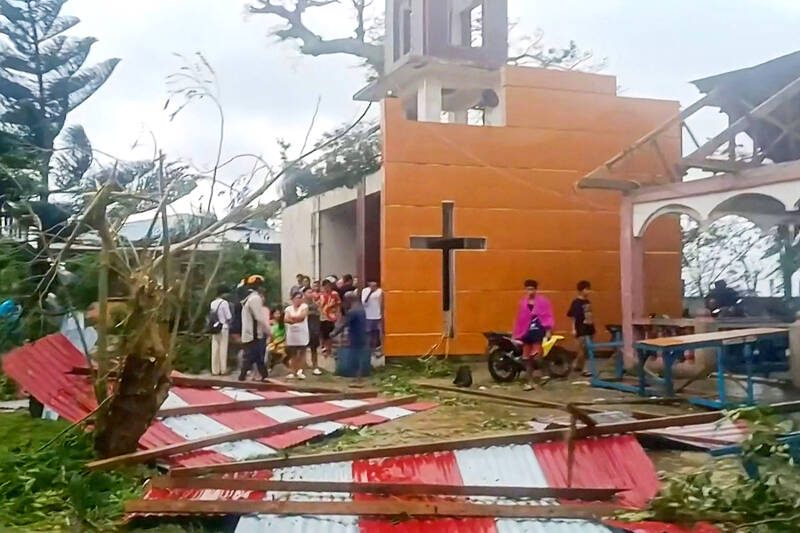
Photo: AFP
Bualoi made landfall in the Philippine town of San Policarpo in Eastern Samar province late on Thursday with sustained winds of 110kph, knocking out power in east-central provinces and setting off flooding and two minor landslides, the country’s disaster-mitigation agency said.
More than 433,000 were evacuated to government emergency shelters as the storm approached, including in Albay province, where villagers on the foothills of Mayon, one of the country’s most active volcanoes, were asked to move to safety due to possible volcanic mudflows, Bernardo Rafaelito Alejandro IV from the Philippine Office of Civil Defense told reporters.
The four deaths were in the central island province of Masbate. Three were hit separately by a falling tree, a collapsed wall and falling debris and a fourth was hit by lightning Thursday night, officials said.
“We need clearing operations because most of our road networks are not really passable for food and health assistance to pass,” Masbate Governor Ricardo Kho told a news conference.
“We also need help to have our ports reopened as early as possible for us to receive help from different provinces,” he said.
The fast-moving storm, which had a rain and wind band of about 450km from its center, was blowing northwest and was expected to blow over densely populated coastal provinces south of the capital, Manila, later yesterday before entering the South China Sea, a Philippine forecaster said.
It could restrengthen to a typhoon on a course toward Vietnam, they added.
Bualoi, locally named Opong, was the 15th tropical cyclone to hit the Philippines this year.

SPEAKING OUT: After Siranudh Scott’s allegations surfaced, celebrities and public figures took to social media to share their own experiences of sexual misconduct and abuse A high-profile alleged sexual abuse case within a wealthy Thai beer brewing family has prompted a wave of painful accounts from survivors of unconnected abuse in the conservative nation. Siranudh Scott, a member of the billionaire Thai family that founded the ubiquitous Singha beer brand, posted an emotional video this month accusing his elder brother Sunit of repeatedly abusing him when he was a teenager. Sunit, who is in his 30s, later denied the allegations in a video posted online, but Singha parent Boonrawd dismissed him from his executive role with the company on Tuesday last week. “I felt I needed to speak

SEEKING ORDER: Rodrigo Paz said that ‘anyone who wants to destroy the nation will have to deal with this president and the full force of the constitution’ Bolivian President Rodrigo Paz on Wednesday said that the nation was at a “breaking point” after nearly a month of protests that have caused shortages of food, fuel and medicine. Paz, who took office six months ago amid the worst economic crisis there in four decades, is battling a groundswell of fury over his policies. The political capital, La Paz, has been besieged by low-income workers and members of the indigenous majority calling for his resignation. “The country needs order and is reaching breaking point,” the 58-year-old said at a public event in La Paz, renewing his appeal for dialogue. On Tuesday, the Bolivian
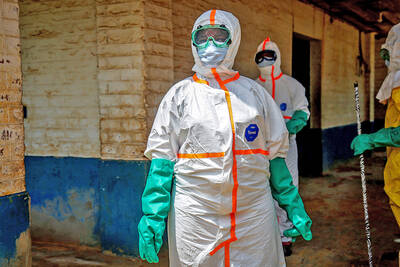
COMMUNITY CONFLICT: Concerns about disease spread from corpses has run up against friends and families’ desire to bury their dead as infection spreads in the area Angry residents of a town at the epicenter of the Ebola outbreak in the Democratic Republic of the Congo (DR Congo) attacked and burned a tent that was part of a health center where people are being treated for the virus, the staff there said Saturday. It was the second such attack in the region in a week. No one was hurt in the attack, according to reports but as patients ran out to escape the fire, 18 people with suspected Ebola infections fled the facility and are unaccounted for, a hospital director said. Angry residents arrived at the clinic in the

INSURGENT ACTION: A local independence movement in Balochistan, alleged by Pakistan’s government to be backed by India, claimed responsibility for the strike A suicide bomber detonated an vehicle-borne IED near a railway as a passenger train passed through the southwestern Pakistani city of Quetta yesterday, killing at least 23 people and wounding over 70, officials said. The explosion caused two of the train cars to overturn and catch fire, according to footage shared online. The attack happened in an area where security forces are usually stationed, badly damaging several nearby buildings and smashing more than a dozen vehicles parked along the road, according to witnesses and images circulating on social media. Doctors at local hospitals said they had received the wounded, with 20 in critical


 RSS
RSS