


US President Donald Trump on Monday said that a strike on an alleged drug trafficking boat from Venezuela killed three people, as Venezuelan President Nicolas Maduro vowed to resist Washington’s “aggression.”
Trump’s administration has faced questions over the legality of deadly military strikes on suspected drug boats since the first such attack earlier this month which killed 11 people.
The fresh attack also comes amid spiraling tensions in the Caribbean as a large US naval buildup sparks speculation that Washington might be seeking regime change in Caracas.
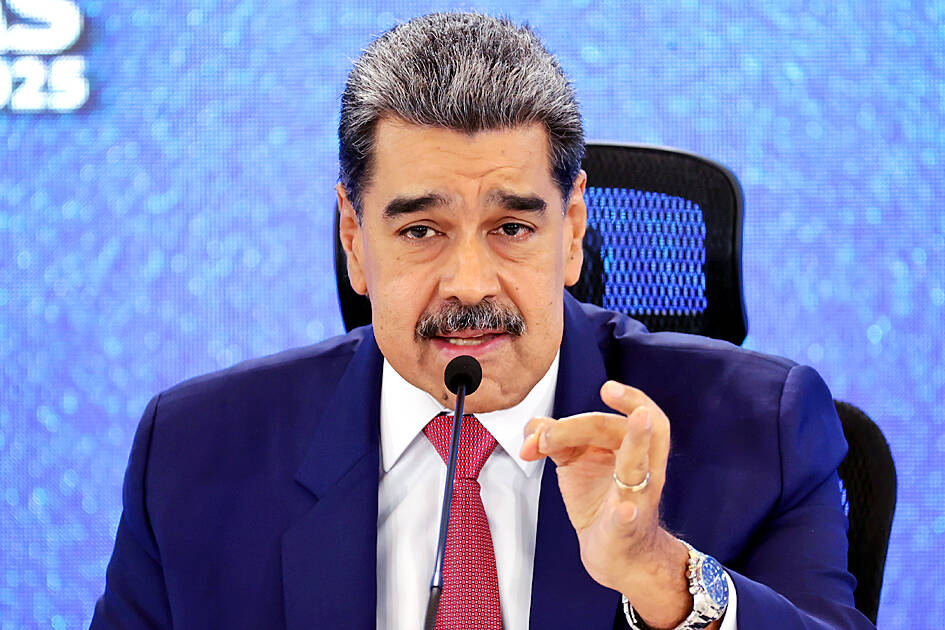
Photo: EPA
Trump posted a video of a boat bobbing in the sea before exploding in a ball of orange flame as he announced the strike on social media, adding that it resulted in “3 male terrorists killed in action.”
The strikes have raised questions about whether they are within international law or effectively amount to extrajudicial killings, but Trump insisted the US was confident that the dead men were traffickers.
“We have proof,” Trump told reporters in the Oval Office.
“All you have to do is look at the cargo that was, like, it’s spattered all over the ocean. Big bags of cocaine and fentanyl all over the place,” he said.
Tensions between longtime foes the US and Venezuela reached new heights after Trump dispatched eight warships to waters near Venezuela to pressure Maduro.
The US accuses the leftist of heading a cocaine trafficking cartel and has doubled its bounty for his capture to US$50 million. Much of the international community rejected his re-election in July last year, with the opposition claiming widespread fraud.
Maduro hit back on Monday, branding US Secretary of State Marco Rubio the “lord of death and war” over his tough rhetoric on Latin American cartels.
Referring to the US naval buildup and the earlier boat attack, Maduro told reporters that Caracas would “fully” exercise its “legitimate right to defend itself.”
Maduro often accuses the US of attempting regime change in his nation.
Speculation has been swirling that the Trump administration could be preparing targeted strikes against Latin American drug cartels, including in Venezuela.
Trump on Sunday refused to deny it was a possibility.
“We’ll see what happens,” Trump told reporters when asked if strikes on the Venezuelan mainland were possible. “Venezuela is sending us their gang members, their drug dealers and drugs. It’s not acceptable.”
Washington earlier this month dramatically upped the ante by blowing up a speedboat with 11 people on board that it claimed was smuggling drugs from Venezuela.
In an interview with Fox News during a visit to Jerusalem on Monday, Rubio defended the attack on the boat traveling in international waters, amid questions over its legality.
“We have 100 percent fidelity and certainty that that boat was involved in that trafficking of those drugs,” Rubio said.
Maduro said communications with the Trump administration had broken down over the US “aggression,” adding that his nation would “confront it.”
He leveled much of the blame at the hawkish Rubio, the son of Cuban immigrants to the US who has been a vehement critic of left-wing authoritarian governments in Latin America.
Although most of the cartels on the terrorism list are Mexican, Washington has focused its attacks on Venezuela.
Maduro said the “bomb threats” had caused a complete collapse in relations between the two nations, which broke off diplomatic ties in 2019.
In the face of the US pressure, he has deployed 25,000 troops to Venezuela’s border with Colombia, a transit point on the Latin American drug trafficking route, and along the Caribbean coast.
Thousands of people have also joined a civilian militia intended as backup for the military.
At the weekend, they thronged training camps where they learned to handle and fire weapons.
“If they [the US] try to attack the homeland, the entire population will defend it,” said Jenny Rojas, a 54-year-old lawyer who was among the recruits.

SPEAKING OUT: After Siranudh Scott’s allegations surfaced, celebrities and public figures took to social media to share their own experiences of sexual misconduct and abuse A high-profile alleged sexual abuse case within a wealthy Thai beer brewing family has prompted a wave of painful accounts from survivors of unconnected abuse in the conservative nation. Siranudh Scott, a member of the billionaire Thai family that founded the ubiquitous Singha beer brand, posted an emotional video this month accusing his elder brother Sunit of repeatedly abusing him when he was a teenager. Sunit, who is in his 30s, later denied the allegations in a video posted online, but Singha parent Boonrawd dismissed him from his executive role with the company on Tuesday last week. “I felt I needed to speak
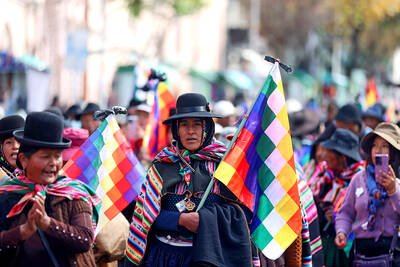
SEEKING ORDER: Rodrigo Paz said that ‘anyone who wants to destroy the nation will have to deal with this president and the full force of the constitution’ Bolivian President Rodrigo Paz on Wednesday said that the nation was at a “breaking point” after nearly a month of protests that have caused shortages of food, fuel and medicine. Paz, who took office six months ago amid the worst economic crisis there in four decades, is battling a groundswell of fury over his policies. The political capital, La Paz, has been besieged by low-income workers and members of the indigenous majority calling for his resignation. “The country needs order and is reaching breaking point,” the 58-year-old said at a public event in La Paz, renewing his appeal for dialogue. On Tuesday, the Bolivian

‘CROSSING THE LINE’: China’s embassy in Seoul criticized US Forces Korea Commander General Xavier Brunson, asking if his ‘hostile’ remarks were authorized by Washington South Korea and the US are in talks over recent public remarks by the commander of US Forces Korea, Seoul’s presidential office said yesterday, after the comments drew sharp criticism from China. In a recent podcast interview, US Forces Korea Commander General Xavier Brunson described South Korea as “the dagger in the heart of Asia” from China’s east coast, prompting the Chinese embassy in Seoul to say that he had “truly crossed the line.” The interview came amid growing speculation that Washington might seek to expand the role of US Forces Korea in countering the growing regional influence of China, a key

Forecasters in Europe yesterday warned of exceptional heat as record temperatures driven by a “heat dome” push temperatures well above seasonal norms across the continent. The surge follows a record-breaking Monday, with France logging its hottest day in the month of May on record, its weather agency said, and the UK also posting unprecedented highs. A so-called “heat dome” of warm air from northern Africa trapped under a high-pressure system over western Europe is behind the high temperatures not usually seen until high summer. Restrictions on outdoor work were imposed in parts of Italy, beaches in southwest France filled earlier than usual and


 RSS
RSS