


Ned is a perfectly nice snail. If he had a dating profile, it might read: good listener, stable home, likes broccoli, seeks love.
However, he has already exhausted his local options and it is not because he is picky or unappealing. Instead, he is a common garden snail with an uncommon anatomical problem that is ruining his love life.
Ned’s shell coils to the left, not the right, making him one of the 1 in 40,000 snails whose sex organs do not line up with those of the rest of their species. Unless another lefty snail is found, the young gastropod faces a lifetime of unintentional celibacy.
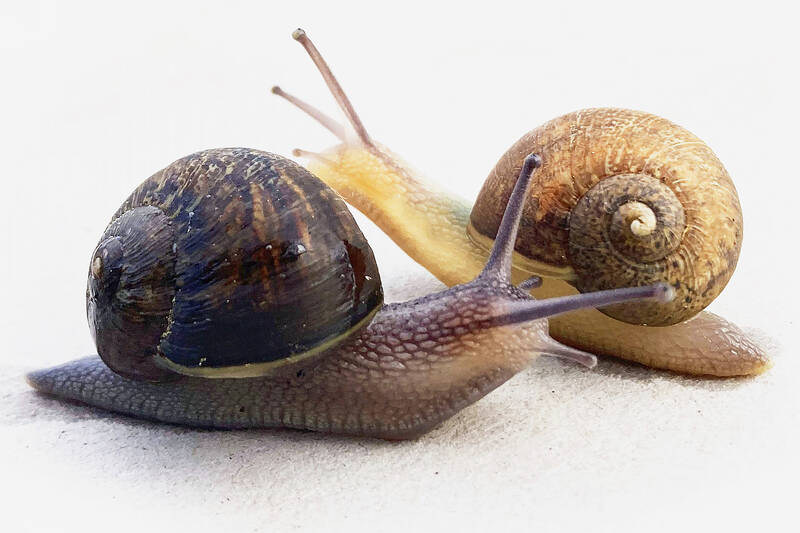
Photo: AP
That dire prospect prompted a New Zealand nature lover who found the snail in her garden last month to launch a campaign to find his perfect match, but Ned’s quest for true love, perhaps predictably, is slow.
Giselle Clarkson was weeding her home vegetable patch in Wairarapa on the North Island when a snail tumbling out of the leafy greens caught her eye.
Clarkson, the author and illustrator of a nature book, The Observologist, has an affection for snails and had long been on the lookout for a sinistral, or left-coiled shell.
“I knew immediately that I couldn’t just toss the snail back into the weeds with the others,” she said.
Instead, she sent a photograph of the snail, pictured alongside a right-coiled gastropod as proof, to her colleagues at New Zealand Geographic.
The magazine launched a nationwide campaign to find a mate for Ned, named for the left-handed character Ned Flanders in The Simpsons, who once opened a store called The Leftorium. That explains the male pronouns some use for Ned, although snails are hermaphrodites with sex organs on their necks and the capacity for both eggs and sperm.
“When you have a right-coiling snail and a left-coiling snail, they can’t slide up and get their pieces meeting in the right position,” Clarkson said. “So a lefty can only mate with another lefty.”
The fact that romantic hopefuls need not be a sex match should have boosted Ned’s prospects, but his inbox has remained empty except for photos of “optimistically misidentified right-coiling snails,” Clarkson said.
“We’ve had lots of enthusiasm and encouragement for Ned, a lot of people who can relate and really want the best for them, as a symbol of hope for everyone who’s looking for love, but as yet, no lefties have been forthcoming,” she said.
Ned’s relatable romantic woes have attracted global news coverage, but New Zealand’s strict biosecurity controls mean long-distance love probably is not on the cards.
However, other left-coiled snails have gotten lucky through public campaigns to find mates before, so Clarkson remains optimistic.
In 2017, the death of British sinistral snail Jeremy — named for left-wing politician and gardening lover Jeremy Corbyn — prompted a New York Times obituary after his eventful two-year life.
A quest to find left-coiled mates for Jeremy prompted the discovery of two prospective matches, who initially preferred each other, but Jeremy got the hang of it eventually, and by the time of his death had 56 offspring — all of them right-coiled.
It was a fascinating chance for scientists to investigate what produces left-coiled snails, with the cause most likely a rare genetic mutation.
Studies of snail farms in Europe prompted researchers to estimate that about 1 in every 40,000 snails is a lefty.
In Wairarapa, Ned’s constant presence in a tank in Clarkson’s living room has kindled a life of quiet companionship and existential questions.
“Maybe snails don’t have a concept of loneliness,” Clarkson found herself thinking: What if Ned didn’t mind being single?
However the young snail feels about his prospects, Ned probably has time.
Garden snails live for two to five years and his shell suggests he is about six months old, Clarkson said.
Still, she feels pressure to see him romantically fulfilled.
“I have never felt this stressed about the welfare of a common garden snail before,” she said. “I check on Ned almost obsessively.”

Crowds in Bangladesh are flocking to snap photographs with an unlikely social media star — an albino buffalo with flowing blond hair nicknamed “Donald Trump” that is due to be sacrificed within days. Owner Zia Uddin Mridha, 38, said his brother named the 700kg bull over its flowing helmet of hair resembling the signature look of the US president. “My younger brother picked this name because of the buffalo’s extraordinary hair,” he said at his farm in Narayanganj, just outside the capital, Dhaka. Mridha said that a constant stream of curious visitors — social media fans, onlookers and children — have come throughout

It began as a satirical online project. Now millions of young people in India are flocking to it as an outlet for their frustration. A parody political party called the Cockroach Janta Party, with the insect as its symbol, has exploded across India’s social media by turning absurdist humor into protest. Memes and short videos mocking corruption, joblessness and political dysfunction have flooded social media sites, where millions of users are embracing the cockroach — known for its ability to survive harsh conditions — as a tongue-in-cheek symbol of endurance. The online movement’s rise has been unusually rapid. The Cockroach Janta Party (CJP)

HOTTER: While Indians are accustomed to summer heat, climate change has caused northwestern India to warm faster than other parts of the country, an academic said Roads and markets have emptied during afternoons and some farmers have switched to nighttime work to avoid scorching temperatures as a heat wave grips large parts of India. The India Meteorological Department forecast maximum temperatures for yesterday of about 45°C in the capital, New Delhi, where authorities have opened temporary “cooling zones” to help people cope. The weather department warned that conditions would likely persist across several northern regions in the coming days, with temperatures staying well above seasonal averages. Authorities urged people to stay indoors during the hottest hours and take precautions against heat-related illnesses. India declares a heat wave whenever maximum temperatures

BIGGER ROLE: Beijing has said it maintains an impartial stance on the war in Ukraine, but by training Russian troops, China is far more involved than previously known China’s armed forces secretly trained about 200 Russian military personnel in China late last year, and some have since returned to fight in Ukraine, according to three European intelligence agencies and documents seen by Reuters. While China and Russia have held a number of joint military exercises since Moscow’s full-scale invasion of Ukraine in 2022, Beijing has repeatedly said that it is neutral in the conflict and presents itself as a peace mediator. The covert training sessions, which predominantly focused on the use of drones, were outlined in a dual-language Russian-Chinese agreement signed by senior Russian and Chinese officers in Beijing on


 RSS
RSS