


Australia yesterday said that it would oblige tech giants to prevent online tools being used to create artificial intelligence (AI)-generated nude images or stalk people without detection.
The government would work with industry on developing new legislation against the “abhorrent technologies,” it said in a statement, without providing a timeline.
“There is no place for apps and technologies that are used solely to abuse, humiliate and harm people, especially our children,” Australian Minister for Communications and Minister for Sport Anika Wells said.

Photo: EPA-EFE
“Nudify” apps — AI tools that digitally strip off clothing — have exploded online, sparking warnings that so-called sextortion scams targeting children are surging.
The government would use “every lever” to restrict access to “nudify” and stalking apps, placing the onus on tech companies to block them, Wells said.
“While this move won’t eliminate the problem of abusive technology in one fell swoop, alongside existing laws and our world-leading online safety reforms, it will make a real difference in protecting Australians,” she said.
The proliferation of AI tools has led to new forms of abuse impacting children, including pornography scandals at universities and schools worldwide, where teenagers create sexualized images of their classmates.
A Save the Children survey found that one in five young people in Spain have been victims of deepfake nudes, with those images shared online without their consent.
Any new legislation would aim to ensure that legitimate and consent-based AI and online tracking services are not inadvertently impacted, the government said.
Australia has been at the forefront of global efforts to curb Internet harm, especially that targeted at children.
The nation passed landmark laws in November last year restricting children younger than 16 from social media.
Social media giants — which face fines of up to A$49.5 million (US$32 million) if they fail to comply with the ban — have described the laws as “vague,” “problematic” and “rushed.”
It is unclear how people would verify their ages to sign up to social media.
The law comes into force by the end of this year.
An independent study ordered by the government found this week that age checking can be done “privately, efficiently and effectively.”
Age assurance is possible through a range of technologies, but “no single solution fits all contexts,” the study’s final report said.

SPEAKING OUT: After Siranudh Scott’s allegations surfaced, celebrities and public figures took to social media to share their own experiences of sexual misconduct and abuse A high-profile alleged sexual abuse case within a wealthy Thai beer brewing family has prompted a wave of painful accounts from survivors of unconnected abuse in the conservative nation. Siranudh Scott, a member of the billionaire Thai family that founded the ubiquitous Singha beer brand, posted an emotional video this month accusing his elder brother Sunit of repeatedly abusing him when he was a teenager. Sunit, who is in his 30s, later denied the allegations in a video posted online, but Singha parent Boonrawd dismissed him from his executive role with the company on Tuesday last week. “I felt I needed to speak

SEEKING ORDER: Rodrigo Paz said that ‘anyone who wants to destroy the nation will have to deal with this president and the full force of the constitution’ Bolivian President Rodrigo Paz on Wednesday said that the nation was at a “breaking point” after nearly a month of protests that have caused shortages of food, fuel and medicine. Paz, who took office six months ago amid the worst economic crisis there in four decades, is battling a groundswell of fury over his policies. The political capital, La Paz, has been besieged by low-income workers and members of the indigenous majority calling for his resignation. “The country needs order and is reaching breaking point,” the 58-year-old said at a public event in La Paz, renewing his appeal for dialogue. On Tuesday, the Bolivian
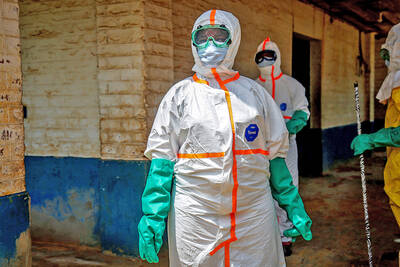
COMMUNITY CONFLICT: Concerns about disease spread from corpses has run up against friends and families’ desire to bury their dead as infection spreads in the area Angry residents of a town at the epicenter of the Ebola outbreak in the Democratic Republic of the Congo (DR Congo) attacked and burned a tent that was part of a health center where people are being treated for the virus, the staff there said Saturday. It was the second such attack in the region in a week. No one was hurt in the attack, according to reports but as patients ran out to escape the fire, 18 people with suspected Ebola infections fled the facility and are unaccounted for, a hospital director said. Angry residents arrived at the clinic in the

Forecasters in Europe yesterday warned of exceptional heat as record temperatures driven by a “heat dome” push temperatures well above seasonal norms across the continent. The surge follows a record-breaking Monday, with France logging its hottest day in the month of May on record, its weather agency said, and the UK also posting unprecedented highs. A so-called “heat dome” of warm air from northern Africa trapped under a high-pressure system over western Europe is behind the high temperatures not usually seen until high summer. Restrictions on outdoor work were imposed in parts of Italy, beaches in southwest France filled earlier than usual and


 RSS
RSS