


Colombian presidential candidate Miguel Uribe has died two months after being shot at a campaign rally, his family said on Monday, as the attack rekindled fears of a return to the nation’s violent past.
The 39-year-old conservative senator, a grandson of former Colombian president Julio Cesar Turbay (1978-1982), was shot in the head and leg on June 7 at a rally in the capital, Bogota, by a suspected 15-year-old hitman.
Despite signs of progress in the past few weeks, his doctors on Saturday announced he had a new brain hemorrhage.
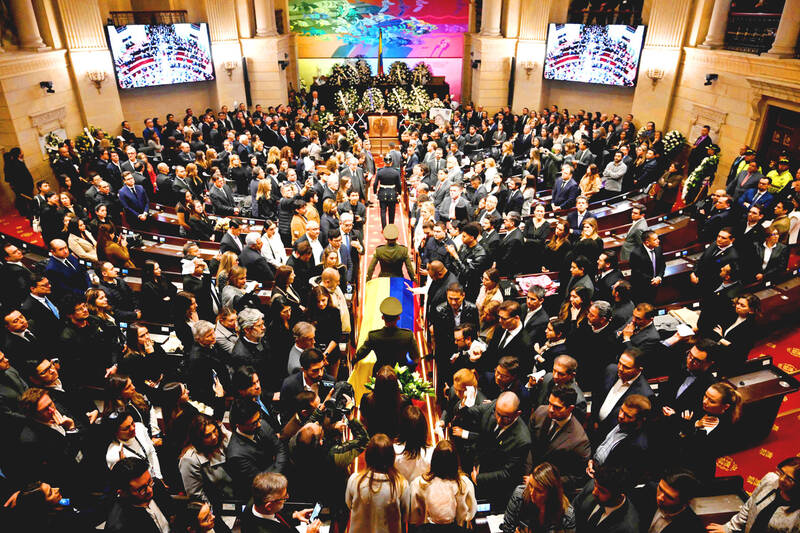
Photo: AFP
“To break up a family is the most horrific act of violence that can be committed,” his widow, Maria Claudia Tarazona, said at his wake on Monday, where she thanked her husband’s medical team for their efforts.
She attended the state ceremony at the National Capitol in Bogota, where Uribe’s body would remain for public viewing until today.
Authorities have arrested six suspects linked to the attack, including the alleged shooter, who was captured at the scene by Uribe’s bodyguards.
Following a nationwide search, police announced the arrest of an alleged mastermind behind the attack, Elder Jose Arteaga Hernandez, alias “El Costeno.”
Police have also pointed to a dissident wing of the defunct Revolutionary Armed Forces of Colombia guerrilla group as being behind the assassination.
The attack on Uribe, a leading candidate ahead of next year’s presidential election, has reopened old wounds in a country racked by violence.
His mother, journalist Diana Turbay, was killed in a botched 1991 police operation to free her from cocaine kingpin Pablo Escobar’s Medellin cartel.
Four presidential candidates were assassinated during the worst phase of violence in the 1980s and 1990s under Escobar, who terrorized citizens of Bogota, Medellin and elsewhere with a campaign of bombings.
Colombian President Gustavo Petro, of whom Uribe was a fierce critic, wrote on social media that the government’s role was to “repudiate crime ... regardless of ideology” and assured the safety of Colombians was his top priority.
“Violence cannot continue to mark our destiny,” Colombian Vice President Francia Marquez wrote on social media. “Democracy is not built with bullets or blood, it is built with respect, with dialogue.”
Uribe had fiercely criticized Petro’s strategy of “total peace,” based on engaging all of Colombia’s remaining armed groups, including drug traffickers, in dialogue.
He announced in October he would seek to succeed the term-limited Petro in the election in May next year.
“Evil destroys everything, they killed hope. May Miguel’s struggle be a light that illuminates Colombia’s rightful path,” former Colombian president Alvaro Uribe wrote on X.

SPEAKING OUT: After Siranudh Scott’s allegations surfaced, celebrities and public figures took to social media to share their own experiences of sexual misconduct and abuse A high-profile alleged sexual abuse case within a wealthy Thai beer brewing family has prompted a wave of painful accounts from survivors of unconnected abuse in the conservative nation. Siranudh Scott, a member of the billionaire Thai family that founded the ubiquitous Singha beer brand, posted an emotional video this month accusing his elder brother Sunit of repeatedly abusing him when he was a teenager. Sunit, who is in his 30s, later denied the allegations in a video posted online, but Singha parent Boonrawd dismissed him from his executive role with the company on Tuesday last week. “I felt I needed to speak

A Hong Kong astronaut is to join a Chinese space mission for the first time as part of a three-person crew launching today, as Beijing edges closer to its goal of landing people on the moon. The Tiangong space station — crewed by teams of three astronauts that are typically rotated every six months — is the crown jewel of China’s space program, boosted by billions in state investment in a bid to catch up with the US and Russia. The Shenzhou-23 mission is to blast off at 11:08pm from the Jiuquan Satellite Launch Center in northwestern China, carrying three astronauts to
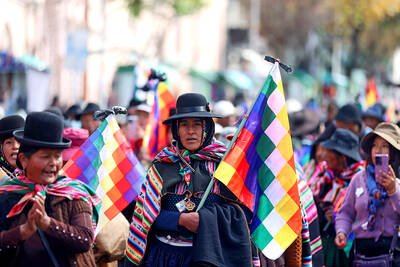
SEEKING ORDER: Rodrigo Paz said that ‘anyone who wants to destroy the nation will have to deal with this president and the full force of the constitution’ Bolivian President Rodrigo Paz on Wednesday said that the nation was at a “breaking point” after nearly a month of protests that have caused shortages of food, fuel and medicine. Paz, who took office six months ago amid the worst economic crisis there in four decades, is battling a groundswell of fury over his policies. The political capital, La Paz, has been besieged by low-income workers and members of the indigenous majority calling for his resignation. “The country needs order and is reaching breaking point,” the 58-year-old said at a public event in La Paz, renewing his appeal for dialogue. On Tuesday, the Bolivian
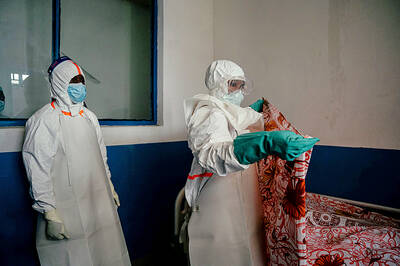
UPGRADED ALERT: The risk inside DR Congo is now considered ‘very high,’ while neighboring countries face a ‘high’ threat as the outbreak continues, the WHO said Ebola is spreading faster than responders can track it in eastern Congo, where health workers managed to follow up with barely one in five identified contacts in a single day. Authorities in the Democratic Republic of the Congo (DR Congo) reported 83 confirmed infections, 746 suspected cases and 1,603 identified contacts as of Thursday, but health workers were able to follow up on only 342 contacts that day — about 21 percent of the total under monitoring — data released by the DR Congo Ministry of Public Health on Friday showed. The figures suggest the response is falling behind the outbreak itself,


 RSS
RSS