


The jailed leader of a Kurdish militant group yesterday renewed a call for his fighters to lay down their arms, days before a symbolic disarmament ceremony is expected to take place as a first concrete step in a peace process with the Turkish state.
In a seven-minute video message broadcast on pro-Kurdish Medya Haber’s YouTube channel, Abdullah Ocalan, the leader of the Kurdistan Workers’ Party (PKK), said that the peace initiative had reached a stage that required practical steps.
“It should be considered natural for you to publicly ensure the disarmament of the relevant groups in a way that addresses the expectations of the [Turkish parliament] and its commission, dispels public doubts and fulfills our commitments,” Ocalan said. “I believe in the power of politics and social peace, not weapons. And I call on you to put this principle into practice.”
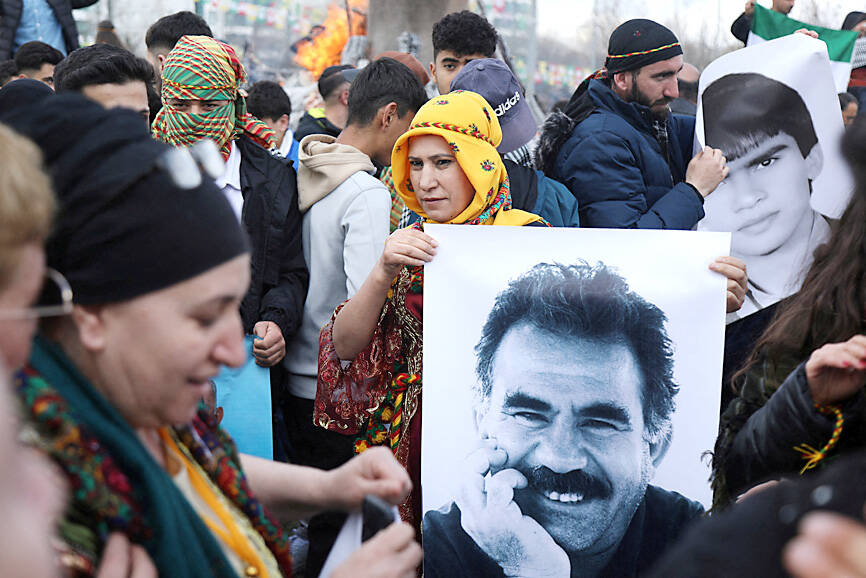
Photo: Reuters
Both the disarmament of the PKK militants and the creation of a Turkish parliamentary committee to oversee the peace process would be “crucial,” Ocalan said.
“The overall process of voluntary disarmament and the comprehensive commission envisioned to be established ... by the Turkish Grand National Assembly are crucial. Care and sensitivity are essential,” he said. “This represents a voluntary transition from the phase of armed conflict to the phase of democratic politics and law. This should be considered a historic achievement, not a loss.”
The DEM, Turkey’s third-biggest party, has played a key role in facilitating the emerging peace deal.
The DEM has submitted a proposal to set up a parliamentary commission, which the 76-year-old militant on Sunday said would play “play a major role” in overseeing the process.
The DEM told reporters that the parliamentary commission would likely be set up by the middle of this month.
Ocalan, who has been imprisoned on an island near Istanbul since 1999, first urged the PKK in February to convene a congress and formally dissolve itself.
Responding to his call, the PKK announced in May that it would disband and renounce armed conflict, ending four decades of hostilities.
Ocalan’s call to end the fighting marked a pivotal step toward ending the decades-long conflict that has claimed tens of thousands of lives since the 1980s.
His message broadcast on Wednesday appeared to be aimed at convincing fighters who might still be hesitant about abandoning armed struggle.
He delivered his message flanked by fellow inmates.
In a first step toward the PKK’s disarmament process, a group of its fighters is expected later this week to lay down their arms in a symbolic ceremony to be held in Sulaymaniyah, in northern Iraq’s semiautonomous Kurdish region.
Zagros Hiwar, a PKK spokesman, said a group of 20 to 30 fighters would descend from the mountains and destroy their weapons in front of civil society organizations and invited observers.
The PKK has long maintained bases in the mountains of northern Iraq.
Turkish forces have launched offensives and airstrikes against the PKK in Iraq, and have set up bases in the area.
The Iraqi government in Baghdad last year announced an official ban on the separatist group, which has long been prohibited in Turkey.
Additional reporting by AFP

SPEAKING OUT: After Siranudh Scott’s allegations surfaced, celebrities and public figures took to social media to share their own experiences of sexual misconduct and abuse A high-profile alleged sexual abuse case within a wealthy Thai beer brewing family has prompted a wave of painful accounts from survivors of unconnected abuse in the conservative nation. Siranudh Scott, a member of the billionaire Thai family that founded the ubiquitous Singha beer brand, posted an emotional video this month accusing his elder brother Sunit of repeatedly abusing him when he was a teenager. Sunit, who is in his 30s, later denied the allegations in a video posted online, but Singha parent Boonrawd dismissed him from his executive role with the company on Tuesday last week. “I felt I needed to speak

SEEKING ORDER: Rodrigo Paz said that ‘anyone who wants to destroy the nation will have to deal with this president and the full force of the constitution’ Bolivian President Rodrigo Paz on Wednesday said that the nation was at a “breaking point” after nearly a month of protests that have caused shortages of food, fuel and medicine. Paz, who took office six months ago amid the worst economic crisis there in four decades, is battling a groundswell of fury over his policies. The political capital, La Paz, has been besieged by low-income workers and members of the indigenous majority calling for his resignation. “The country needs order and is reaching breaking point,” the 58-year-old said at a public event in La Paz, renewing his appeal for dialogue. On Tuesday, the Bolivian

A Hong Kong astronaut is to join a Chinese space mission for the first time as part of a three-person crew launching today, as Beijing edges closer to its goal of landing people on the moon. The Tiangong space station — crewed by teams of three astronauts that are typically rotated every six months — is the crown jewel of China’s space program, boosted by billions in state investment in a bid to catch up with the US and Russia. The Shenzhou-23 mission is to blast off at 11:08pm from the Jiuquan Satellite Launch Center in northwestern China, carrying three astronauts to
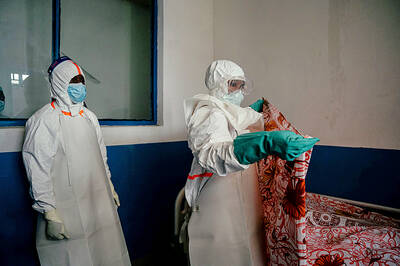
UPGRADED ALERT: The risk inside DR Congo is now considered ‘very high,’ while neighboring countries face a ‘high’ threat as the outbreak continues, the WHO said Ebola is spreading faster than responders can track it in eastern Congo, where health workers managed to follow up with barely one in five identified contacts in a single day. Authorities in the Democratic Republic of the Congo (DR Congo) reported 83 confirmed infections, 746 suspected cases and 1,603 identified contacts as of Thursday, but health workers were able to follow up on only 342 contacts that day — about 21 percent of the total under monitoring — data released by the DR Congo Ministry of Public Health on Friday showed. The figures suggest the response is falling behind the outbreak itself,


 RSS
RSS