


China and Russia pledged to further deepen their already “no limits” partnership in a joint statement published ahead of Russia’s military parade yesterday, as the two sides stressed the importance of maintaining the “correct view” of World War II history.
In a lengthy statement published during Chinese President Xi Jinping’s (習近平) visit to Moscow for the commemoration of the 80th anniversary of the end of the World War II, which Russia celebrates on 9 May as Victory Day, Xi and his Russian counterpart Vladimir Putin said “certain countries ... are attempting to tamper with the results of the victory of World War II.”
Xi is on his 11th visit to Russia since becoming president in 2013. On Thursday, Xi and Putin held nearly four hours of talks in which both leaders described the other as a close friend. Putin announced plans to visit China in the autumn for the commemoration of Japan’s defeat in World War II.
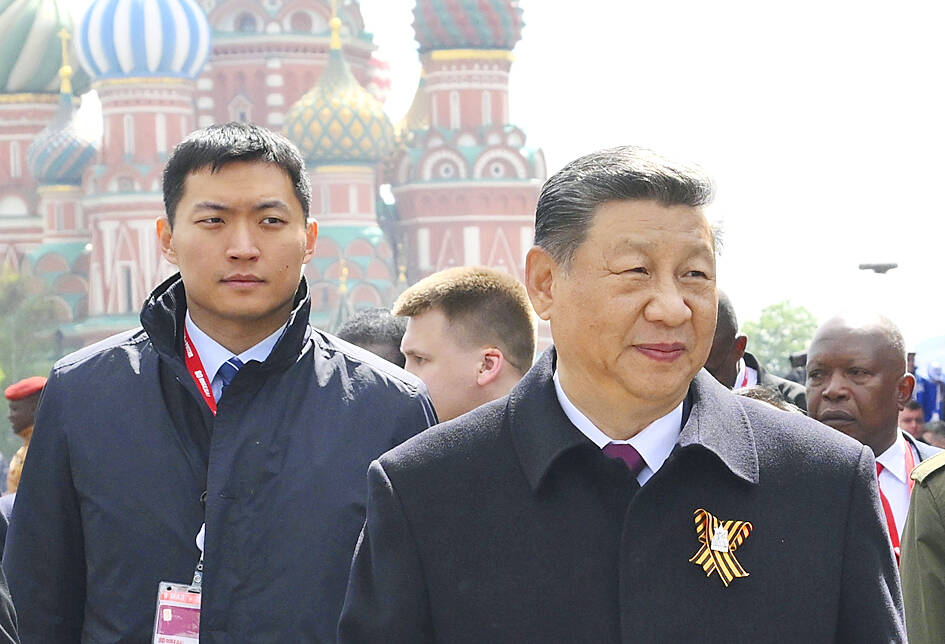
Photo: AP
The Xi-Putin statement went further than previous ones in directly condemning the US.
“The United States and its allies are trying to promote NATO’s eastward expansion into the Asia-Pacific region, build ‘small circles’ in the Asia-Pacific region and win over countries in the region to promote their ‘Indo-Pacific strategy,’ undermining regional peace, stability and prosperity,” the statement said.
The statement also said that “unilateral coercive measures, including economic sanctions, that bypass the UN Security Council violate the UN Charter and other international laws and undermine international security interests.”
This week’s meeting of the Chinese and Russian leaders underscores the close relationship between the two men who see themselves as a bulwark against US hegemony
Earlier this week, Xi claimed that World War II also represented the “liberation” of Taiwan and marked “Taiwan’s return to China.”
The joint Xi-Putin statement stated that Russia “firmly supports the measures taken by the Chinese government to safeguard national sovereignty and territorial integrity and achieve national reunification.”
Although China and Russia do not have a normal military alliance, there are growing concerns in the West about the close security cooperation between the two countries. China and Russia conducted 14 joint military exercises last year, according to data compiled by the Washington-based Center for Strategic and International Studies’ ChinaPower project, which tracks military and economic developments.
A Chinese honor guard participated in yesterday’s military parade in Moscow for the first time since 2015.

An American scientist convicted of lying to US authorities about payments from China while he was at Harvard University has rebuilt his research lab in Shenzhen, China, to pursue technology the Chinese government has identified as a national priority: embedding electronics into the human brain. Charles Lieber, 67, is among the world’s leading researchers in brain-computer interfaces. The technology has shown promise in treating conditions such as amyotrophic lateral sclerosis and restoring movement in paralyzed people. It also has potential military applications: Scientists at the Chinese People’s Liberation Army have investigated brain interfaces as a way to engineer super soldiers by boosting

Indonesian police have arrested 13 people after shocking images of alleged abuse against small children at a daycare center went viral, sparking outrage across the nation, officials said on Monday. Police on Friday last week raided Little Aresha, a daycare center in Yogyakarta on Java island, following a report from a former employee. CCTV footage circulating on social media showed children, most younger than two, lying on the floor wearing only diapers, their hands and feet bound with rags. The police have confirmed that the footage is authentic. Police said they also found 20 children crammed into a room just 3m by 3m. “So
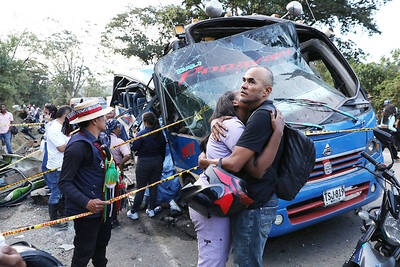
A highway bomb attack in a restive region of southwestern Colombia on Saturday killed 14 people and injured at least 38, the latest spate of violence ahead of next month’s presidential election. Authorities blamed the attack in the Cauca department — a conflict-ridden, coca-growing region — on dissidents of the now-disbanded FARC guerrilla army, who have been sowing violence across the country. “Those who carried out this attack ... are terrorists, fascists and drug traffickers,” Colombian President Gustavo Petro said on social media. “I want our very best soldiers to confront them,” he added. The leftist leader blamed the bombing
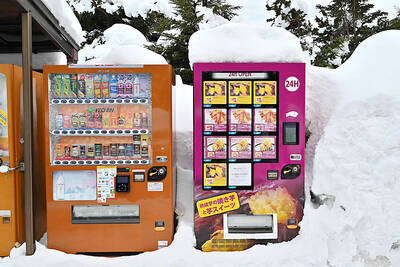
From post offices and parks to stations and even the summit of Mount Fuji, Japan’s vending machines are ubiquitous, but with the rapid pace of inflation cooling demand for their drinks, operators are being forced to rethink the business. Last month beverage giant DyDo Group Holdings announced it would remove about 20,000 vending machines — about 7 percent of their stock nationwide — by January next year, to “reconstruct a profitable network.” Pokka Sapporo Food & Beverage, based in Nagoya, also said last month it would sell its 40,000-machine operation to Osaka-based Lifedrink Co. “The strength of the vending machine


 RSS
RSS