


An Australian warship yesterday rescued a Lithuanian solo rower who had encountered a tropical cyclone while attempting to cross the Pacific Ocean from California.
Aurimas Mockus was taken aboard Royal Australian Navy landing ship HMAS Choules, where he was undergoing a medical assessment, Vice Admiral Justin Jones said in a statement.
“Because of highly unfavorable sea conditions, Mr. Mockus’s boat could not be recovered except for two oars and some personal items,” the Australian Maritime Safety Authority, which coordinated the rescue, said in a statement
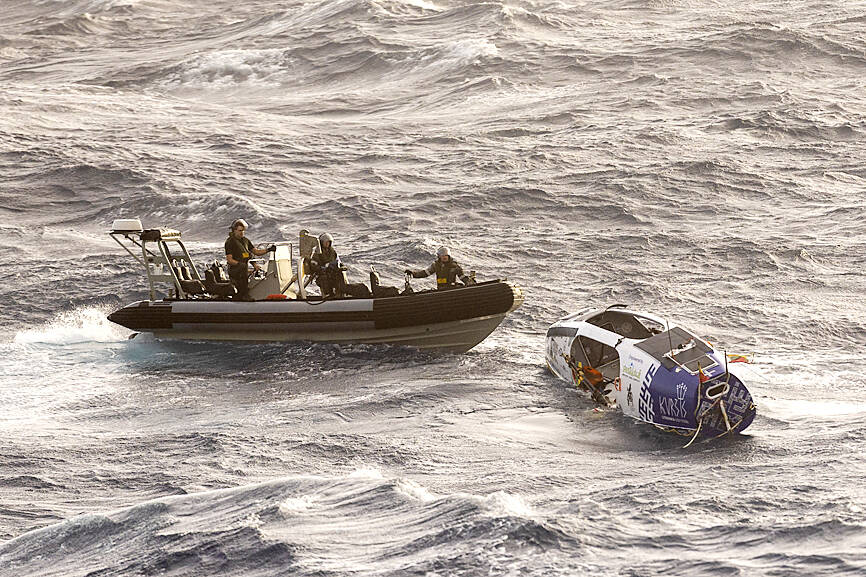
Photo: Australian Defence Force via AP
The 44-year-old adventurer had been stranded for three days in the Coral Sea about 740km east of the Queensland state coastal city of Mackay. He had rowed there in an enclosed boat nonstop from San Diego headed for the Queensland capital, Brisbane.
He began the 12,000km journey in October and was days away from Brisbane when he ran into the storm, which is forecast to cross the Australian coast within days.
Brisbane is 800km south of Mackay by air.
Mockus activated an emergency beacon on Friday after rowing into stormy seas and 80kph winds generated by Tropical Cyclone Alfred, the rescue authority said.
The authority sent a plane that made radio contact with Mockus on Saturday.
Mockus reported he was “fatigued,” the authority said.
The warship is taking Mockus south beyond Brisbane to Sydney in New South Wales, the navy said.
The cyclone has continued to track south and yesterday was 450km east of Brisbane, authorities said.
The cyclone is forecast to turn west and cross the Australian coast on Thursday or Friday.
Mockus was attempting to become one of the few rowers who have crossed the Pacific alone and without stopping.
Brit Peter Bird arguably became the first in 1983. He rowed from San Francisco and was towed the final 48km to the Australian mainland. However, he is considered to have rowed close enough to Australia to have made the crossing.
Fellow Brit John Beeden rowed from San Francisco to the Queensland city of Cairns in 2015 and is considered by some to have made the first successful crossing.
Australian Michelle Lee became the first woman to make the crossing in 2023, rowing from Ensenada in Mexico to Queensland’s Port Douglas.
Another Australian, Tom Robinson, in 2022 attempted to become the youngest to across the Pacific, albeit with a break in the Cook Islands. He set out from Peru and spent 265 days at sea before he was rescued off Vanuatu in 2023.
A wave capsized the 24-year-old’s boat, leaving him clinging naked to the hull for 14 hours before he was rescued by a cruise ship that made a 200km detour to reach him.

Four contenders are squaring up to succeed Antonio Guterres as secretary-general of the UN, which faces unprecedented global instability, wars and its own crushing budget crisis. Chile’s Michelle Bachelet, Argentina’s Rafael Grossi, Costa Rica’s Rebeca Grynspan and Senegal’s Macky Sall are each to face grillings by 193 member states and non-governmental organizations for three hours today and tomorrow. It is only the second time the UN has held a public question-and-answer, a format created in 2016 to boost transparency. Ultimately the five permanent members of the UN’s top body, the Security Council, hold the power, wielding vetoes over who leads the

A humanoid robot that won a half-marathon race for robots in Beijing on Sunday ran faster than the human world record in a show of China’s technological leaps. The winner from Honor, a Chinese smartphone maker, completed the 21km race in 50 minutes and 26 seconds, said a WeChat post by the Beijing Economic-Technological Development Area, also known as Beijing E-Town, where the race began. That was faster than the human world record holder, Ugandan Jacob Kiplimo, who finished the same distance in about 57 minutes in March at the Lisbon road race. The performance by the robot marked a significant step forward

An earthquake registering a preliminary magnitude of 7.7 off northern Japan on Monday prompted a short-lived tsunami alert and the advisory of a higher risk of a possible mega-quake for coastal areas there. The Cabinet Office and the Japan Meteorological Agency said there was a 1% chance for a mega-quake, compared to a 0.1% chance during normal times, in the next week or so following the powerful quake near the Chishima and Japan trenches. Officials said the advisory was not a quake prediction but urged residents in 182 towns along the northeastern coasts to raise their preparedness while continuing their daily lives. Prime
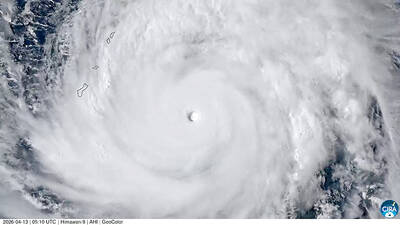
HAZARDOUS CONDITION: The typhoon’s sheer size, with winds extending 443km from its center, slowed down the ability of responders to help communities, an official said The US Coast Guard was searching for six people after losing contact with their disabled boat off the coast of Guam following Typhoon Sinlaku. The crew of the 44m dry cargo vessel, the US-registered Mariana, on Wednesday notified the coast guard that the boat had lost its starboard engine and needed assistance, Petty Officer 3rd Class Avery Tibbets said yesterday. The coast guard set up a one-hour communication schedule with the vessel, but lost contact on Thursday. A Coast Guard HC-130 Hercules aircraft was launched to search for the six people on board, but it had to return to Guam because of


 RSS
RSS