


Britain’s newest reality TV show has been slammed as “insensitive,” “voyeuristic” and “nauseating” for recreating with six Britons the often fatal journeys made by thousands of refugees to the UK.
Bluntly titled Go Back to Where You Came From, the part-documentary, part-reality TV show by Channel 4 follows the group of six, who hold strong views both for and against immigration.
They are divided into two teams, with one dropped into war-ravaged Raqqa in Syria and the other sent to Mogadishu in Somalia. Over four episodes, which launched on Monday last week, they “experience some of the most perilous parts of the refugee journeys” according to Channel 4 — although they travel largely in armored vehicles.

Photo: AFP
The outspoken views of some participants, as well as the show’s format, have been criticized by viewers, charities and some media.
Amnesty International UK called it “deeply disappointing” and “sensational.”
Participant and chef Dave Marshall, 35, opened the series standing on the cliffs of Dover, calling for immigrants crossing the Channel to be “blown up.”
Moments later, political commentator Chloe Dobbs, 24, says that unless immigration is reined in “Britain will be a hellhole full of people wearing burqas.”
In the first episode, the six are taken to markets where they meet families, play soccer with kids and accompany them as they search through litter for scraps.
At one point, when they visit a bombed-out family home in Raqqa, Marshall and two other participants are invited to stay the night.
“Very kind of you for offering your house to us,” Marshall said.
“The series explores the varied and sometimes polarized opinions in our society in a fresh way,” a series spokesperson said.
In upcoming episodes, both groups undertake “challenges,” including a boat crossing and trekking through a Libyan desert.
The reality TV genre “exists and its success depends on actually performing shocking opinions,” said Myria Georgiou, media and communications professor at the London School of Economics.
“I’m sure the contestants are competing for that shock element — who is going to be more extreme in their opinions,” she said.
Dobbs defended it as a “really fun show that lots of people will tune into.”
“More so than just some bog-standard, boring documentary,” she said.
Go Back to Where You Came From is based on a popular Australian series which first ran in the early 2010s.
At around that time, politicians in Australia were campaigning to “stop the boats” of irregular migrants reaching the country.
A decade later, the same catchphrase has been seized upon by politicians opposing asylum seekers crossing the Channel to reach the UK.
The timing of the British version did not surprise Georgiou.
“You have the political leadership, nationally and globally, that have made the most outrageous opinions mainstream,” she said. “We can see that politics have become entertainment and thus it’s no surprise that entertainment has become politics.”
Some viewers have praised Channel 4 for giving a rare primetime spot to the hot-button immigration debate, with British charity Refugee Council “welcoming” the show’s premise.
“Television shows have huge potential to highlight the human stories behind the headlines,” Refugee Council CEO Enver Solomon said.
In one heavily criticized “challenge,” the group get into a dinghy in a simulation of the often fatal Channel crossings.
For Dobbs, who has previously said small boats were made out to be “fun” by some refugees, getting into a flimsy vessel in the middle of the night was a turning point.
“It was that moment for me that it really hit me. Gosh, people must be really desperate to get on these boats,” she said.
However, clips of the simulation sparked outrage across the Channel, with French lawmaker Xavier Bertrand calling for the “nauseating” show to be canceled.
“Hundreds of people have died in the Channel in recent years. This situation is a humanitarian tragedy, not the subject of a game,” Bertrand wrote on X.

It began as a satirical online project. Now millions of young people in India are flocking to it as an outlet for their frustration. A parody political party called the Cockroach Janta Party, with the insect as its symbol, has exploded across India’s social media by turning absurdist humor into protest. Memes and short videos mocking corruption, joblessness and political dysfunction have flooded social media sites, where millions of users are embracing the cockroach — known for its ability to survive harsh conditions — as a tongue-in-cheek symbol of endurance. The online movement’s rise has been unusually rapid. The Cockroach Janta Party (CJP)

SPEAKING OUT: After Siranudh Scott’s allegations surfaced, celebrities and public figures took to social media to share their own experiences of sexual misconduct and abuse A high-profile alleged sexual abuse case within a wealthy Thai beer brewing family has prompted a wave of painful accounts from survivors of unconnected abuse in the conservative nation. Siranudh Scott, a member of the billionaire Thai family that founded the ubiquitous Singha beer brand, posted an emotional video this month accusing his elder brother Sunit of repeatedly abusing him when he was a teenager. Sunit, who is in his 30s, later denied the allegations in a video posted online, but Singha parent Boonrawd dismissed him from his executive role with the company on Tuesday last week. “I felt I needed to speak

A Hong Kong astronaut is to join a Chinese space mission for the first time as part of a three-person crew launching today, as Beijing edges closer to its goal of landing people on the moon. The Tiangong space station — crewed by teams of three astronauts that are typically rotated every six months — is the crown jewel of China’s space program, boosted by billions in state investment in a bid to catch up with the US and Russia. The Shenzhou-23 mission is to blast off at 11:08pm from the Jiuquan Satellite Launch Center in northwestern China, carrying three astronauts to
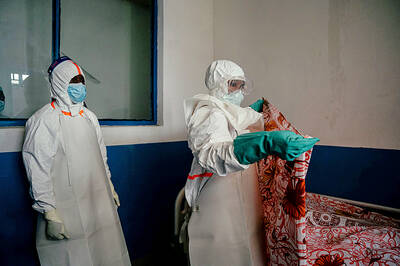
UPGRADED ALERT: The risk inside DR Congo is now considered ‘very high,’ while neighboring countries face a ‘high’ threat as the outbreak continues, the WHO said Ebola is spreading faster than responders can track it in eastern Congo, where health workers managed to follow up with barely one in five identified contacts in a single day. Authorities in the Democratic Republic of the Congo (DR Congo) reported 83 confirmed infections, 746 suspected cases and 1,603 identified contacts as of Thursday, but health workers were able to follow up on only 342 contacts that day — about 21 percent of the total under monitoring — data released by the DR Congo Ministry of Public Health on Friday showed. The figures suggest the response is falling behind the outbreak itself,


 RSS
RSS