


Japanese media are still failing to report sexual assault cases properly, a key figure in the country’s nascent #MeToo movement said in the wake of the scandal surrounding celebrity Masahiro Nakai and Fuji Television.
Former boy band star Nakai was accused in a tabloid last month of sexually assaulting a woman in 2023, allegedly paying her about ¥90 million (about US$579,240) as she signed a non-disclosure agreement.
The furor culminated last week with Nakai, 52, one of Fuji Television’s most famous hosts, announcing his retirement.
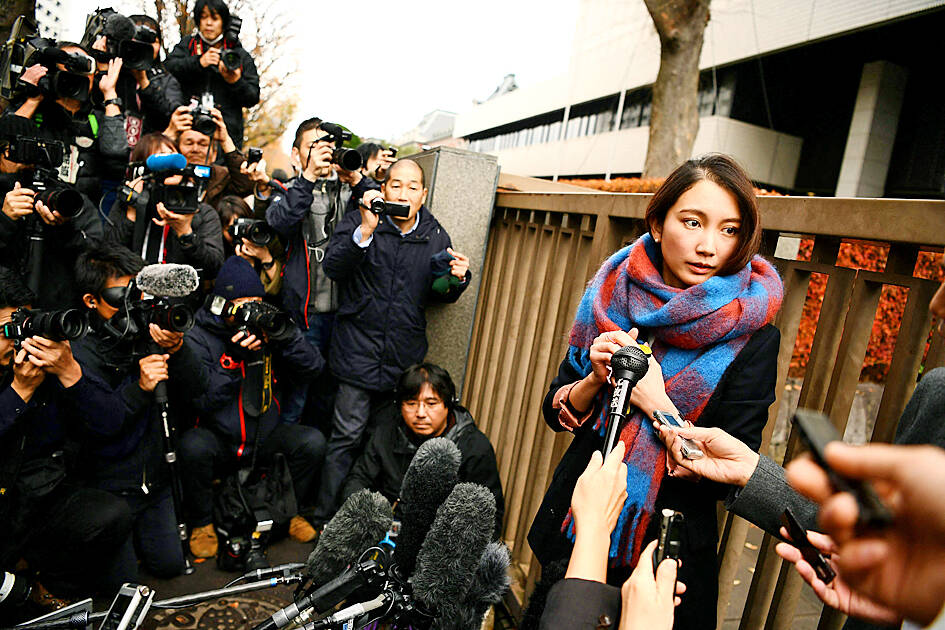
Photo: AFP
Top executives at the company then resigned on Monday after facing growing criticism over their handling of the case.
Shiori Ito, who won a landmark civil case in 2019 against a prominent TV reporter accused of raping her, said she was not surprised to hear about the Nakai allegations.
“Japanese media are more comfortable to [report on] sexual violence compared to when I went public in 2017,” said Ito, 35, who has turned her ordeal into an Oscar-nominated documentary.
However, the journalist added: “I am disappointed, because of how media are always, and still, covering these cases up for powerful people, not just Nakai, but who’s sitting in the boardroom.”
In the Nakai case, most Japanese media used the word “trouble” instead of directly referring to the allegations of sexual violence — something Ito feels “so mad” about.
“It could sound like there was romantic involvement,” or as if “the woman must have done something,” she said.
‘STONES THROWN’
Despite several high-profile cases, Japan has never seen an outpouring of #MeToo allegations, Ito said.
Instead, in Japan, survivors who reveal their identity get “all these stones thrown at them, these nasty words online,” Ito said.
“I knew how hard it would be speaking up about [my] case, as a woman, with my face and name, but I’m still constantly trolled,” she said.
“It’s not creating a safe space for other survivors who could possibly want to speak out to seek justice,” she added.
Government surveys in Japan show few rape victims report the crime to the police, though the number of consultations at sexual violence support centers is rising.
Former soldier Rina Gonoi won praise, but also faced online hate when she posted on YouTube about being sexually assaulted by male colleagues, three of whom were later given suspended jail sentences.
Earlier this month, the president of Fuji Television — who resigned on Monday — admitted the channel knew about the Nakai scandal before it was reported in the media and dozens of brands pulled their adverts from the network.
Some media have described an endemic culture within Japan’s entertainment industry of wining and dining top presenters, with women staffers often invited to join such parties.
Ito said this “toxic culture” is easy to imagine, because “sexual violence, harassment, always happens when power is unbalanced.”
BLACK BOX DIARIES
Ito alleges that former TV journalist Noriyuki Yamaguchi — with close links to then-prime minister Shinzo Abe — raped her after inviting her to dinner to discuss a job opportunity in 2015. He denies the charges.
Her film, Black Box Diaries, nominated for best documentary feature at the Academy Awards, shows how she was initially ignored by police, prosecutors and many media outlets.
Having told Ito there was insufficient evidence, police then said they would arrest Yamaguchi — before suddenly backing off.
In the film, Ito records one police investigator telling her the order came from “higher-ups.”
She eventually won US$30,000 in damages in a civil case followed by a toughening of Japan’s rape laws.
While the documentary has been shown around the world, it has not been released in Japan.
A lawyer representing Ito has said the documentary uses video and audio that was covertly shot or meant for court, which is “legally and ethically problematic.”
“Even though we’re Oscar-nominated, I haven’t been able to show my film in Japan,” Ito said.

The team behind the long-awaited Vera Rubin Observatory in Chile yesterday published their first images, revealing breathtaking views of star-forming regions as well as distant galaxies. More than two decades in the making, the giant US-funded telescope sits perched at the summit of Cerro Pachon in central Chile, where dark skies and dry air provide ideal conditions for observing the cosmos. One of the debut images is a composite of 678 exposures taken over just seven hours, capturing the Trifid Nebula and the Lagoon Nebula — both several thousand light-years from Earth — glowing in vivid pinks against orange-red backdrops. The new image
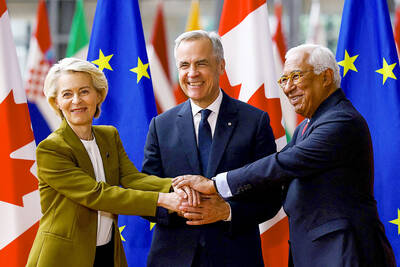
Canada and the EU on Monday signed a defense and security pact as the transatlantic partners seek to better confront Russia, with worries over Washington’s reliability under US President Donald Trump. The deal was announced after a summit in Brussels between Canadian Prime Minister Mark Carney and European Commission President Ursula von der Leyen and European Council President Antonio Costa. “While NATO remains the cornerstone of our collective defense, this partnership will allow us to strengthen our preparedness ... to invest more and to invest smarter,” Costa told a news conference. “It opens new opportunities for companies on both sides of the

ESPIONAGE: The British government’s decision on the proposed embassy hinges on the security of underground data cables, a former diplomat has said A US intervention over China’s proposed new embassy in London has thrown a potential resolution “up in the air,” campaigners have said, amid concerns over the site’s proximity to a sensitive hub of critical communication cables. The furor over a new “super-embassy” on the edge of London’s financial district was reignited last week when the White House said it was “deeply concerned” over potential Chinese access to “the sensitive communications of one of our closest allies.” The Dutch parliament has also raised concerns about Beijing’s ideal location of Royal Mint Court, on the edge of the City of London, which has so

OVERHAUL: The move would likely mark the end to Voice of America, which was founded in 1942 to counter Nazi propaganda and operated in nearly 50 languages The parent agency of Voice of America (VOA) on Friday said it had issued termination notices to more than 639 more staff, completing an 85 percent decrease in personnel since March and effectively spelling the end of a broadcasting network founded to counter Nazi propaganda. US Agency for Global Media (USAGM) senior advisor Kari Lake said the staff reduction meant 1,400 positions had been eliminated as part of US President Donald Trump’s agenda to cut staffing at the agency to a statutory minimum. “Reduction in Force Termination Notices were sent to 639 employees at USAGM and Voice of America, part of a


 RSS
RSS