


A US intervention over China’s proposed new embassy in London has thrown a potential resolution “up in the air,” campaigners have said, amid concerns over the site’s proximity to a sensitive hub of critical communication cables.
The furor over a new “super-embassy” on the edge of London’s financial district was reignited last week when the White House said it was “deeply concerned” over potential Chinese access to “the sensitive communications of one of our closest allies.”
The Dutch parliament has also raised concerns about Beijing’s ideal location of Royal Mint Court, on the edge of the City of London, which has so far failed to gain planning permission.
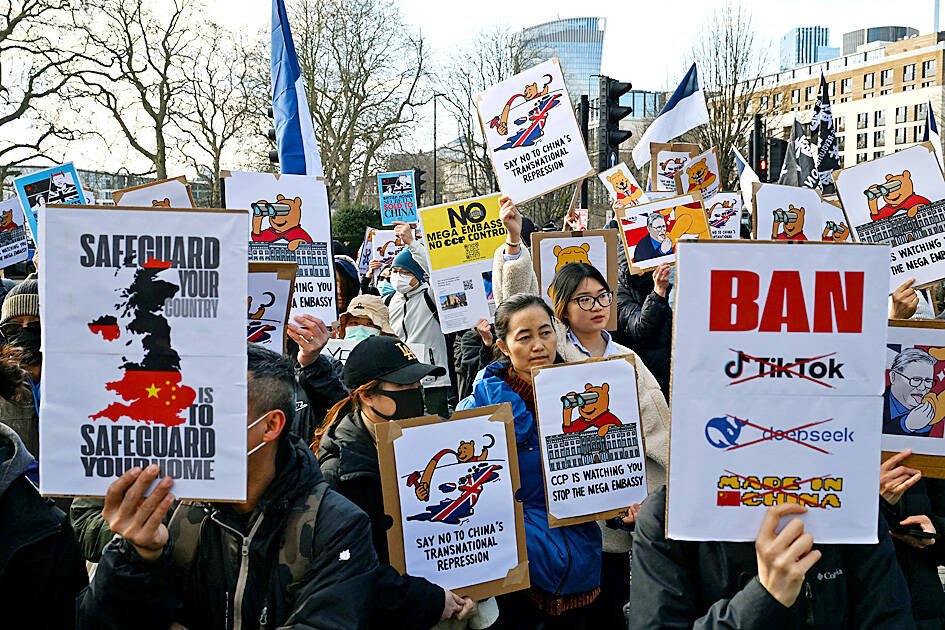
Photo: Reuters
The ultimate decision lies with the government, which has taken control over the stalled decision after permission was initially rejected on security grounds two years ago.
The Labour government is expected to make a decision over the proposed 2-hectare site opposite the Tower of London after an inquiry was held earlier this year.
Those who have long campaigned against the move over security concerns have criticized the row’s revival, saying it has sidelined their views.
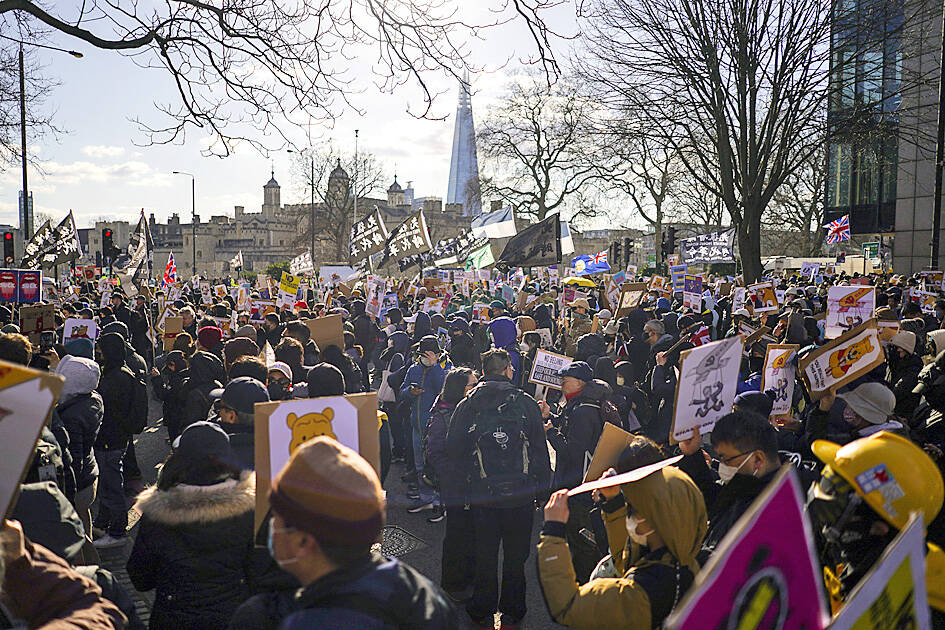
Photo: AP
“They seem to be struggling to make the right decision,” said Dave Lake, the chair of the local residents’ association and lead of the local campaign.
“It’s got too political now. It was a straightforward inquiry, but because of this, that and the other, particularly the Americans getting involved, it’s made it all up in the air,” he said.
Before the deal was signed, a US official told the Sunday Times: “The United States is deeply concerned about providing China with potential access to the sensitive communications of one of our closest allies.” In the Netherlands, lawmakers have raised similar security concerns.
Lake has lived near the proposed site, bought by the Chinese government in 2018 for £255 million (US$344 million), for 35 years.
On Saturday last week, he attended the latest demonstration there, fearing that building an embassy could attract further demonstrations and political attacks.
Recent concerns have shifted to cables underneath the sites, which serve as an arterial link between the City of London and Canary Wharf, London’s two financial centers.
“We know there are cables running underground, and we know the capabilities of the Chinese. In the early conversations, it was never part of it; it was just completely our security,” he said.
Charles Parton, who spent 22 years working in and on China as a British diplomat and has advised the British parliament’s Foreign Affairs Select Committee, said it was “a big problem” if there are sensitive cables running directly under the site.
“There are two ways to be seen with it: one way is to say, well, you can’t use the site; the other is to say reroute the cables. How difficult is it to reroute the cables? I don’t know the answer to that question,” he said.
Parton said the British embassy had been wanting to rebuild its Beijing site for as long as he could remember.
The building had not been fit for purpose for several decades, and the wishes of both countries for newer embassies were “normal diplomatic business,” as relations had greatly expanded, he said.
“There are many things we should worry about with the Chinese,” Parton said, citing Beijing’s geopolitical agenda and strangle on rare earth exports, “but we need to choose the important ones and not the unimportant ones, and all goes back to the nature of these cables. What is crucial is the security issue. If that is resolved satisfactorily, then why shouldn’t we both go ahead and build new embassies?”
The government, which has said it is committed to “robust” and “evidence-based” decisionmaking, is expected to issue its verdict by Sept. 9.

An American scientist convicted of lying to US authorities about payments from China while he was at Harvard University has rebuilt his research lab in Shenzhen, China, to pursue technology the Chinese government has identified as a national priority: embedding electronics into the human brain. Charles Lieber, 67, is among the world’s leading researchers in brain-computer interfaces. The technology has shown promise in treating conditions such as amyotrophic lateral sclerosis and restoring movement in paralyzed people. It also has potential military applications: Scientists at the Chinese People’s Liberation Army have investigated brain interfaces as a way to engineer super soldiers by boosting
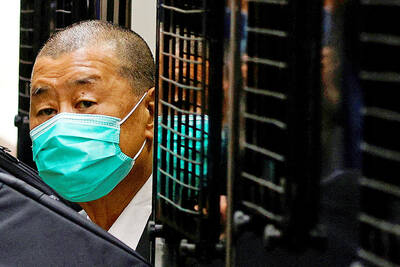
Jailed media entrepreneur Jimmy Lai (黎智英) has been awarded Deutsche Welle’s (DW) freedom of speech award for his contribution to Hong Kong’s pro-democracy movement. The German public broadcaster on Thursday said Lai would be presented in absentia with the 12th iteration of the award on June 23 at the DW Global Media Forum in Bonn. Deutsche Welle director-general Barbara Massing praised the 78-year-old founder of the now-shuttered news outlet Apple Daily for standing “unwaveringly for press freedom in Hong Kong at great personal risk.” “With Apple Daily, he gave journalists a platform for free reporting and a voice to the democracy movement in
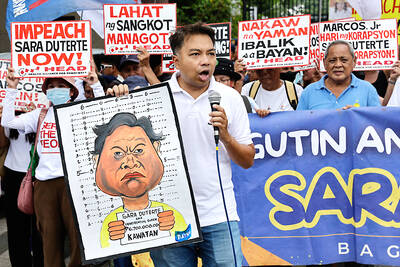
PHILIPPINE COMMITTEE: The head of the committee that made the decision said: ‘If there is nothing to hide, there is no reason to hide, there is no reason to obstruct’ A Philippine congressional committee on Wednesday ruled that there was “probable cause” to impeach Philippine Vice President Sara Duterte after hearing allegations of unexplained wealth, misuse of state funds and threats to have the president assassinated. The unanimous decision of the 53-member committee in the Philippine House of Representatives sends the two impeachment complaints to deliberations and voting by the entire lower chamber, which has more than 300 lawmakers. The complaints centered on Duterte’s alleged illegal use and mishandling of intelligence funds from the vice president’s office, and from her time as education secretary under Philippine President Ferdinand Marcos Jr. Duterte and the

Burmese President Min Aung Hlaing yesterday cut all prisoners’ sentences by one-sixth, a blanket measure that a source close to deposed leader Aung San Suu Kyi said would further shorten her detention. Aung San Suu Kyi has been sequestered since a 2021 military coup, but the senior member of her dissolved National League for Democracy (NLD) party said that while her term had been reduced, her remaining sentence is still unclear. “We also don’t know exactly how many years she has left,” the source told reporters, speaking on condition of anonymity for security reasons. The military toppled Aung San Suu Kyi’s elected government


 RSS
RSS