


Her voice tinged with anger, an American mother worried about what the future holds for her teenage daughter, just one of dozens of girls targeted in yet another artificial intelligence (AI)-enabled pornography scandal that has rocked a US school.
The controversy that engulfed the Lancaster Country Day School in Pennsylvania last year highlights a new normal for pupils and educators struggling to keep up with a boom in cheap, easily available AI tools that have facilitated hyperrealistic deepfakes. One parent, who spoke to Agence France-Presse (AFP) on the condition of anonymity, said her 14-year-old daughter came to her “hysterically crying” last summer after finding AI-generated nude pictures of her circulating among her peers.
“What are the ramifications to her long term?” the mother said, voicing fears that the manipulated images could resurface when her daughter applies to college, starts dating or enters the job market.

Photo: AFP
“You can’t tell that they are fake,” she said.
Multiple charges — including sexual abuse of children and possession of child pornography — were filed last month against two teenage boys who authorities allege created the images.
Investigators uncovered 347 images and videos affecting a total of 60 victims, most of them female students at the private school, on the messaging app Discord.
All but one was younger than 18.
The scandal is the latest in a wave of similar incidents in schools across US states — from California to New Jersey — leading to a warning from the FBI last year that such child sexual abuse material, including realistic AI-generated images, was illegal.
“The rise of generative AI has collided with a long-standing problem in schools: the act of sharing non-consensual intimate imagery,” said Alexandra Reeve Givens, chief executive of the nonprofit Center for Democracy & Technology (CDT).
“In the digital age, kids desperately need support to navigate tech-enabled harassment,” she said.
A CDT survey of public schools in September last year found that 15 percent of students and 11 percent of teachers knew of at least one “deepfake that depicts an individual associated with their school in a sexually explicit or intimate manner.”
Such non-consensual imagery can lead to harassment, bullying or blackmail, sometimes causing devastating mental health consequences.
The mother who spoke to AFP said she knows of victims who had avoided school, had trouble eating, or required medical attention and counseling to cope with the ordeal.
She said she and other parents brought into a detective’s office to scrutinize the deepfakes were shocked to find printed out images stacked a “foot-and-a-half” (45.72cm) high.
“I had to see pictures of my daughter,” she said.
“If someone looked, they would think it’s real, so that’s even more damaging,” she added.
The alleged perpetrators, whose names have not been released, are accused of lifting pictures from social media, altering them using an AI application and sharing them on Discord.
The mother told AFP the fakes of her daughter were primarily altered from public photos on the school’s Instagram page, as well as a screenshot of a FaceTime call.
A simple online search throws up dozens of apps and Web sites that allow users to create “deepnudes,” digitally removing clothing, or superimpose selected faces onto pornographic images.
“Although results may not be as realistic or compelling as a professional rendition, these services mean that no technical skills are needed to produce deepfake content,” said Roberta Duffield, director of intelligence at Blackbird.AI.
Only a handful of US states have passed laws to deal with sexually explicit deepfakes, including Pennsylvania at the end of last year. The top leadership at the Pennsylvania school stepped aside after parents of the victims filed a lawsuit accusing the administration of failing to report the activity when they were first alerted to it in late 2023.
Researchers say schools are ill-equipped to tackle the threat of AI technology evolving at a rapid pace, in part because the law is still playing catchup.
“Underage girls are increasingly subject to deepfake exploitation from their friends, colleagues, school classmates,” Duffield said.
“Education authorities must urgently develop clear, comprehensive policies regarding the use of AI and digital technologies,” she said.

SPEAKING OUT: After Siranudh Scott’s allegations surfaced, celebrities and public figures took to social media to share their own experiences of sexual misconduct and abuse A high-profile alleged sexual abuse case within a wealthy Thai beer brewing family has prompted a wave of painful accounts from survivors of unconnected abuse in the conservative nation. Siranudh Scott, a member of the billionaire Thai family that founded the ubiquitous Singha beer brand, posted an emotional video this month accusing his elder brother Sunit of repeatedly abusing him when he was a teenager. Sunit, who is in his 30s, later denied the allegations in a video posted online, but Singha parent Boonrawd dismissed him from his executive role with the company on Tuesday last week. “I felt I needed to speak

SEEKING ORDER: Rodrigo Paz said that ‘anyone who wants to destroy the nation will have to deal with this president and the full force of the constitution’ Bolivian President Rodrigo Paz on Wednesday said that the nation was at a “breaking point” after nearly a month of protests that have caused shortages of food, fuel and medicine. Paz, who took office six months ago amid the worst economic crisis there in four decades, is battling a groundswell of fury over his policies. The political capital, La Paz, has been besieged by low-income workers and members of the indigenous majority calling for his resignation. “The country needs order and is reaching breaking point,” the 58-year-old said at a public event in La Paz, renewing his appeal for dialogue. On Tuesday, the Bolivian
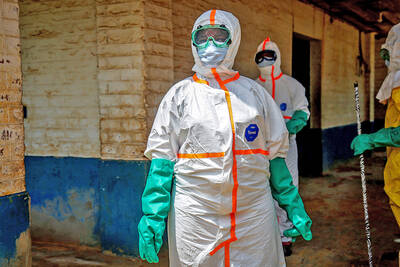
COMMUNITY CONFLICT: Concerns about disease spread from corpses has run up against friends and families’ desire to bury their dead as infection spreads in the area Angry residents of a town at the epicenter of the Ebola outbreak in the Democratic Republic of the Congo (DR Congo) attacked and burned a tent that was part of a health center where people are being treated for the virus, the staff there said Saturday. It was the second such attack in the region in a week. No one was hurt in the attack, according to reports but as patients ran out to escape the fire, 18 people with suspected Ebola infections fled the facility and are unaccounted for, a hospital director said. Angry residents arrived at the clinic in the

Forecasters in Europe yesterday warned of exceptional heat as record temperatures driven by a “heat dome” push temperatures well above seasonal norms across the continent. The surge follows a record-breaking Monday, with France logging its hottest day in the month of May on record, its weather agency said, and the UK also posting unprecedented highs. A so-called “heat dome” of warm air from northern Africa trapped under a high-pressure system over western Europe is behind the high temperatures not usually seen until high summer. Restrictions on outdoor work were imposed in parts of Italy, beaches in southwest France filled earlier than usual and


 RSS
RSS