


The Taliban’s foreign office on Wednesday said that it saw India as a “significant regional and economic partner” after meeting with its most senior foreign ministry official, the highest-level talks with Delhi since the group’s takeover of Afghanistan in 2021.
Indian Foreign Secretary Vikram Misri met with Acting Taliban Minister of Foreign Affairs Amir Khan Muttaqi in Dubai, United Arab Emirates, on Wednesday.
The Afghan Ministry of Foreign Affairs said in a statement that the two officials discussed expanding relations with Afghanistan and boosting trade through Chabahar Port in Iran, which India has been developing for goods to bypass the ports of Karachi and Gwadar in Pakistan.
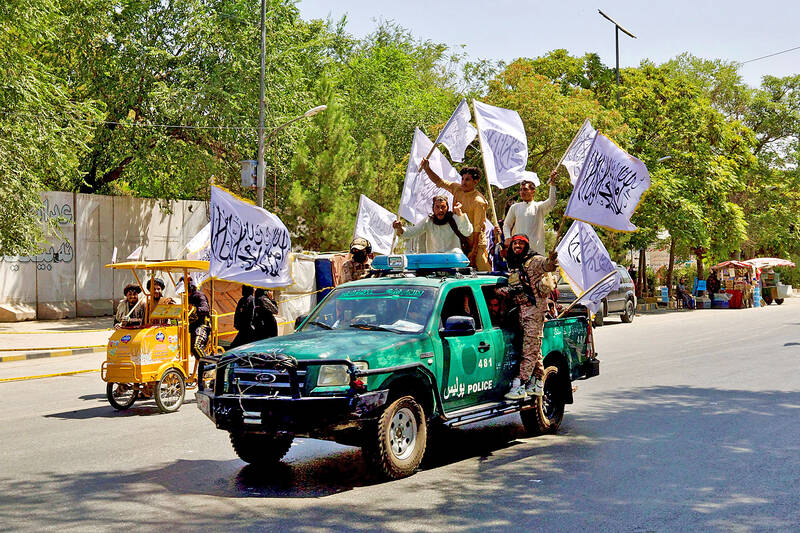
Photo: Reuters
“In line with Afghanistan’s balanced and economy-focused foreign policy, the Islamic Emirate aims to strengthen political and economic ties with India as a significant regional and economic partner,” the statement said.
The Indian Ministry of External Affairs said after the meeting in Delhi that India was considering engaging in development projects in Afghanistan and looking to boost trade ties.
No foreign government, including India, officially recognizes the Taliban administration.
However, India is one of several countries with a small mission in Kabul to facilitate trade, aid and medical support, and has sent humanitarian aid to Afghanistan under the Taliban.
Regional players, including China and Russia, have signaled that they are willing to boost trade and investment in Afghanistan.
The Delhi meeting could ruffle Pakistan, which borders both countries and has fought three wars against India.
Pakistan and Afghanistan also have a strained relationship, with Pakistan saying that several militant attacks that have occurred in its country have been launched from Afghan soil — a charge that the Taliban denies.

Indonesia was to sign an agreement to repatriate two British nationals, including a grandmother languishing on death row for drug-related crimes, an Indonesian government source said yesterday. “The practical arrangement will be signed today. The transfer will be done immediately after the technical side of the transfer is agreed,” the source said, identifying Lindsay Sandiford and 35-year-old Shahab Shahabadi as the people being transferred. Sandiford, a grandmother, was sentenced to death on the island of Bali in 2013 after she was convicted of trafficking drugs. Customs officers found cocaine worth an estimated US$2.14 million hidden in a false bottom in Sandiford’s suitcase when
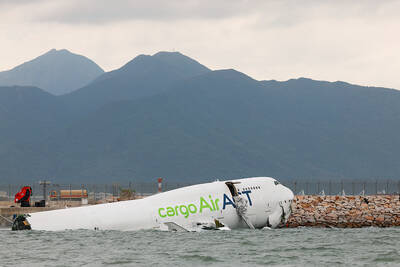
CAUSE UNKNOWN: Weather and runway conditions were suitable for flight operations at the time of the accident, and no distress signal was sent, authorities said A cargo aircraft skidded off the runway into the sea at Hong Kong International Airport early yesterday, killing two ground crew in a patrol car, in one of the worst accidents in the airport’s 27-year history. The incident occurred at about 3:50am, when the plane is suspected to have lost control upon landing, veering off the runway and crashing through a fence, the Airport Authority Hong Kong said. The jet hit a security patrol car on the perimeter road outside the runway zone, which then fell into the water, it said in a statement. The four crew members on the plane, which
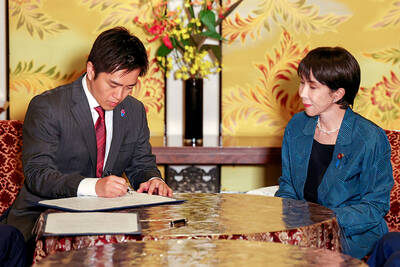
Japan’s ruling Liberal Democratic Party (LDP) and its junior partner yesterday signed a coalition deal, paving the way for Sanae Takaichi to become the nation’s first female prime minister. The 11th-hour agreement with the Japan Innovation Party (JIP) came just a day before the lower house was due to vote on Takaichi’s appointment as the fifth prime minister in as many years. If she wins, she will take office the same day. “I’m very much looking forward to working with you on efforts to make Japan’s economy stronger, and to reshape Japan as a country that can be responsible for future generations,”
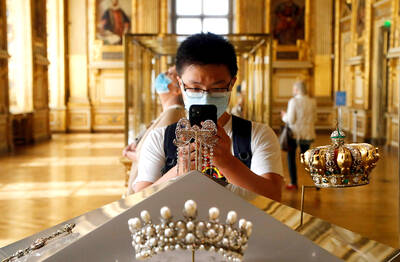
SEVEN-MINUTE HEIST: The masked thieves stole nine pieces of 19th-century jewelry, including a crown, which they dropped and damaged as they made their escape The hunt was on yesterday for the band of thieves who stole eight priceless royal pieces of jewelry from the Louvre Museum in the heart of Paris in broad daylight. Officials said a team of 60 investigators was working on the theory that the raid was planned and executed by an organized crime group. The heist reignited a row over a lack of security in France’s museums, with French Minister of Justice yesterday admitting to security flaws in protecting the Louvre. “What is certain is that we have failed, since people were able to park a furniture hoist in the middle of


 RSS
RSS