


A Russian court has ordered Internet company Yandex to hide access to maps and photos of one of Russia’s largest oil refineries due to constant attacks by Ukrainian drones, state news agency TASS reported yesterday.
Yandex, often referred to as “Russia’s Google,” operates the country’s largest search engine and other online services such as maps, translate and e-mail, as well as ride-hailing and food delivery.
The court in Moscow ordered Yandex to exclude information about the refinery’s infrastructure from its search results by removing and editing images of workshops, compressor stations and other parts of the plant from Yandex Maps, TASS reported.
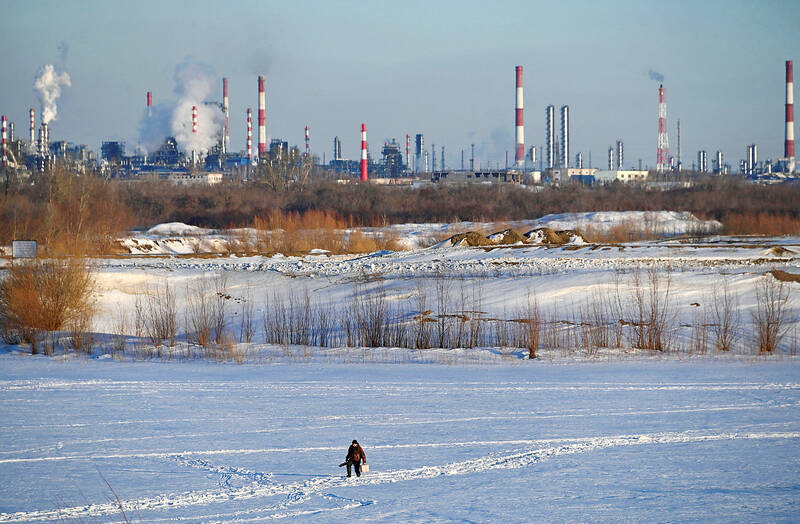
Photo: Reuters
It was not clear which refinery the court decision referred to, but TASS said the facility had been attacked four times by Ukrainian drones last year.
Ukraine has staged numerous strikes on Russian oil storage facilities and refineries, responding to Moscow’s February 2022 invasion and repeated attacks on Ukrainian cities and infrastructure.
The court’s decision can be appealed.
Yandex did not immediately respond to a request for comment.
The refinery tried to resolve the issue directly with Yandex before taking the matter to court, TASS said.
The claimant said that the availability of information about the refinery online undermined Russia’s defense capability and negatively impacted the armed forces.

SPEAKING OUT: After Siranudh Scott’s allegations surfaced, celebrities and public figures took to social media to share their own experiences of sexual misconduct and abuse A high-profile alleged sexual abuse case within a wealthy Thai beer brewing family has prompted a wave of painful accounts from survivors of unconnected abuse in the conservative nation. Siranudh Scott, a member of the billionaire Thai family that founded the ubiquitous Singha beer brand, posted an emotional video this month accusing his elder brother Sunit of repeatedly abusing him when he was a teenager. Sunit, who is in his 30s, later denied the allegations in a video posted online, but Singha parent Boonrawd dismissed him from his executive role with the company on Tuesday last week. “I felt I needed to speak

SEEKING ORDER: Rodrigo Paz said that ‘anyone who wants to destroy the nation will have to deal with this president and the full force of the constitution’ Bolivian President Rodrigo Paz on Wednesday said that the nation was at a “breaking point” after nearly a month of protests that have caused shortages of food, fuel and medicine. Paz, who took office six months ago amid the worst economic crisis there in four decades, is battling a groundswell of fury over his policies. The political capital, La Paz, has been besieged by low-income workers and members of the indigenous majority calling for his resignation. “The country needs order and is reaching breaking point,” the 58-year-old said at a public event in La Paz, renewing his appeal for dialogue. On Tuesday, the Bolivian
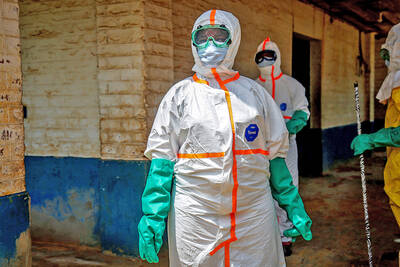
COMMUNITY CONFLICT: Concerns about disease spread from corpses has run up against friends and families’ desire to bury their dead as infection spreads in the area Angry residents of a town at the epicenter of the Ebola outbreak in the Democratic Republic of the Congo (DR Congo) attacked and burned a tent that was part of a health center where people are being treated for the virus, the staff there said Saturday. It was the second such attack in the region in a week. No one was hurt in the attack, according to reports but as patients ran out to escape the fire, 18 people with suspected Ebola infections fled the facility and are unaccounted for, a hospital director said. Angry residents arrived at the clinic in the
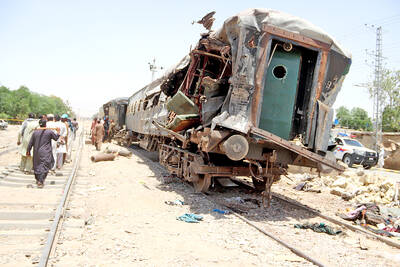
INSURGENT ACTION: A local independence movement in Balochistan, alleged by Pakistan’s government to be backed by India, claimed responsibility for the strike A suicide bomber detonated an vehicle-borne IED near a railway as a passenger train passed through the southwestern Pakistani city of Quetta yesterday, killing at least 23 people and wounding over 70, officials said. The explosion caused two of the train cars to overturn and catch fire, according to footage shared online. The attack happened in an area where security forces are usually stationed, badly damaging several nearby buildings and smashing more than a dozen vehicles parked along the road, according to witnesses and images circulating on social media. Doctors at local hospitals said they had received the wounded, with 20 in critical


 RSS
RSS