


South Korean President Yoon Suk-yeol yesterday defended his martial law decree as an act of governance and denied rebellion charges, vowing to “fight to the end” in the face of attempts to impeach him and intensifying investigations into last week’s move.
Yoon’s statement came hours before the main opposition Democratic Party submitted a new impeachment motion against him for a floor vote this weekend.
Parliament yesterday afternoon passed motions to impeach national police chief Cho Ji-h and South Korean Minister of Justice Park Sung-jae, suspending them from official duties, over their enforcement of martial law.
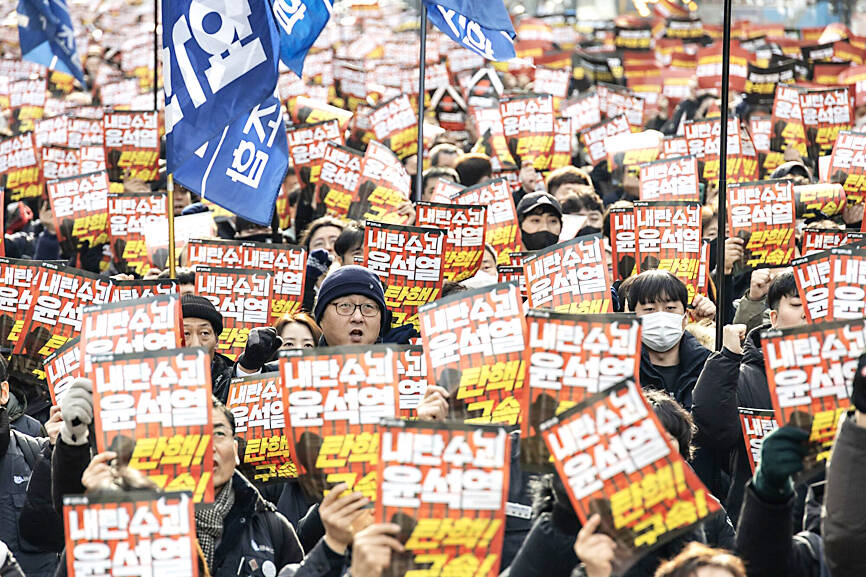
Photo: Bloomberg
Yoon’s Dec. 3 martial law declaration has generated political chaos and large protests calling for his ouster. The decree brought hundreds of armed troops attempting to encircle parliament and raiding the election commission, although no major violence or injuries occurred.
Martial law lasted only six hours as Yoon was forced to lift it after the South Korean National Assembly unanimously voted it down.
Yoon said he enacted martial law as a warning to the Democratic Party, which controls parliament.
He called the party “a monster” and “anti-state forces” that tried to use its legislative muscle to impeach top officials, undermined the government’s budget bill for next year and sympathized with North Korea.
“I will fight to the end to prevent the forces and criminal groups that have been responsible for paralyzing the country’s government and disrupting the nation’s constitutional order from threatening the future of the Republic of Korea,” Yoon said, referring to the South by its official name.
“The opposition is now doing a sword dance of chaos, claiming that the declaration of martial law constitutes to an act of rebellion, but was it really?” he said.
Yoon said martial law was an act of governance that cannot be the subject of investigations and does not amount to rebellion.
The deployment of nearly 300 soldiers to the National Assembly was designed to maintain order, not dissolve or paralyze it, he said.
The Democratic Party said that Yoon’s statement was “an expression of extreme delusion” and “a declaration of war against the people.”
Kim Min-seok, head of a party task force, accused the president of attempting to incite pro-Yoon riots.
The Democratic Party would focus on getting the motion impeaching Yoon passed tomorrow, Kim said.
It was unclear how Yoon’s comments would affect his fate. The Democratic Party and smaller opposition parties hold 192 seats combined, eight votes short of a two-thirds majority, or 200 of the 300 lawmakers, in the National Assembly.
The earlier attempt to impeach Yoon failed with most lawmakers from Yoon’s governing People Power Party (PPP) boycotting the vote.
Yoon’s speech was expected to deepen a divide inside the PPP.
When PPP Chair Han Dong-hun, a critic of Yoon, called Yoon’s statement “a confession of rebellion” during a party meeting, Yoon loyalists jeered and called on Han to stop speaking.
Han has urged party members to vote in favor of Yoon’s impeachment.
Opposition parties and even some PPP members said that the martial law decree was unconstitutional.
They said that South Korean law allows the president to declare martial law only during wartime or similar emergencies.
Deploying troops to seal the National Assembly to suspend its political activities amounted to rebellion because the constitution does not give a president such rights in any situation, they said.
The country’s law enforcement authorities are investigating whether Yoon and others involved in imposing martial law committed rebellion, abuse of power and other crimes.
A conviction for rebellion carries a maximum penalty of death.
The National Assembly yesterday passed a bill that could introduce an independent counsel to investigate Yoon on rebellion charges without his approval.
A bill it endorsed earlier this week on appointing an independent counsel requires Yoon’s approval.
The South Korean Ministry of Justice on Monday placed an overseas travel ban on Yoon.
South Korean law gives presidents immunity from prosecution while in office, except for allegations of rebellion or treason.
On Wednesday, Yoon’s former defense minister, Kim Yong-hyun, was arrested on allegations of playing a key role in a rebellion and committing abuse of power.
Cho and the head of Seoul’s metropolitan police have been detained while their actions of sending police forces to the National Assembly are investigated as a criminal matter.

Crowds in Bangladesh are flocking to snap photographs with an unlikely social media star — an albino buffalo with flowing blond hair nicknamed “Donald Trump” that is due to be sacrificed within days. Owner Zia Uddin Mridha, 38, said his brother named the 700kg bull over its flowing helmet of hair resembling the signature look of the US president. “My younger brother picked this name because of the buffalo’s extraordinary hair,” he said at his farm in Narayanganj, just outside the capital, Dhaka. Mridha said that a constant stream of curious visitors — social media fans, onlookers and children — have come throughout

It began as a satirical online project. Now millions of young people in India are flocking to it as an outlet for their frustration. A parody political party called the Cockroach Janta Party, with the insect as its symbol, has exploded across India’s social media by turning absurdist humor into protest. Memes and short videos mocking corruption, joblessness and political dysfunction have flooded social media sites, where millions of users are embracing the cockroach — known for its ability to survive harsh conditions — as a tongue-in-cheek symbol of endurance. The online movement’s rise has been unusually rapid. The Cockroach Janta Party (CJP)

HOTTER: While Indians are accustomed to summer heat, climate change has caused northwestern India to warm faster than other parts of the country, an academic said Roads and markets have emptied during afternoons and some farmers have switched to nighttime work to avoid scorching temperatures as a heat wave grips large parts of India. The India Meteorological Department forecast maximum temperatures for yesterday of about 45°C in the capital, New Delhi, where authorities have opened temporary “cooling zones” to help people cope. The weather department warned that conditions would likely persist across several northern regions in the coming days, with temperatures staying well above seasonal averages. Authorities urged people to stay indoors during the hottest hours and take precautions against heat-related illnesses. India declares a heat wave whenever maximum temperatures

A Hong Kong astronaut is to join a Chinese space mission for the first time as part of a three-person crew launching today, as Beijing edges closer to its goal of landing people on the moon. The Tiangong space station — crewed by teams of three astronauts that are typically rotated every six months — is the crown jewel of China’s space program, boosted by billions in state investment in a bid to catch up with the US and Russia. The Shenzhou-23 mission is to blast off at 11:08pm from the Jiuquan Satellite Launch Center in northwestern China, carrying three astronauts to


 RSS
RSS