


The world’s first wooden satellite, built by Japanese researchers, was yesterday launched into space, in an early test of using timber in lunar and Mars exploration.
LignoSat, developed by Kyoto University and homebuilder Sumitomo Forestry, was to be flown to the International Space Station on a SpaceX mission, and later released into orbit about 400km above the Earth.
Named after the Latin word for “wood,”, the palm-sized LignoSat is tasked to demonstrate the cosmic potential of the renewable material as humans explore living in space.
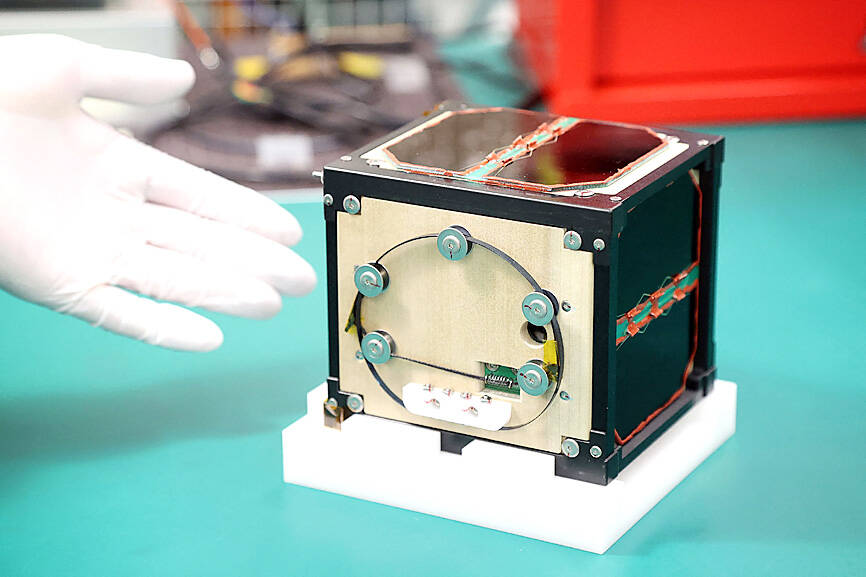
Photo: AFP
“With timber, a material we can produce by ourselves, we will be able to build houses, live and work in space forever,” said Takao Doi, an astronaut who has flown on the Space Shuttle and studies human space activities at Kyoto University.
With a 50-year plan of planting trees and building timber houses on the moon and Mars, Doi’s team decided to develop a NASA-certified wooden satellite to prove wood is a space-grade material.
“Early 1900s airplanes were made of wood,” Kyoto University forest science professor Koji Murata said. “A wooden satellite should be feasible, too.”
Wood is more durable in space than on Earth, because there is no water or oxygen that would rot or inflame it, Murata added.
A wooden satellite also minimizes the environmental impact at the end of its life, researchers say.
Decommissioned satellites must re-enter the atmosphere to avoid becoming space debris.
Conventional metal satellites create aluminium oxide particles during re-entry, but wooden ones would just burn up with less pollution, Doi said.
“Metal satellites might be banned in the future,” Doi said. “If we can prove our first wooden satellite works, we want to pitch it to Elon Musk’s SpaceX.”
The researchers found that honoki, a kind of magnolia tree native in Japan and traditionally used for sword sheaths, is most suited for spacecraft, after a 10-month experiment aboard the International Space Station.
LignoSat is made of honoki, using a traditional Japanese crafts technique without screws or glue.
Once deployed, LignoSat would stay in the orbit for six months, with the electronic components onboard measuring how wood endures the extreme environment of space, where temperatures fluctuate from minus-100°C to 100°C every 45 minutes as it orbits from darkness to sunlight.
LignoSat will also gauge wood’s ability to reduce the impact of space radiation on semiconductors, making it useful for applications such as data center construction, said Kenji Kariya, a manager at Sumitomo Forestry Tsukuba Research Institute.
“It may seem outdated, but wood is actually cutting-edge technology as civilization heads to the moon and Mars,” he said. “Expansion to space could invigorate the timber industry.”

An American scientist convicted of lying to US authorities about payments from China while he was at Harvard University has rebuilt his research lab in Shenzhen, China, to pursue technology the Chinese government has identified as a national priority: embedding electronics into the human brain. Charles Lieber, 67, is among the world’s leading researchers in brain-computer interfaces. The technology has shown promise in treating conditions such as amyotrophic lateral sclerosis and restoring movement in paralyzed people. It also has potential military applications: Scientists at the Chinese People’s Liberation Army have investigated brain interfaces as a way to engineer super soldiers by boosting
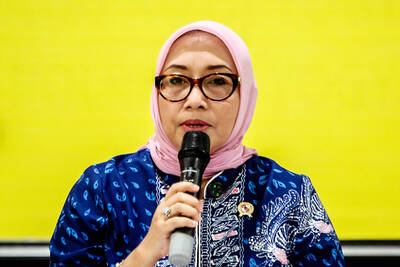
Indonesian police have arrested 13 people after shocking images of alleged abuse against small children at a daycare center went viral, sparking outrage across the nation, officials said on Monday. Police on Friday last week raided Little Aresha, a daycare center in Yogyakarta on Java island, following a report from a former employee. CCTV footage circulating on social media showed children, most younger than two, lying on the floor wearing only diapers, their hands and feet bound with rags. The police have confirmed that the footage is authentic. Police said they also found 20 children crammed into a room just 3m by 3m. “So

A highway bomb attack in a restive region of southwestern Colombia on Saturday killed 14 people and injured at least 38, the latest spate of violence ahead of next month’s presidential election. Authorities blamed the attack in the Cauca department — a conflict-ridden, coca-growing region — on dissidents of the now-disbanded FARC guerrilla army, who have been sowing violence across the country. “Those who carried out this attack ... are terrorists, fascists and drug traffickers,” Colombian President Gustavo Petro said on social media. “I want our very best soldiers to confront them,” he added. The leftist leader blamed the bombing
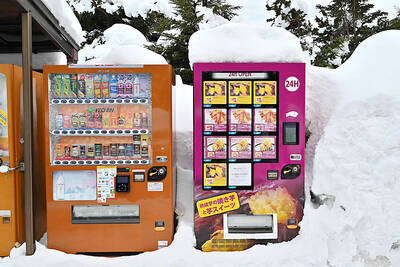
From post offices and parks to stations and even the summit of Mount Fuji, Japan’s vending machines are ubiquitous, but with the rapid pace of inflation cooling demand for their drinks, operators are being forced to rethink the business. Last month beverage giant DyDo Group Holdings announced it would remove about 20,000 vending machines — about 7 percent of their stock nationwide — by January next year, to “reconstruct a profitable network.” Pokka Sapporo Food & Beverage, based in Nagoya, also said last month it would sell its 40,000-machine operation to Osaka-based Lifedrink Co. “The strength of the vending machine


 RSS
RSS