


A team of doctors and vets in Pakistan has developed a novel treatment for a pair of elephants with tuberculosis (TB) that involves feeding them at least 400 pills a day.
The jumbo effort at the Karachi Safari Park involves administering the tablets — the same as those used to treat TB in humans — hidden inside food ranging from apples and bananas, to Pakistani sweets.
The amount of medication is adjusted to account for the weight of the 4,000kg elephants.
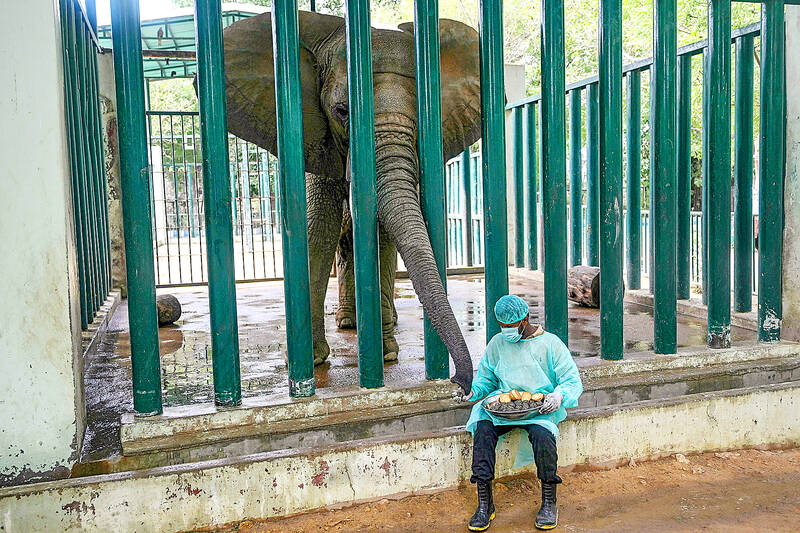
Photo: AFP
However, it has taken Madhubala and Malika several weeks to settle into the treatment after spitting out the first few doses they tasted of the bitter medicine, and crankily charging their keepers.
“Giving treatment for TB to elephants is always challenging. Each day we use different methods,” said Buddhika Bandara, a veterinary surgeon from Sri Lanka who flew in to oversee the treatment.
“The animals showed some stress in the beginning, but gradually they adapted to the procedure,” said Bandara, who has helped more than a dozen elephants recover from the illness in Sri Lanka.
Mahout Ali Baloch wakes early daily to stew rice and lentils, mixed with plenty of sugar cane molasses, and rolls the concoction into dozens of balls pierced with the tablets.
“I know the pills are bitter,” the 22-year-old said, watching the elephants splashing under a hose to keep cool.
Four African elephants — captured young in the wild in Tanzania — arrived in Karachi in 2009. Noor Jehan died in 2023 at the age of 17, and another, Sonia, followed at the end of last year. An autopsy showed she had contracted tuberculosis, which is endemic in Pakistan.
Tests carried out on Madhubala and Malika also came back positive, and the city council — which owns the safari park — assembled a team to care for the pachyderms.
Bandara said it is not uncommon for elephants to contract the contagious illness from humans, but that Sonia — and now Madhubala and Malika — had shown no symptoms.
“It was surprising for me that elephants have TB,” said Naseem Salahuddin, head of the Infectious Disease Department at the Indus Hospital and Health Network, who was enrolled to monitor staff.
“This is an interesting case for me and my students — everyone wants to know about the procedure and its progress,” she said.

SPEAKING OUT: After Siranudh Scott’s allegations surfaced, celebrities and public figures took to social media to share their own experiences of sexual misconduct and abuse A high-profile alleged sexual abuse case within a wealthy Thai beer brewing family has prompted a wave of painful accounts from survivors of unconnected abuse in the conservative nation. Siranudh Scott, a member of the billionaire Thai family that founded the ubiquitous Singha beer brand, posted an emotional video this month accusing his elder brother Sunit of repeatedly abusing him when he was a teenager. Sunit, who is in his 30s, later denied the allegations in a video posted online, but Singha parent Boonrawd dismissed him from his executive role with the company on Tuesday last week. “I felt I needed to speak

A Hong Kong astronaut is to join a Chinese space mission for the first time as part of a three-person crew launching today, as Beijing edges closer to its goal of landing people on the moon. The Tiangong space station — crewed by teams of three astronauts that are typically rotated every six months — is the crown jewel of China’s space program, boosted by billions in state investment in a bid to catch up with the US and Russia. The Shenzhou-23 mission is to blast off at 11:08pm from the Jiuquan Satellite Launch Center in northwestern China, carrying three astronauts to
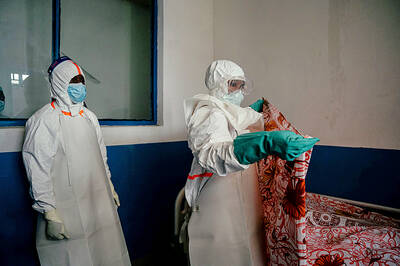
UPGRADED ALERT: The risk inside DR Congo is now considered ‘very high,’ while neighboring countries face a ‘high’ threat as the outbreak continues, the WHO said Ebola is spreading faster than responders can track it in eastern Congo, where health workers managed to follow up with barely one in five identified contacts in a single day. Authorities in the Democratic Republic of the Congo (DR Congo) reported 83 confirmed infections, 746 suspected cases and 1,603 identified contacts as of Thursday, but health workers were able to follow up on only 342 contacts that day — about 21 percent of the total under monitoring — data released by the DR Congo Ministry of Public Health on Friday showed. The figures suggest the response is falling behind the outbreak itself,

SEEKING ORDER: Rodrigo Paz said that ‘anyone who wants to destroy the nation will have to deal with this president and the full force of the constitution’ Bolivian President Rodrigo Paz on Wednesday said that the nation was at a “breaking point” after nearly a month of protests that have caused shortages of food, fuel and medicine. Paz, who took office six months ago amid the worst economic crisis there in four decades, is battling a groundswell of fury over his policies. The political capital, La Paz, has been besieged by low-income workers and members of the indigenous majority calling for his resignation. “The country needs order and is reaching breaking point,” the 58-year-old said at a public event in La Paz, renewing his appeal for dialogue. On Tuesday, the Bolivian


 RSS
RSS