


Turkish Cypriot activist Sude Dogan feels “trapped in northern Cyprus,” a self-proclaimed statelet recognised only by Ankara, saying she cannot travel, study or work abroad because she cannot get a Cypriot passport.
Since a Turkish invasion 50 years ago triggered by an Athens-backed coup, Cyprus has been divided between the Greek-speaking UN-recognized republic in the south and the Turkish Cypriot north, which unilaterally declared independence in 1983.
The 24-year-old activist’s mother is Turkish Cypriot, which should grant her the right to Cypriot citizenship.
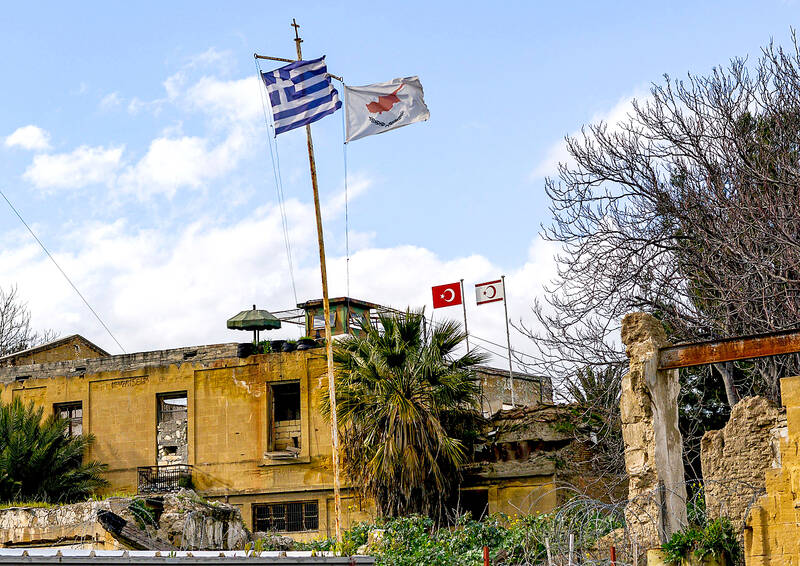
Photo: AFP
However, her paternal grandmother moved from Turkey after the 1974 invasion, making her an illegal settler according to Cyprus.
An EU member, Cyprus refuses to grant citizenship to Turks who moved to the north after the 1974 invasion or to their descendants, making Dogan ineligible.
“I’m trapped in northern Cyprus,” Dogan told AFP from the northern half of the island’s divided capital Nicosia.
She does not have a Turkish passport, and her identity card was issued by the breakaway Turkish Republic of Northern Cyprus (TRNC), which covers about a third of the eastern Mediterranean island.
Greek Cypriot lawyer Achilleas Demetriades, who works in the republic, represents a Turkish Cypriot whose case is similar to Dogan’s.
He said that under the constitution of the Republic of Cyprus, having a parent born on the island should give the right to Cypriot nationality.
However, Loizos Hadjivasiliou of the Cypriot Ministry of the Interior said the law on citizenship rights “is not implemented in cases where one of the two parents has either entered or resided illegally in Cyprus.”
A ministerial council has the power to grant individual requests from descendants of Turkish settlers, but “it is very difficult to give citizenship to the children of invaders,” he said.
Ministry figures show that 4,895 such Turkish Cypriots have been granted citizenship since 2003.
“No application under this category has ever been rejected. In cases [in] which the above criteria are not met, applications remain pending” for examination, the ministry said.
Demetriades said the Republic of Cyprus has made it difficult to apply for citizenship, reflecting a “political position.”
“It’s extremely simple,” he said, adding that Cypriot citizenship “is given by parents of birth, not place of birth.”
Such laws are “applied all over the planet, except in the occupied territories,” Demetriades said.
Dogan fears returning to Turkey, the only place where her TRNC documents are recognised and where she had been studying medicine.
“In a documentary on France 24 in 2023 I called Turkey an occupier,” she said, adding that her comments sparked attacks in the Turkish press and even death threats.
In 2022 Dogan, now studying law at the University of Nicosia in the republic, started an advocacy group “for the resolution of the mixed marriage problem.”
She estimates that about 15,000 Turkish Cypriots are in a similar situation, with Cypriot roots but also parents or grandparents from mainland Turkey, and only TRNC citizenship.
A Turkish Cypriot association in the north — Kimliksizler Dernegi (Association of Those with No Identity) gives a similar figure.
A 2021 census showed a TRNC population of about 290,000, compared with about 920,000 in the republic that year.
Surreya Celman, 43, is the daughter of Turkish Cypriots and has Cypriot citizenship.
Her oldest son was born in Turkey to a Turkish father and is eligible for citizenship through her, but her youngest son was born in the republic and is not — because the authorities say his father entered Cyprus illegally via the north.
Celman tried to sue the Cyprus government over her youngest son’s status, but the ministry said he “must wait for the decision from the council of ministers, like others on the list.”
Turkish Cypriot academic Huri Yontucu, 34, is an activist with Unite Cyprus Now, a group she said “is trying to increase awareness of the daily difficulties faced by mixed marriage children,”
“No Cypriot ID means no visa to travel abroad other than Turkey,” she said.
Obtaining a Turkish passport “was my only option to travel.”
Yontucu’s mother is Turkish Cypriot, but her father is Turkish, and she too has a pending nationality application.
“I am punished because my mum and dad fell in love,” she said.
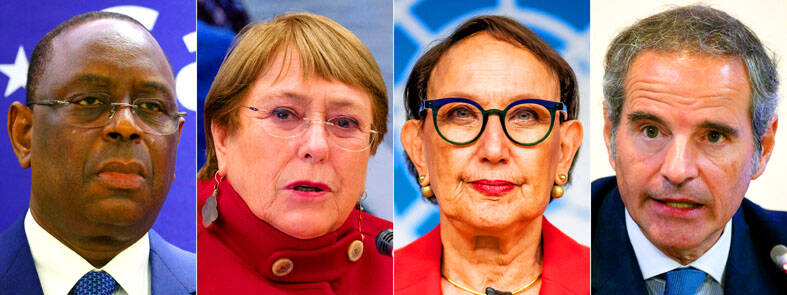
Four contenders are squaring up to succeed Antonio Guterres as secretary-general of the UN, which faces unprecedented global instability, wars and its own crushing budget crisis. Chile’s Michelle Bachelet, Argentina’s Rafael Grossi, Costa Rica’s Rebeca Grynspan and Senegal’s Macky Sall are each to face grillings by 193 member states and non-governmental organizations for three hours today and tomorrow. It is only the second time the UN has held a public question-and-answer, a format created in 2016 to boost transparency. Ultimately the five permanent members of the UN’s top body, the Security Council, hold the power, wielding vetoes over who leads the

South Korea’s air force yesterday apologized for a 2021 midair collision involving two fighter jets, a day after auditors said the pilots were taking selfies and filming during the flight and held them responsible for the accident. “We sincerely apologize to the public for the concern caused by the accident that occurred in 2021,” an air force spokesman told a news conference, adding that one of the pilots involved had been suspended from flying duties, received severe disciplinary action and has since left the military. The apology followed a report released on Wednesday by the South Korean Board of Audit and Inspection,

Young Chinese, many who fear age discrimination in their workplace after turning 35, are increasingly starting “one-person companies” that have artificial intelligence (AI) do most of the work. Smaller start-ups are already in vogue in Silicon Valley and elsewhere, with rapidly advancing AI tools seen as a welcome teammate even as they threaten layoffs at existing firms. More young people in China are subscribing to the model, as cities pledge millions of dollars in funding and rent subsidies for such ventures, in alignment with Beijing’s political goal of “technological self-reliance.” “The one-person company is a product of the AI era,” said Karen Dai

About 240 Indians claiming descent from a Biblical tribe landed at Tel Aviv airport on Thursday as part of a government operation to relocate them to Israel. The newcomers passed under a balloon arch in blue and white, the colors of the Israeli flag, as dozens of well-wishers welcomed them with a traditional Jewish song. They were the first “bnei Menashe” (“sons of Manasseh”) to arrive in Israel since the government in November last year announced funding for the immigration of about 6,000 members of the community from the states of Manipur and Mizoram in northeast India. The community claims to descend from


 RSS
RSS